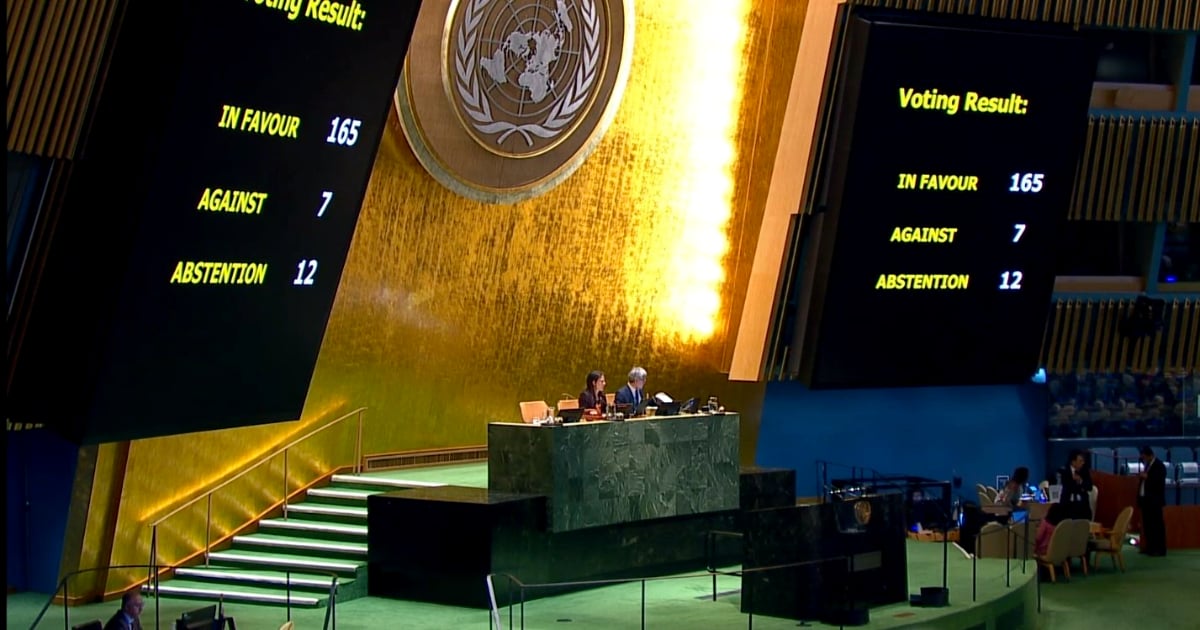
On Tuesday, the United Nations General Assembly passed a resolution calling for the end of the United States' economic, commercial, and financial embargo against Cuba with 165 votes in favor, 7 against, and 12 abstentions.
Despite Cuban Foreign Minister Bruno Rodríguez Parrilla lauding the outcome as a "victory for the people," the figures reveal a significant decline in international support for the Cuban regime. This year's backing is the lowest in over a decade.
Unlike previous years, the vote—labeled as resolution A/80/L.6—showcased a drastically different landscape. In 2024, the resolution was approved with 187 votes in favor, just two against (the United States and Israel) and one abstention.
This year, there was a noticeable drop of over twenty countries supporting the resolution, while abstentions and opposing votes surged, indicating an unprecedented fracture in the usual automatic majority that Havana typically secured in such debates.
The Votes Against and Abstentions
According to official UN data, the seven nations that opposed the resolution were Argentina, Hungary, Israel, the United States, North Macedonia, Paraguay, and Ukraine.
The group of 12 abstentions included several European and Latin American partners, such as Poland, Romania, Bosnia-Herzegovina, Costa Rica, Ecuador, Estonia, Morocco, Albania, Lithuania, the Republic of Moldova, the Czech Republic, Latvia, and Micronesia.
This diplomatic shift mirrors the impact of recent scandals involving the Cuban regime—from Cubans participating as mercenaries in the Ukraine war through networks linked to Moscow, to international accusations of structural corruption and currency hoarding by the military conglomerate GAESA, which controls assets exceeding $18 billion.
Triumphant Rhetoric from Havana
From Havana, Foreign Minister Rodríguez Parrilla characterized the result as a "victory for Cuba, for the people, and for truth against imperialist lies."
The regime and its embassies launched an intense social media campaign under the hashtag '#TumbaElBloqueo,' portraying the vote as a renewed condemnation of Washington's policies.
The Cuban Embassy in Nicaragua, for example, celebrated the resolution by declaring, "the world demands the lifting of the blockade," despite support falling below 170 votes for the first time since 2011.
Diplomatic sources consulted by international media warned that rather than bolstering its legitimacy, Cuba is facing increasing moral and political isolation. The shift in stance by countries like Argentina and Paraguay—historically aligned with the Latin American bloc supporting Havana—signals a growing fatigue with the embargo narrative as the sole cause of Cuba's crisis.
Political Context and Diplomatic Fracture
The erosion of support occurs amid rising regional tensions. Washington has increased its military presence in the Caribbean and tightened sanctions against Cuba's allied governments, such as Venezuela and Nicaragua.
Simultaneously, several Eastern European countries, affected by the war in Ukraine, have hardened their stance against regimes that collaborate with or sympathize with Moscow.
Analysts note that Ukraine's decision to vote against the resolution is especially notable, following its accusations against Cuba for recruiting citizens as combatants for Russian forces. While Havana denied these connections, Kiev documented them before international bodies.
Lowest Support Since 2010
According to historical UN records, support for the embargo resolution has not been this low since 2010.
In 2016, during the thaw initiated by Barack Obama, the resolution received a record 191 votes in favor with no opposition. Since then, support has steadily declined.
In contrast, the U.S. stance remains unchanged. The State Department reiterated that sanctions "are a legitimate tool of pressure against an authoritarian regime that denies its people basic rights," emphasizing that laws allow for humanitarian and food trade.
A New Diplomatic Landscape
The 2025 vote reshapes the political map of support for Cuba.
The long-standing narrative of an "overwhelming victory" has weakened: more countries choose to abstain or distance themselves from a regime increasingly scrutinized for internal repression, lack of transparency, and alliances with authoritarian powers.
The triumphant rhetoric from Havana starkly contrasts with the reality of an island in crisis, isolated even among those who once defended it unreservedly.
Understanding the Shifting Support for Cuba at the UN
Why has international support for Cuba decreased at the UN?
International support for Cuba has decreased due to recent scandals involving the Cuban regime, such as the recruitment of mercenaries for the Ukraine war and accusations of structural corruption by the military conglomerate GAESA.
Which countries opposed the UN resolution against the U.S. embargo on Cuba?
The countries that voted against the resolution were Argentina, Hungary, Israel, the United States, North Macedonia, Paraguay, and Ukraine.
What impact has the U.S. embargo had on Cuba according to the resolution?
The resolution calls for the end of the U.S. embargo, arguing it has significant negative effects on Cuba's economy, although the U.S. maintains that sanctions are a legitimate pressure tool against an authoritarian regime.
How has the U.S. responded to the UN resolution?
The U.S. has reiterated that its sanctions are legitimate measures against Cuba's authoritarian regime, emphasizing that humanitarian and food trade are still permitted.