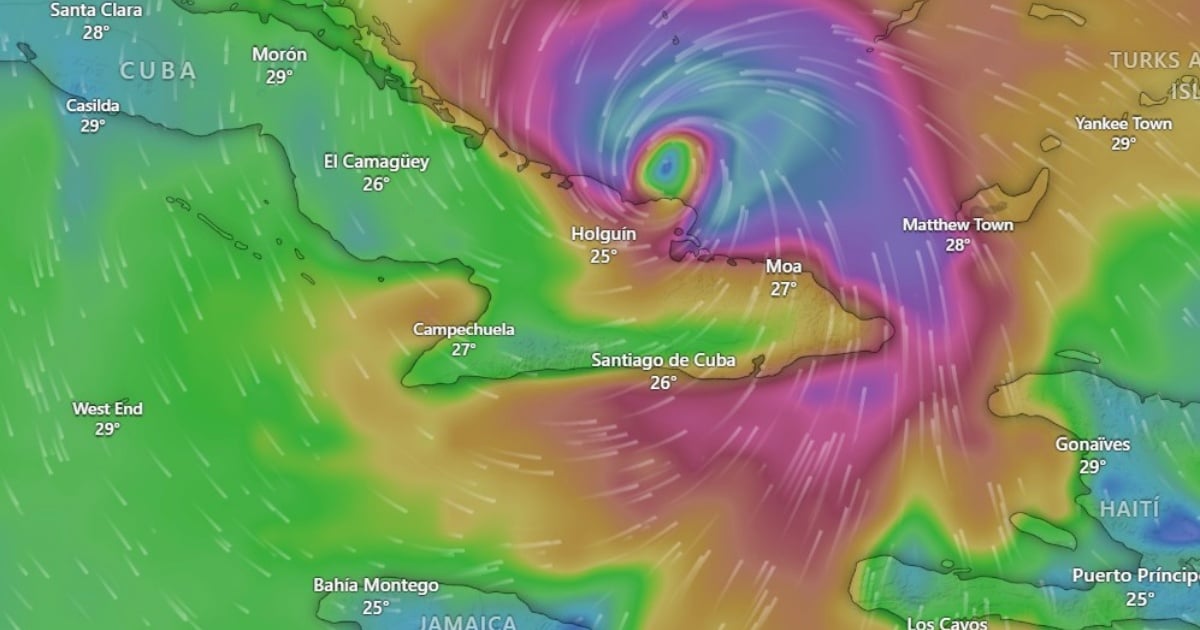
After battering eastern Cuba with its destructive force, Hurricane Melissa is now moving away from the island, leaving behind a trail of flooding, damaged homes, and isolated communities.
On Wednesday morning, Cuba's Institute of Meteorology (INSMET) announced in its Tropical Cyclone Update No. 25 that Hurricane Melissa is "beginning to leave the national territory," heading out to sea via Banes in Holguín Province.
Path and Movement of Melissa
The hurricane's path took it across Holguín Province in the last few hours, following its powerful landfall in the southeastern part of the country, specifically in Santiago de Cuba Province.
By 9:00 a.m. local time, Cuban radars positioned Melissa's center at 20.7 degrees North latitude and 75.4 degrees West longitude, approximately 45 kilometers southeast of Banes. The hurricane's north-northeast movement at 22 km/h directs it away from Cuba, but its rain bands continue to affect the island's eastern regions.
The U.S. National Hurricane Center (NHC) also confirmed Melissa's exit to the sea.
Destruction in Holguín: Torrential Rains and Ferocious Winds
Melissa's passage through Holguín brought torrential rains and hurricane-force winds to communities such as Cueto, Mayarí, and Banes, where a brief calm was felt as they were located at the hurricane's center.
However, the aftermath was severe: rainfall amounts reached 335.2 millimeters at the Holguín Meteorological Center and 268.4 millimeters in Guaro, also in Holguín, as reported in INSMET's Update No. 25. These figures far exceed normal averages, causing flash floods, river overflows, and dangerous surges, particularly in mountainous areas where an additional 200 to 350 millimeters of rain are expected over the next 24 hours.
Hurricane Winds and Extreme Waves
Previously a Category 3 hurricane, Melissa has weakened to a Category 2 on the Saffir-Simpson scale, with maximum sustained winds of 165 km/h and higher gusts, after interacting with the Sierra Maestra mountain range. This interaction also increased the system's central pressure to 968 hectoPascal, indicating gradual weakening.
Nevertheless, the hurricane maintained its threat as it traversed land. Wind gusts reached up to 126 km/h in Guaro and 110 km/h in Puerto Padre, Las Tunas Province, according to INSMET. These winds, along with severe waves, caused significant damage along the coasts.
"Strong swells are expected along both eastern coasts and the northern coast of Camagüey, with waves reaching between 4.0 and 6.0 meters, and up to 7.0 meters on the northern coasts of Holguín and Las Tunas," warns the Institute. Authorities have also cautioned about moderate to severe flooding in low-lying areas, which may persist even after the storm moves away, due to saturated soil and coastal surges.
INSMET is closely monitoring the storm's development and future path, given the potential for further indirect impacts or a resurgence of the system's outer circulation.
Preliminary Damage Assessment
Although official figures on material and human damage have not yet been released, field reports confirm flooded homes, roofs torn off, devastated crops, and roads blocked by fallen trees and poles. The hardest-hit provinces, particularly Santiago de Cuba, Holguín, Las Tunas, and Granma, now face a challenging recovery phase.
Civil defense organizations are actively working on evacuations, damage assessments, and restoring basic services while the nation remains vigilant to the evolving weather conditions.
Frequently Asked Questions About Hurricane Melissa in Cuba
What areas in Cuba were most affected by Hurricane Melissa?
The provinces of Santiago de Cuba, Holguín, Las Tunas, and Granma were among the most severely impacted by Hurricane Melissa.
What is the current status of Hurricane Melissa?
Hurricane Melissa has weakened to a Category 2 storm and is moving away from Cuba, but its rain bands continue to affect the eastern part of the country.
How are the Cuban authorities responding to the damage caused by Melissa?
Cuban civil defense agencies are conducting evacuations, assessing damage, and working to restore essential services as the country braces for further potential impacts.