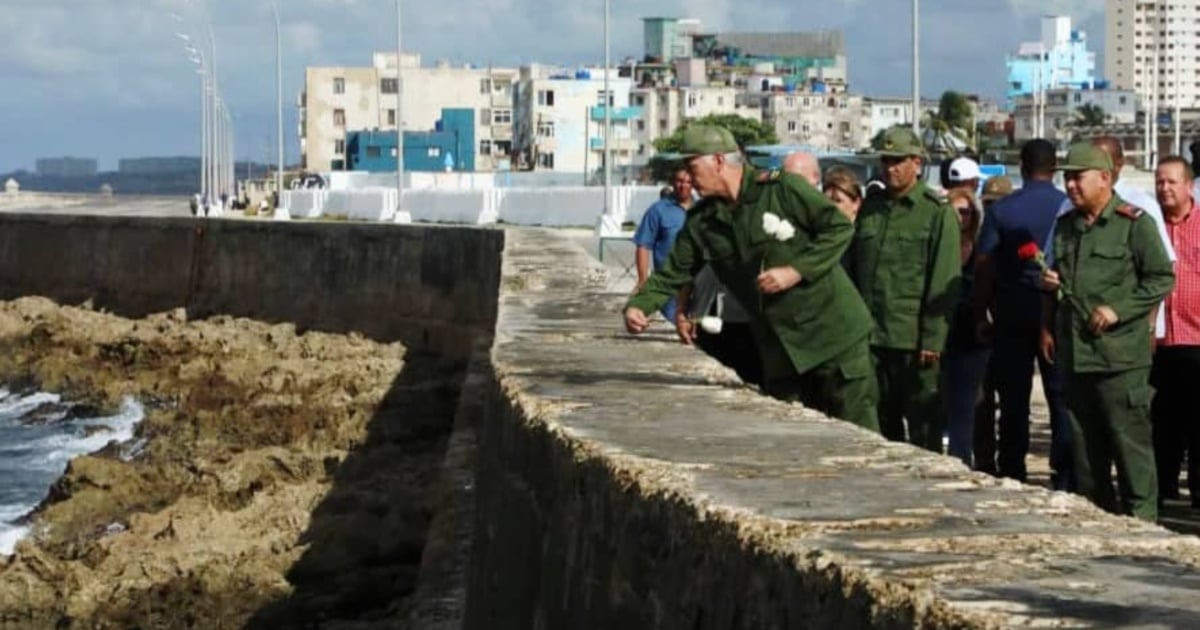
As Hurricane Melissa poses an extremely dangerous threat with catastrophic rainfall and winds, Cuban leader Miguel Díaz-Canel headed a political event along Havana's Malecón, marking the 66th anniversary of Camilo Cienfuegos' disappearance.
The political-cultural ceremony took place in the presence of Politburo members, Revolutionary veterans, and citizens who gathered to lay flowers at sea.
The juxtaposition of this commemoration with the worsening meteorological situation in Cuba and the Caribbean sparked criticism, highlighting the contrast between ceremonial activities and the urgent need for civil protection ahead of potential disasters.
In its evening update, the National Hurricane Center (NHC) reported that the eye of the hurricane had passed over Jamaica, causing direct hits on the southwest coast, and was emerging off the northern coast, leading to life-threatening flash floods, landslides, and destructive winds across the island.
The agency emphasized that “extremely dangerous hours lie ahead” and urged people to remain in shelters.
Meanwhile, Melissa’s center was projected to approach southeastern Cuba overnight and into Wednesday morning, with forecasts of widespread damaging winds, storm surges of 8 to 12 feet, and rainfall accumulations of 10 to 20 inches, with peaks of up to 25 inches expected between Manzanillo, Santiago de Cuba, and Guantánamo. The message was clear: complete preparations and immediate sheltering in the eastern part of the country.
Despite the meteorological warnings urging swift protective measures in eastern Cuba and maintaining alerts for the Bahamas and Turks and Caicos, the authorities in Havana, alongside organizations like the Ministry of Tourism, underscored their presence and “commitment to historical memory” during the ceremony for Camilo Cienfuegos.
The scene at the Malecón—featuring officials, guests, and the public—stood in stark contrast to the atmosphere of tension and preparation spreading across the eastern provinces, where Civil Defense activated evacuation and shelter plans.
This discrepancy provoked criticism over the incongruity of holding a large symbolic event in the capital while citizens were called to exercise discipline, restraint, and focus on life protection in the face of a major hurricane.
According to the NHC, after making its way through eastern Cuba, Melissa was expected to move over the southeast of the island by Wednesday morning, continuing to pose a risk of hurricane-force winds.
In this high-impact regional context, the continuation of the political agenda in Havana reinforced perceptions of a disconnect between the official narrative and the priorities dictated by the emergency.
With nightfall and increasingly severe conditions in the eastern part of the country, specialists continue to urge sheltering, adherence to Civil Defense instructions, and constant attention to official warnings.
Meanwhile, the image of a leadership engrossed in patriotic solemnities as a massive hurricane threatens millions of Cubans encapsulates the paradox of a day where political ritual clashed with meteorological urgency.
Questions About Hurricane Melissa's Impact on Cuba
What is the current threat level of Hurricane Melissa?
Hurricane Melissa poses an extremely dangerous threat with catastrophic rainfall and winds, according to the National Hurricane Center.
How did the Cuban government respond to the hurricane warnings?
While warnings called for urgent protective measures, Cuban leader Miguel Díaz-Canel attended a political event in Havana, drawing criticism for prioritizing ceremonial activities over emergency preparations.
Where is Hurricane Melissa expected to hit in Cuba?
The hurricane's center is projected to approach southeastern Cuba, particularly affecting areas between Manzanillo, Santiago de Cuba, and Guantánamo.