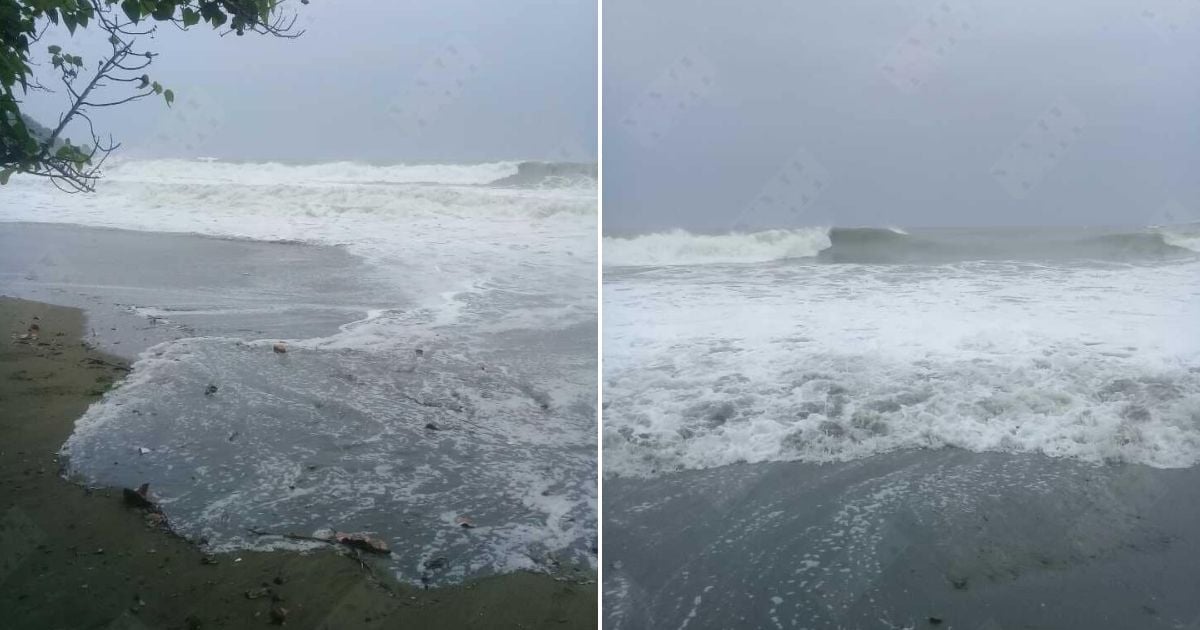
Hurricane Melissa is making its way through the Caribbean, gradually shifting northwest. This movement is causing significant swells, with waves ranging from 2.5 to 4 meters high along the southern coast of Cuba, particularly affecting the shores of Granma, Santiago de Cuba, and Guantánamo.
According to Tropical Cyclone Advisory No. 16 issued on Monday by the Cuban Institute of Meteorology (INSMET), Melissa remains a category five storm on the Saffir-Simpson scale. It sustains maximum winds of 280 kilometers per hour, with even stronger gusts, and its central pressure has dropped to 906 hectopascals, marking it as an extremely dangerous hurricane.
The report highlights that intense swells are already impacting the southeastern coastline, where waves could reach heights between 2.5 and 4 meters, leading to minor to moderate flooding in low-lying coastal areas.
Experts have warned that maritime conditions will continue to worsen as the hurricane approaches.
As of 6 p.m., the hurricane's eye was located at 16.7 degrees north latitude and 78.4 degrees west longitude, approximately 215 kilometers southwest of Kingston, Jamaica, 350 kilometers south-southwest of Cabo Cruz, Granma, and 460 kilometers southwest of Santiago de Cuba.
The system is slowly moving northwest at a speed of six kilometers per hour.
Specialists predict that within the next 24 hours, the hurricane will shift direction toward the north and then northeast, increasing speed and nearing the southern coast of eastern Cuba between Tuesday afternoon and evening.
Additionally, the cyclone's outer bands are causing increased cloudiness and rainfall in the eastern part of the country, with heavy and intense precipitation expected in some mountainous areas.
Winds from the northeast to east are maintaining speeds between 35 and 50 kilometers per hour, with gusts potentially reaching tropical storm force overnight.
The INSMET Forecast Center reiterated that Melissa will remain a highly intense hurricane as it passes Jamaica and approaches Cuba, maintaining close monitoring of its development and future path.
The next tropical cyclone advisory is scheduled for release at midnight on Monday.
Meteorologist José Rubiera warned on Monday that Melissa is already a "gigantic, monstrous category 5 hurricane" nearing Jamaica.
In his latest update on his YouTube channel, the expert cautioned that after passing over the island between night and early morning, Melissa might be caught by a trough and surge toward eastern Cuba as a high-intensity cyclone—possibly category 4 or 3—between Tuesday night and Wednesday morning.
"It's extremely dangerous," he emphasized, noting that the system has a small eye, sustained maximum winds of 270 km/h, and gusts exceeding 300 km/h, with the center located about 200 kilometers southwest of Kingston.
Hurricane Melissa Impact on Cuba
What areas in Cuba are most affected by Hurricane Melissa?
The southern coast of Cuba, particularly the shores of Granma, Santiago de Cuba, and Guantánamo, are most affected by Hurricane Melissa's waves and swells.
What is the current classification of Hurricane Melissa?
Hurricane Melissa is classified as a category five storm on the Saffir-Simpson scale, indicating it is an extremely dangerous hurricane.
How fast is Hurricane Melissa moving?
Hurricane Melissa is advancing northwest at a speed of six kilometers per hour.