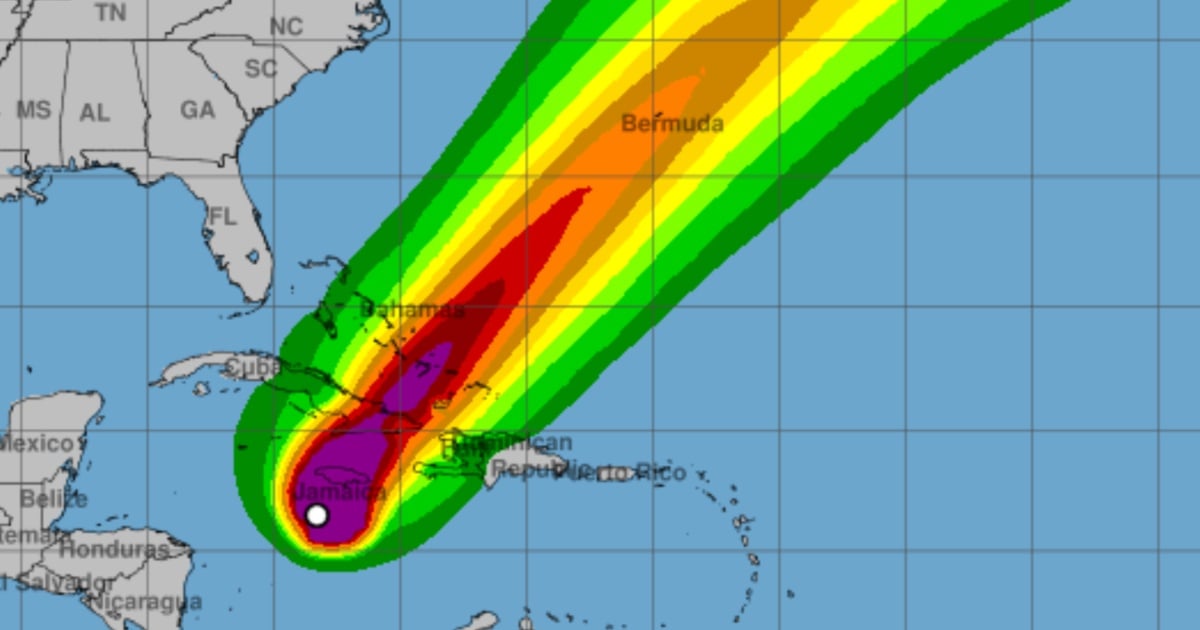
The National Hurricane Center (NHC) reported on Monday afternoon that Hurricane Melissa is sustaining maximum winds of 175 mph (280 km/h) with a central pressure of 906 mb. The storm remains a Category 5 hurricane, moving very slowly towards the northwest.
According to the latest update, the NHC noted that the eye of the hurricane was located at 16.7°N, 78.4°W, approximately 140 miles (225 km) southwest of Kingston, Jamaica, and 320 miles (515 km) southwest of Guantánamo, Cuba.
The NHC warns that life-threatening catastrophic winds, flooding, and storm surges are imminent in Jamaica from tonight through Tuesday.
Projected Path and Impact Areas
The core of the hurricane is expected to move near or over Jamaica during this time, cross southeastern Cuba on Tuesday night, and continue over the southeastern or central Bahamas by Wednesday. It will then gradually turn north and northeast, picking up speed between Tuesday and Thursday.
Despite potential intensity fluctuations before making landfall in Jamaica, the official forecast keeps Melissa as an extremely powerful major hurricane as it approaches Jamaica and southeastern Cuba, retaining hurricane strength while passing through the Bahamas.
Warnings and Watches in Effect
The severity of the situation is underscored by the current warnings: A hurricane warning is in place for Jamaica; for the Cuban provinces of Granma, Santiago de Cuba, Guantánamo, and Holguín; and for the southeastern and central Bahamas.
A hurricane watch remains for the Turks and Caicos, while a tropical storm warning is active for Haiti, Las Tunas (Cuba), and the Turks and Caicos.
Preparations and Potential Hazards
On land, preparations in Jamaica should be complete, and those in the warned areas of Cuba need to be expedited, the report emphasizes.
The hurricane's vast size is confirmed by the wind field: hurricane-force winds extend 30 miles (45 km) from the center, and tropical storm-force winds reach up to 195 miles (315 km).
The NHC also highlights extreme rainfall dangers: Jamaica could see 15 to 30 inches, with local maximums of up to 40 inches, while the southern parts of Hispaniola might receive an additional 6 to 12 inches. Eastern Cuba is expected to get 10 to 20 inches, peaking at 25 inches between Monday and Wednesday, potentially causing life-threatening flash floods and numerous landslides.
In the Bahamas, rainfall totals are expected to be 5 to 10 inches on Tuesday and Wednesday.
Another critical component is the storm surge. On Jamaica's southern coast, the NHC forecasts 9 to 13 feet above ground level, with large and destructive waves; on the northwest coast, 1 to 3 feet are possible.
For Cuba's southeastern coast, significant storm surge potential reaches 7 to 11 feet late Tuesday or Wednesday, and in the Bahamas and Turks and Caicos, 4 to 6 feet above normally dry ground are possible.
Dangerous swells and rip currents will spread across Hispaniola, Jamaica, eastern Cuba, and the Cayman Islands, later affecting the Bahamas, Turks and Caicos, and Bermuda.
The NHC reiterates that this is a high-impact event, and those with interests in Bermuda should also monitor its progress closely.
FAQs about Hurricane Melissa's Impact
What are the expected impacts of Hurricane Melissa in Jamaica?
Jamaica is expected to experience life-threatening winds, storm surges, and heavy rainfall, with accumulations of 15 to 30 inches and local peaks of up to 40 inches, leading to potential flash floods and landslides.
What areas are under hurricane warnings due to Melissa?
Hurricane warnings are in effect for Jamaica, the Cuban provinces of Granma, Santiago de Cuba, Guantánamo, and Holguín, and the southeastern and central Bahamas.
How is the NHC advising the public to prepare for Hurricane Melissa?
The NHC advises that preparations in Jamaica should be complete and expedited in the warned areas of Cuba to ensure safety and minimize potential damage.