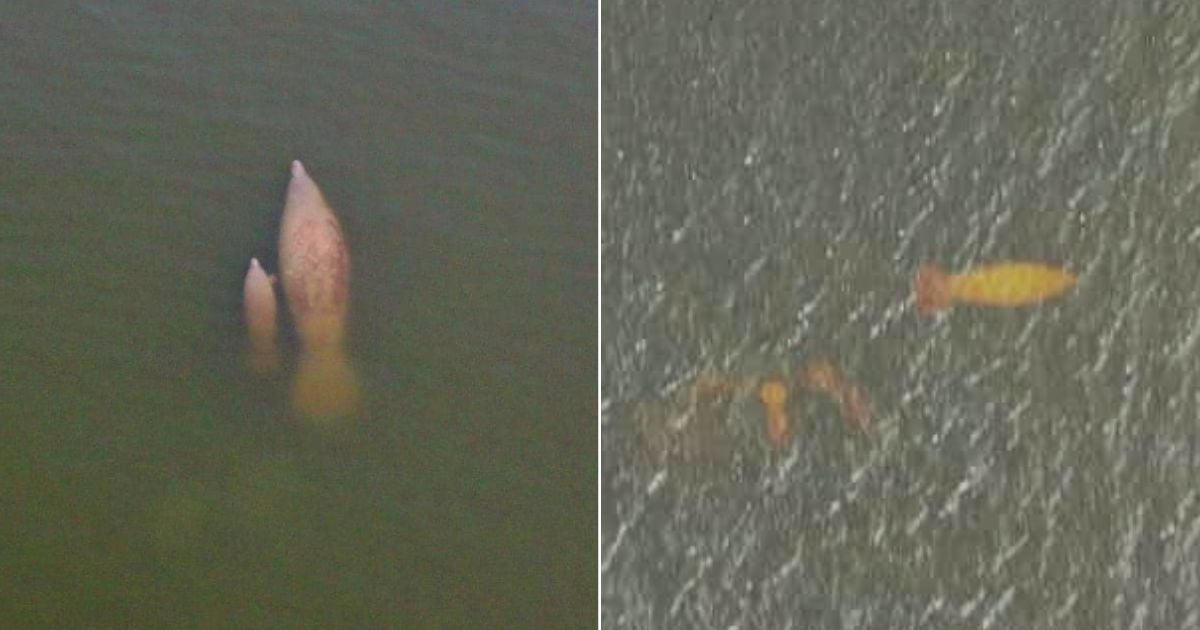
Amid the national anxiety surrounding the impending arrival of Hurricane Melissa, a beacon of hope emerged from the Zapata Swamp in Matanzas: scientists have confirmed the sighting of manatees in Laguna del Tesoro, a habitat where these gentle creatures had seen a significant decline over recent decades.
On Monday, Armando Rodríguez Batista, the Minister of Science, Technology, and Environment (CITMA), announced on Facebook that the expedition was orchestrated by the Zapata Swamp National Park in partnership with the Greater Caribbean Manatee Alliance, the Clearwater Aquarium Research Institute, and Dr. Anmari Álvarez Alemán, a researcher and coordinator of the alliance, who also serves as co-chair of the Sirenia Specialist Group of the International Union for Conservation of Nature (IUCN).
The manatee is an endangered species, with only a few hundred remaining across the Caribbean, found in Cuba, the Dominican Republic, Haiti, Jamaica, and Puerto Rico. The Lesser Antilles no longer host any populations, though Florida and some countries in Central America have more stable communities.
Historical Manatee Relocations
The Zapata Swamp, along with the Ensenada de la Broa, has long been recognized as a crucial habitat for manatees in the Greater Caribbean. In 1964, six individuals were relocated to the fresh waters of Laguna del Tesoro, a landlocked body of water, to bolster the local population. In the 1990s, two more manatees from Villa Clara and Varadero were introduced.
For years, it was common to see over twenty manatees in this lagoon, a symbol of the swamp's natural wealth. However, sightings became increasingly rare in recent decades, nearly disappearing, which concerned scientists and conservationists alike. Presently, only sporadic observations are recorded.
Innovative Methods for Wildlife Observation
The recent expedition employed an innovative, non-invasive methodology: drones equipped with 4K video cameras flew at an altitude of about 90 meters above the water. These recordings were later analyzed in laboratories, allowing researchers to identify the presence of the animals without disturbing their habitat. This approach has proven effective, saving both time and resources compared to traditional direct observation techniques.
The footage confirmed manatee presence in Laguna del Tesoro, marking a positive development for conservation efforts on the island. Rodríguez emphasized the significance of continuing research and protecting Caribbean sirenians, which face severe threats from habitat loss, pollution, and maritime traffic.
Continued Conservation Efforts
The CITMA, along with the national protected areas system, the University of Havana's Marine Research Center, and other institutions, will maintain support for research on this species, viewed as a crucial indicator of coastal and marine ecosystem health.
In the wake of the distress and anxiety caused by Hurricane Melissa, the discovery in the Zapata Swamp stands as a sign of hope, demonstrating that life perseveres in Cuba's wetlands despite adversity.
Manatee sightings have become more frequent in coastal areas of Cuba, astonishing residents and inspiring environmental advocates. In Santa Fe, Havana, a sighting occurred in a fishing zone, surprising locals with the presence of an animal rarely seen so close to the capital. More recently, a manatee was spotted at the Iron Bridge in Havana, drawing attention to the species' presence in urban settings.
The event sparked concern among internet users and residents worried about the animal's safety amid potential capture threats, especially given increasing food insecurity. In Matanzas, multiple manatees amazed locals by appearing in the bay, with images shared on social media showing them swimming in relatively clear waters, hinting at a potential temporary habitat recovery in certain regions.
Manatee Conservation and Sightings in Cuba
Why are manatees considered endangered in the Caribbean?
Manatees are considered endangered due to habitat loss, pollution, and increased maritime traffic, which threaten their survival across the Caribbean.
What new methods are being used to observe manatees in Cuba?
Researchers are using drones equipped with 4K cameras to observe manatees from a distance, allowing them to monitor these animals without disturbing their natural habitat.
Where have recent manatee sightings occurred in Cuba?
Recent manatee sightings have been reported in areas like Santa Fe, Havana, and Matanzas Bay, indicating their presence in both coastal and urban regions.