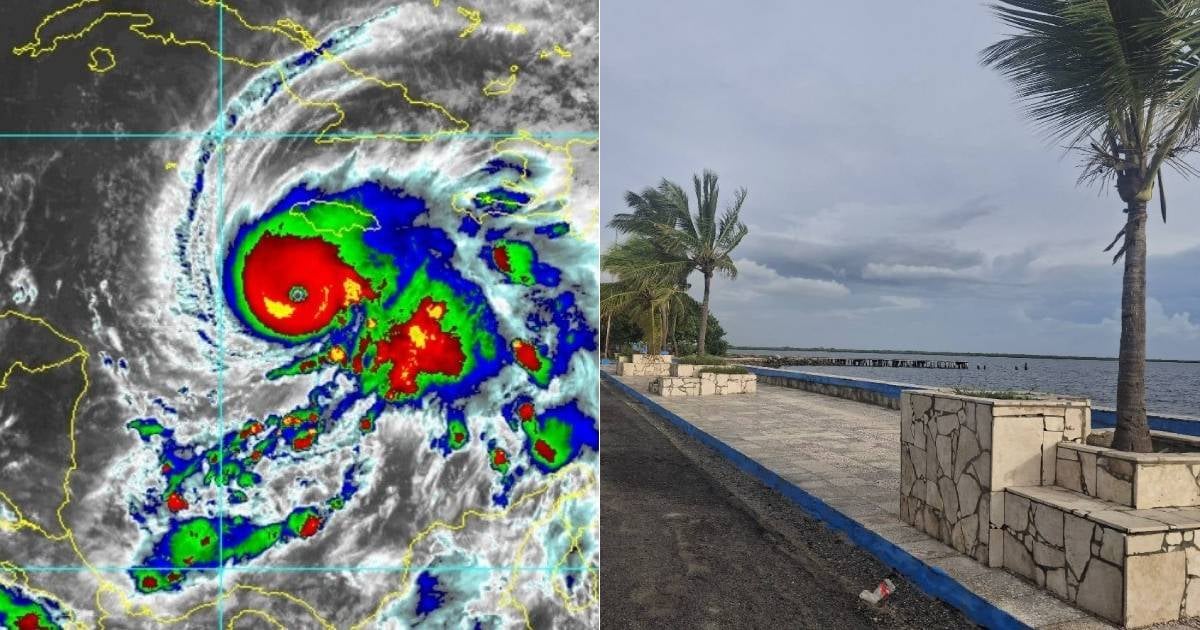
As eastern Cuba braces for the onslaught of Hurricane Melissa, now a formidable Category 5 storm, a resident from Puerto Padre in Las Tunas province voices deep concerns about the fragility with which many Cubans face yet another meteorological threat.
José Luis Pérez Parra, a local citizen, shared a poignant message on social media that has resonated with his fellow Cubans, reflecting on the persistent wounds of the nation that hurricanes repeatedly expose.
"Melissa's threat extends beyond the Saffir-Simpson scale. It also reveals the vulnerabilities we carry," he noted, recalling how Puerto Padre's waterfront, with its poor drainage, might flood again as it did during Hurricane Ike. "Water cascading from the city's high points with no adequate outlet to the sea. Each street turning into a temporary riverbed," he described.
Pérez Parra also highlighted the plight of other towns in Las Tunas where danger escalates with each heavy rain. "In Vázquez, Delicias, San Manuel, and neighborhoods like La Base and Parada, the threat isn't just from the sky, but from the ground," he cautioned. Intense rainfall could raise reservoir levels and trigger floods in rural communities with fragile infrastructure.
His message comes at a time of heightened anxiety. The latest updates from the National Hurricane Center (NHC) report Melissa packing sustained winds of up to 168 mph, a central pressure of 908 mb, and a trajectory that directly endangers the eastern region of the island.
Provinces including Guantánamo, Santiago de Cuba, Holguín, Granma, Las Tunas, and Camagüey are under hurricane alerts, with forecasts predicting torrential rains, storm surges up to 10 feet, and possible landslides.
From his coastal municipality, Pérez Parra warns of the daily fears rekindled by the impending hurricane: "Now more than ever, prevention is not just a slogan: it is a vital necessity. Because nature does not wait. And resilience is not improvised: it is built before the storm."
His words echo a sentiment shared by many Cubans living far from urban centers or in areas with dilapidated infrastructure. In Puerto Padre, as in much of the eastern interior, issues with electricity supply, access to potable water, and food scarcity turn every weather alert into a significant crisis.
"Melissa is no longer a threat; it is a certainty that will strike Eastern Cuba with irrational force. To our people on the Island, I ask them to be strong to endure not only the storm's passage but the devastation it will leave in such an impoverished region, testing them to their limits," he wrote.
While Civil Defense coordinates evacuations and residents seek shelter, José Luis's words echo as a call for resilience and civic awareness. They are not merely a chronicle of fear but also a warning about the urgent need for investment in prevention, reconstruction, and real planning in the face of climate change and the country's structural decay.
Melissa, poised to be one of the most intense hurricanes to hit the Caribbean in recent years, will not only test the sturdiness of roofs but also, as Pérez Parra stated, "for those of us outside, for now, all we can do is pray with broken hearts."
The Impact of Hurricane Melissa on Eastern Cuba
What are the main concerns in Puerto Padre regarding Hurricane Melissa?
The primary concerns in Puerto Padre include inadequate drainage systems that may lead to flooding, as well as the broader infrastructural vulnerabilities that hurricanes expose.
How is the community in Las Tunas preparing for the hurricane?
The community in Las Tunas is on high alert, with Civil Defense coordinating evacuations and residents seeking shelter. They are braced for torrential rains, potential flooding, and power outages.
Why is resilience important in facing Hurricane Melissa?
Resilience is crucial because it involves preparation and the ability to recover from the hurricane's impact. It ensures that communities can withstand the immediate and long-term challenges posed by such storms.