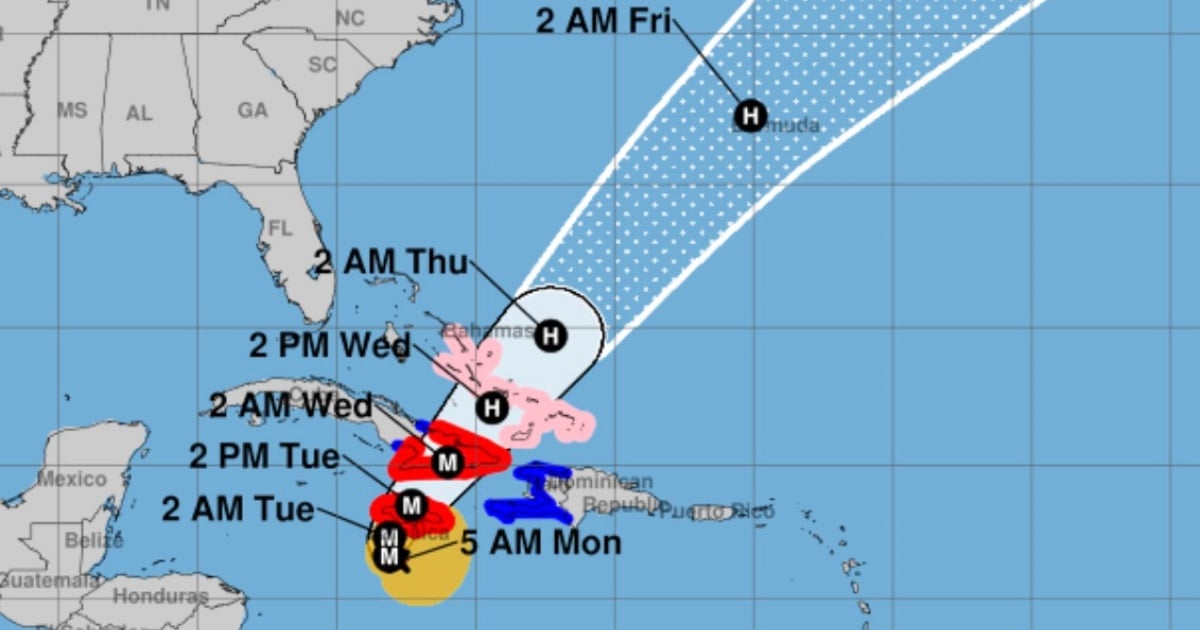
The National Hurricane Center (NHC) has announced in its 5:00 a.m. advisory on Monday, October 27, that Hurricane Melissa has intensified into a Category 5 on the Saffir-Simpson scale, boasting maximum sustained winds of 160 mph (260 km/h).
This development positions Melissa as one of the most hazardous storms of the season, with its path set towards southeastern Cuba, where hurricane warnings have already been initiated.
Currently, the hurricane's center is located at coordinates 16.4°N, 77.8°W, approximately 315 miles (505 km) south-southwest of Guantánamo, moving westward at 6 km/h.
Expected Path and Movement
A gradual shift towards the northwest and north is anticipated in the coming hours, with acceleration towards the northeast expected starting Tuesday.
According to the NHC forecast, “Melissa's core is projected to pass near or over Jamaica tonight and Tuesday, southeastern Cuba on Tuesday night, and through the southeastern Bahamas on Wednesday.”
Regions Under Hurricane Warning
The situation has necessitated hurricane warnings for the provinces of Granma, Santiago de Cuba, Guantánamo, and Holguín. Additionally, Las Tunas is under a tropical storm warning.
A hurricane warning indicates that “hurricane conditions are expected within the warning area, typically issued 36 hours before the potential impact,” urging authorities to complete emergency preparations immediately.
Potential Intensification and Wind Threat
Data from a U.S. Air Force hurricane reconnaissance aircraft has confirmed that Melissa is not only a Category 5 storm but may strengthen further.
The NHC warns of “additional strengthening today, with fluctuations in intensity possible before Melissa makes landfall in Jamaica.”
Hurricane-force winds extend up to 45 km from the center, and tropical-storm-force winds stretch out to 315 km, meaning that these conditions will be felt well before the cyclone's eye arrives.
Severe Rainfall and Flooding Risks
Beyond the wind, rainfall poses a major threat with Melissa. The NHC estimates between 10 and 15 inches of rain will fall in eastern Cuba, with local totals reaching up to 20 inches (over 500 mm) from today through Wednesday.
This heavy rainfall could lead to “potentially life-threatening flash floods and numerous landslides,” particularly in mountainous or inaccessible areas surrounding the Sierra Maestra.
Destructive Storm Surges
The bulletin also highlights potentially deadly storm surges expected to hit Cuba’s southeastern coast between Tuesday night and Wednesday.
Water levels could rise 6 to 9 feet (up to nearly 3 meters) above normal, accompanied by “large and destructive waves.”
This phenomenon, already impacting Jamaica, poses a grave threat to Cuba’s coastal communities, where the combination of surge, rain, and wind could have catastrophic consequences.
Regional Alert in the Western Caribbean
Besides Cuba, Hurricane Melissa places several Caribbean countries on alert. Jamaica is under a hurricane warning, as are parts of the Bahamas and the Turks and Caicos Islands. Haiti is also under a tropical storm warning.
The NHC emphasizes that “interests in Bermuda should monitor Melissa’s progress,” noting the potential for the system to indirectly affect that archipelago later in the week.
Melissa has become the second Category 5 Atlantic hurricane of 2025, challenging early warning systems and community preparedness in the region.
The system's central pressure is 917 mb, underscoring its formidable intensity.
Cuban authorities, in collaboration with the Institute of Meteorology and Civil Defense, have begun mobilizing resources, issuing guidelines, and preparing shelters in the eastern provinces.
Melissa is now a meteorological powerhouse, with its trajectory directly threatening eastern Cuba. The upcoming 48 hours will be critical in mitigating its impacts.
Frequently Asked Questions about Hurricane Melissa
What makes Hurricane Melissa a Category 5 storm?
Hurricane Melissa is classified as a Category 5 storm due to its maximum sustained winds of 160 mph (260 km/h), qualifying it as a severe hurricane on the Saffir-Simpson scale.
Which areas in Cuba are under the greatest threat from Hurricane Melissa?
The provinces of Granma, Santiago de Cuba, Guantánamo, and Holguín are under hurricane warnings, with Las Tunas under a tropical storm warning, indicating these areas are at significant risk.
What are the anticipated impacts of Hurricane Melissa's landfall?
Hurricane Melissa is expected to cause destructive winds, severe rainfall leading to flash floods and landslides, and potentially deadly storm surges along the southeastern coast of Cuba.