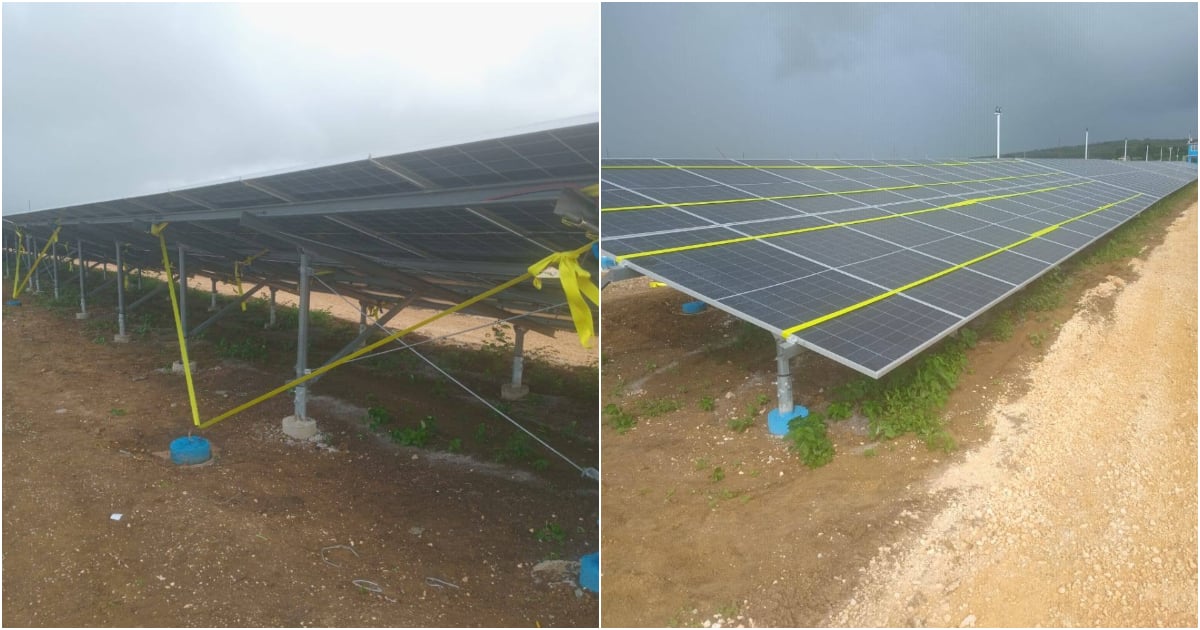
The sight of solar panels being secured with ribbons at the Serones II solar park in Mayarí, Holguín, has raised eyebrows among Cubans, sparking skepticism about the effectiveness of such measures against the powerful Hurricane Melissa, a Category 4 storm on the Saffir-Simpson scale.
"We, the electric workers of Holguín, are doubling our efforts to protect our installations and ensure the continuous supply of electricity through our renewable sources. Prevention is our best ally! We continue working with responsibility and commitment for the well-being of our people," the local utility posted on Facebook, attempting to instill confidence with emojis and slogans of unity.
This scenario was mirrored in Manzanillo, Granma Province, where journalist Roberto Mesa Matos reported similar actions at the Las Tapias photovoltaic solar park. "Faced with the danger posed by Hurricane Melissa, constructors are securing the sites for panel installation and fastening containers and tables with special ribbons," he noted on his Facebook page, highlighting efforts to safeguard materials and structures from the storm's rains and winds.
However, the intended reassurance backfired, as ironic comments quickly flooded social media. One user jested, "I've got my net ready to catch them flying into Florida." Another quipped, "Those little strings will turn the solar panels into kites."
Alexander Martínez joked, "After Melissa passes, the panels will be closer to the sun," while others suggested dismantling them rather than risking them going airborne. Julio César Chiong Fernández commented, "It was more sensible to remove them for a few days than to lose them; it's a hurricane, not just a shower."
Joan Llerena Reverón expressed concern that "while the ribbons might withstand the intense winds, the panels would still be vulnerable to debris Melissa might fling, like sand and stones, potentially causing partial or total damage. They should be better protected."
The ridicule reflects growing doubt about the authorities' genuine preparedness for such meteorological threats, with many feeling that prevention has become more of a slogan than a practical policy.
Back in May, the UNE assured that the solar parks across the country are built to endure high-intensity hurricanes, even those reaching Category 4, with winds of up to 141 mph. This claim was made on the state entity's Facebook page, citing data from the book "Photovoltaic Energy for Cuba" by Professor Daniel Stolik, a pioneer in this field.
According to UNE, the solar modules installed have undergone wind and hail resistance tests conducted by the manufacturers, boasting an estimated lifespan of 25 years. Factors enhancing their resilience include the panels' low height, southward tilt, row design that reduces wind impact, natural barriers, and the terrain's topography.
In a related note, Yulié Salgado Barrizonte, director of the La Barbarita photovoltaic park in Consolación del Sur, stated that the Chinese system used is not designed to be dismantled during extreme weather events, and previous experiences, such as Hurricane Ian in September 2022, resulted in "minimal damage."
Hurricane Melissa, a Category 4 storm with winds of 136 mph and stronger gusts, is slowly moving through the Caribbean, threatening Cuba's eastern region in the coming hours. Experts predict the storm will gradually shift north and northeast between Monday and Tuesday, posing a significant risk to eastern Cuba.
Understanding Hurricane Preparedness for Solar Parks in Cuba
How are solar panels in Cuba protected against hurricanes?
Solar panels in Cuba are designed to withstand high-intensity hurricanes, including Category 4 storms, with measures such as low panel height, southward tilt, and strategic row designs to reduce wind impact.
Why is there skepticism about the use of ribbons to secure solar panels?
The skepticism arises because many believe that using ribbons to secure panels is insufficient against the extreme winds and debris that a Category 4 hurricane like Melissa can bring, leading to doubts about the authorities' preparedness.
What were the previous experiences with similar solar panel systems during hurricanes in Cuba?
During Hurricane Ian in September 2022, similar systems experienced minimal damage, suggesting a degree of resilience. However, the approach of using ribbons has led to public skepticism.