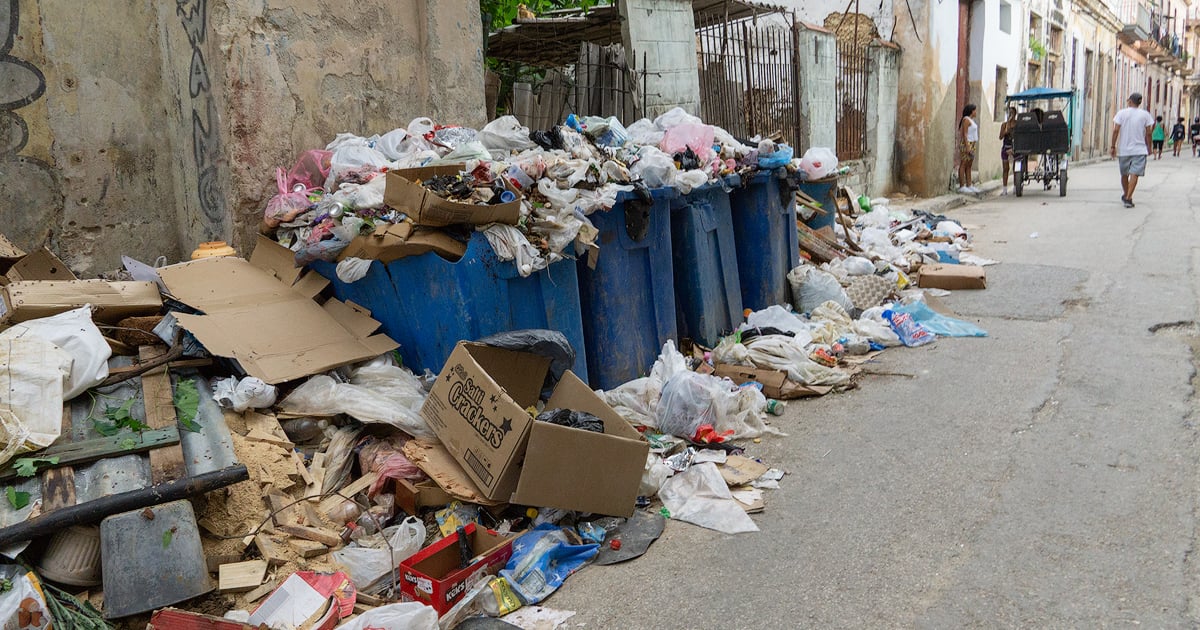
More than twenty days have passed since the start of Havana's so-called intensive cleaning campaign, and authorities have reported the collection of 396,157 cubic meters of trash. While this figure may seem substantial, it fails to mask the significant breakdown of urban sanitation in Cuba's capital.
In a meeting led by Miguel Díaz-Canel alongside other Communist Party leaders, it was acknowledged that "a lot remains to be done." This admission highlights the inadequacy of waste management policies and the dire state of basic services across the city.
Governor Yanet Hernández Pérez revealed that in the past week alone, 128,370 cubic meters of waste were collected using an average of 284 pieces of equipment, 180 of which were additional support units.
Nevertheless, even the official numbers acknowledge that garbage continues to pile up in numerous neighborhoods, where overflowing containers and makeshift dumps have become everyday sights.
Challenges in Waste Management
Government reports themselves concede that garbage dumps still dominate many areas, necessitating an "increase in debris collection" generated by both residents and other entities.
The Ministry of Transport has initiated a project to convert unused containers into roll-on/roll-off boxes designed to collect waste in peripheral neighborhoods like Guanabacoa using animal traction.
Urban Infrastructure Deterioration
Meanwhile, the state of the urban infrastructure remains a major concern. The company Aguas de La Habana reported over 2,800 water leaks, a rise compared to the previous week, and more than 46,000 residents still lack regular access to potable water.
The inadequate sanitation and accumulated waste have also led to increased epidemiological risks, prompting the mobilization of over 800 people daily to operate 420 fumigating devices.
Despite official claims of "commendable results," the reality on the streets of the capital depicts a city mired in filth, illness, and disarray, where state inefficiency and resource shortages turn every corner into a potential breeding ground for disease.
Frequently Asked Questions on Havana's Sanitation Crisis
What measures are being taken to address the waste management issue in Havana?
Efforts include the conversion of unused containers into roll-on/roll-off boxes to collect waste, particularly in peripheral neighborhoods, and the deployment of additional support equipment to aid garbage collection.
How is the waste problem affecting Havana's residents?
The accumulation of waste and inadequate sanitation are increasing epidemiological risks and leading to health concerns among the population, exacerbated by unreliable access to potable water.