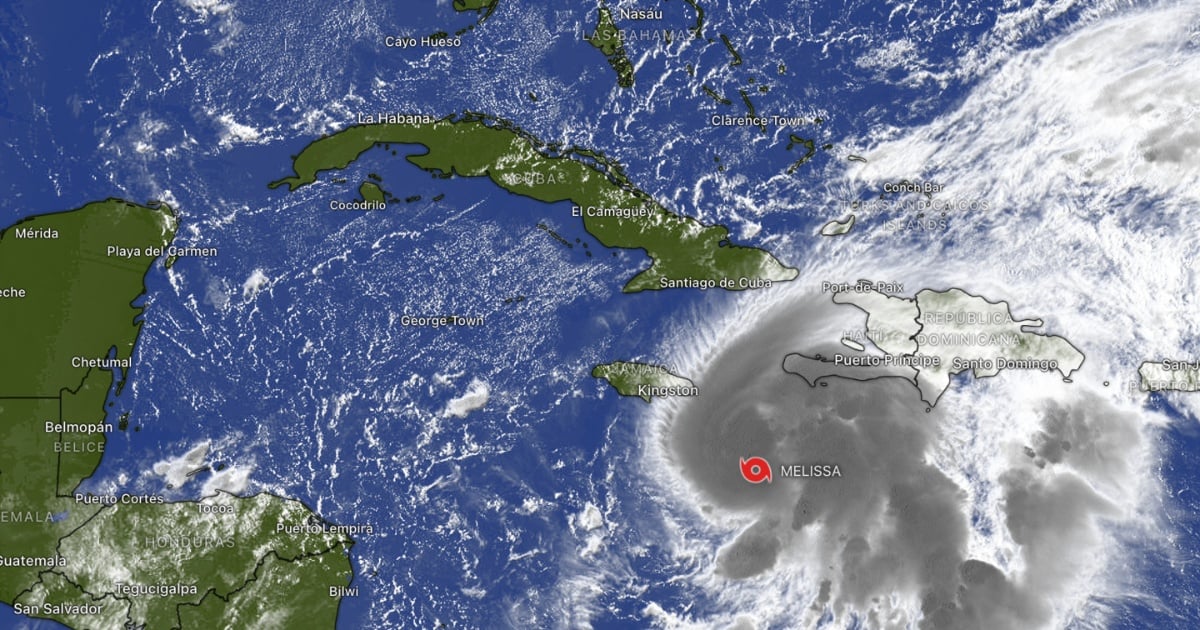
The National Hurricane Center (NHC) has issued a warning that Tropical Storm Melissa is nearing hurricane strength and is expected to rapidly intensify over the weekend. This development poses a significant threat of life-threatening flooding and landslides in Jamaica and southern Hispaniola.
As of 11:00 a.m. on Saturday, the storm's center was located at 16.5°N, 75.1°W, approximately 155 miles (245 km) southeast of Kingston and 235 miles (375 km) southwest of Port-au-Prince. It was packing maximum sustained winds of 70 mph (110 km/h) and moving very slowly west-northwest at 1 mph (2 km/h), with a minimum pressure of 982 mb.
The tropical-storm-force winds extended up to 125 miles (205 km) from the center.
The NHC has maintained a hurricane warning for Jamaica and has issued a hurricane watch along with a tropical storm warning for the southwestern peninsula of Haiti, from the Dominican Republic border to Port-au-Prince.
According to the projected path, Melissa's center is expected to pass near or over Jamaica between the weekend and early next week, with a potential approach to eastern Cuba by midweek.
The agency further mentioned that warnings might soon be issued for parts of eastern Cuba, urging residents in Haiti, the Dominican Republic, eastern Cuba, the southeastern and central Bahamas, and Turks and Caicos to closely monitor the system's progress.
The most hazardous aspect of this event is the potential for extreme and persistent rainfall.
The official forecast predicts rainfall totals of 15 to 25 inches in Jamaica and southern Hispaniola through Wednesday, with localized maxima of up to 35 inches possible in eastern Jamaica and the Tiburon Peninsula of Haiti.
The NHC has warned of flash flooding and landslides, which could result in catastrophic impacts in these regions.
In eastern Cuba, 5 to 10 inches of rain is expected, with peaks of 15 inches anticipated through Wednesday, enough to trigger flash floods and landslides on saturated slopes. However, rainfall amounts beyond Wednesday remain uncertain.
Aside from the heavy rain, storm surge is also a concern. The NHC notes that a life-threatening storm surge is increasingly likely along Jamaica's southern coast late this weekend or early next week, with heights reaching 7 to 11 feet above ground level, especially near and east of Melissa's landfall point.
This surge will be accompanied by large and destructive waves. There is also the potential for significant storm surge along the southeastern coast of Cuba early next week, while swells generated by the cyclone will impact Hispaniola, Jamaica, and eastern Cuba in the coming days.
Regarding intensity, reconnaissance aircraft from the Air Force Reserve and NOAA have confirmed that sustained winds remain near 70 mph. However, the NHC forecasts that Melissa will strengthen into a hurricane later on Saturday and could become a major hurricane by Sunday, given the highly favorable conditions over the central Caribbean.
Meanwhile, the very slow movement expected today and tomorrow will keep rainbands over the same areas, increasing the risk of extreme accumulations before the system turns north and northeast between Monday and Tuesday.
Authorities are urging residents in areas under warning and watch to expedite preparations and follow local directives as updates are issued.
FAQs about Hurricane Melissa's Impact
What areas are at risk from Hurricane Melissa?
Jamaica, southern Hispaniola, and potentially eastern Cuba are at significant risk due to Hurricane Melissa's expected path and intensity.
How much rainfall is expected in Jamaica?
Forecasts suggest Jamaica could experience 15 to 25 inches of rain, with some areas seeing up to 35 inches, leading to potential flash floods and landslides.
When will Hurricane Melissa likely make landfall?
Melissa is expected to pass near or over Jamaica between the weekend and early next week, with potential impacts on eastern Cuba by midweek.
What is the expected storm surge impact?
A life-threatening storm surge is likely along Jamaica's southern coast, with expected heights of 7 to 11 feet above ground level.