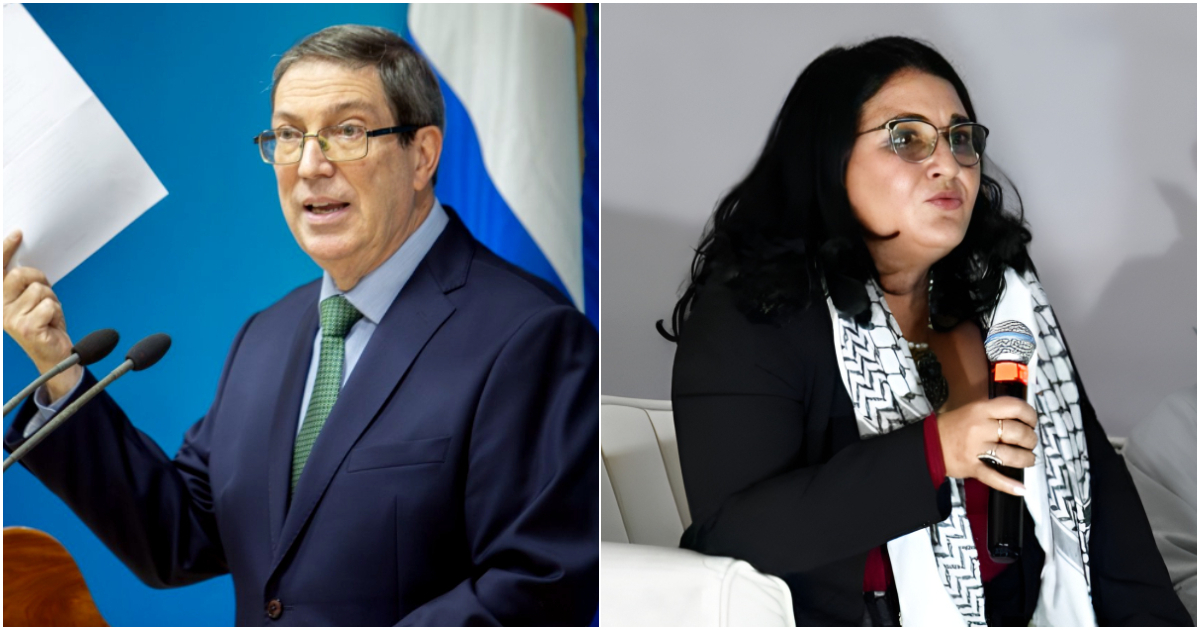
As the annual United Nations General Assembly vote on the resolution against the U.S. embargo draws near, the Cuban regime has activated its most disciplined propaganda machine.
Within a week, notable regime figures like Bruno Rodríguez Parrilla and Miguel Díaz-Canel have echoed a familiar narrative through prime-time news and media outlets. The most prominent face of Cuban diplomacy, Johana Tablada de la Torre, also stresses that Cuba is the victim of the "world's harshest economic siege," with Washington allegedly trying to "torture a noble people" under the influence of Marco Rubio.
However, beneath the speeches, hashtags, and accusations, the reality is starkly different: Cuba is not isolated. It engages in trade with the United States and numerous other countries, receives donations, investments, and soft loans. The crisis stems from its own insolvency, inefficiency, and internal repression, not from external sanctions.
Media Offensive and Conference Tactics
The offensive began with a conference by Foreign Minister Bruno Rodríguez Parrilla on October 22. For nearly two hours, he accused the U.S. State Department of a deceptive campaign to influence Latin American and European governments ahead of the UN vote.
Rodríguez Parrilla read excerpts from U.S. diplomatic documents, denouncing as a "shameless lie" the claim that Cuba threatens regional peace. This past Thursday, the Cuban National Television News (NTV) devoted an extensive segment to amplify his declarations and "respond" to Undersecretary of State Christopher Landau, who reminded viewers that "there is no blockade in Cuba, only a failed system."
The program, led by journalist Jorge Legañoa Alonso, accused Landau of engaging in "Trumpist diplomacy" and claimed that without the embargo, "there would be no blackouts or shortages." Yet, the show itself failed to acknowledge the significant volume of imports from the U.S., the steady flow of European and Canadian tourists, and Cuba's legal access to international trade.
Official statistics, in fact, contradict the program's script.
Active Trade: Unshown Data
According to the U.S. Department of Agriculture (USDA), Cuba imported over $204.9 million in food between January and May 2025, a 16.6% increase from the same period in 2024. The most purchased items included chicken (with $15.7 million in May alone), powdered milk, rice, pork, coffee, and health products.
In 2024, total food and agricultural product imports reached $301.7 million, with purchases doubling in March compared to the previous year, surpassing $40 million monthly. Since 2001, under the Trade Sanctions Reform and Export Enhancement Act (TSREEA) exceptions, Cuba has spent over $8 billion on American products, including food, medicine, and machinery.
This flexibility extends to non-essential goods. In the first seven months of 2024, Cuba spent $36 million on imported cars from the U.S., with August seeing expenditures on vehicles 46 times higher than on food. These transactions, authorized by the Treasury Department under special licenses for the private sector, occur through micro, small, and medium enterprises (MSMEs)—the only relatively dynamic part of the Cuban economy.
In essence, while the news criticizes a blockade, the regime purchases cars, chicken, and machinery from the country it claims is suffocating it.
Medicine Imports Allowed
Rodríguez Parrilla and Tablada de la Torre often argue that the "blockade" prevents acquiring medicines. However, in 2023, the U.S. Embassy in Havana publicly countered these claims. "Medicines can indeed be imported from the U.S. to Cuba. The embargo allows for medical and humanitarian exports. The issue is not the law, but management."
According to Commerce Department data, nearly $900 million in medical exports to Cuba were approved that year, double the amount in 2021. Supplies included hospital equipment, reagents, surgical supplies, and essential medicines, provided the Cuban buyer pays in cash without military intermediaries.
Yet, the regime prefers to maintain the narrative of a total ban to shift its healthcare inefficiency into the political realm. The shortage of medicines in Cuban pharmacies and the widespread deterioration of the public health system are not due to the Helms-Burton Act, but to BioCubaFarma's bankruptcy, lack of foreign currency, the regime's investment priorities, and the exodus of medical personnel.
Targeted Measures, Not Collective Punishment
In a recent statement, Tablada de la Torre accused Washington of "inhuman measures," listing 2025 sanctions like visa restrictions, suspension of cultural exchanges, flight limitations, Airbnb exclusion, and more.
However, the list itself reveals their selective nature. Most sanctions target Cuban officials, military personnel, judges, and prosecutors involved in human rights violations, not ordinary citizens. Travel and visa restrictions are based on the Global Magnitsky Act, which sanctions individuals responsible for political repression or corruption.
Similarly, measures against Cuban medical missions are considered a form of human trafficking by the State Department. As publicized and documented through numerous testimonies and evidence, professionals are sent abroad under state contracts, with up to 80% of their salaries withheld and monitored by security agents. Far from being a "solidarity work," the program generates millions for the Cuban state while violating multiple international labor standards.
Cuba's Trade Capabilities
Neither the Helms-Burton Act nor any other U.S. law prevents Cuba from trading with third-party countries. The island maintains trade relations with over 70 nations, including China, Russia, Spain, Canada, Brazil, Mexico, Vietnam, and Algeria.
The embargo only prohibits U.S. companies (and their subsidiaries) from trading with the regime, except for humanitarian goods. Current obstacles are not due to external sanctions but repeated non-payments. Chinese, Russian, and Spanish energy projects have stalled due to payment failures.
Cuba owes over $3 billion to the Paris Club, and even the French government acknowledges that Cuba stopped meeting its commitments in 2019. The country's credit rating is extremely risky, meaning no international bank grants it credit. As a result, all purchases—even humanitarian ones—must be made in cash and at a premium.
This is the real "financial suffocation": the one the regime inflicts upon itself.
The Rationale Behind Sanctions
Washington does not impose sanctions arbitrarily. Recent decisions are based on specific, documented reasons.
- Support for terrorism and military ties with adversarial powers: Cuba has sheltered Colombian ELN members and allowed recruitment of Cuban mercenaries in Ukraine. Its strategic alliance with Russia and China includes military training and cooperation in espionage and electronic intelligence.
- Internal repression and political prisoners: Personal sanctions target judges, prosecutors, and officers involved in the July 11 protests' trials and arbitrary detentions of dissidents.
- Human trafficking and labor exploitation: The State Department continues to list Cuba among countries not meeting minimum standards in combating human trafficking.
- Corruption and money laundering: GAESA's military conglomerate controls foreign currency without public oversight or audits.
- Support for civil society: Far from a covert operation, U.S. assistance to independent media and Cuban NGOs is legal and recorded in the federal budget.
In summary, sanctions are reactive, not original: they respond to regime violations and alliances, not as a cause of its woes.
The Victimhood Diplomacy
Tablada de la Torre and Rodríguez Parrilla's rhetoric aims to rally internal consensus around an external enemy. Amid the collapse of the electrical system, soaring inflation, and mass emigration, the regime needs to frame its disaster as foreign aggression. Thus, every October, the "genocidal blockade" script resurfaces, accompanied by selective testimonies and manipulated figures.
But reality contradicts this narrative: Cuba imports, exports, receives tourists, maintains diplomatic relations with over 160 countries, and benefits from debt forgiveness and investments. Its crisis is not due to sanctions but the structural failure of its economic and political model.
While the Ministry of Foreign Affairs denounces an "economic war," private MSMEs import cars, state stores sell American chicken in dollars, and pharmacies lack medicines due to management failures, not lack of permits.
"The embargo is an excuse"
The blockade narrative fulfills a political function, not an informative one. It allows the regime to justify scarcity, conceal corruption, and maintain ideological control over an exhausted populace.
But facts are stubborn: Cuba is not blockaded; it is bankrupt. And not because of Washington, but because of a state that bans competition, represses dissent, and defaults on its debts.
As recently summarized by a European diplomat stationed in Havana: "The embargo is an excuse; the real blockade is the one the government imposes on its own economy."
Just days before the UN vote, Cuban diplomacy will once again win in numbers but lose in credibility. Each year that the same rhetoric is repeated without results, it becomes clearer that the enemy is not in the White House but in the Palace of the Revolution.
Understanding the Cuban Embargo and Its Implications
What is the main argument of the Cuban regime regarding the embargo?
The Cuban regime argues that the embargo is a brutal economic blockade that tortures the Cuban people, primarily blaming the United States and its policies for the island's economic woes.
How does Cuba engage in international trade despite the embargo?
Cuba trades with over 70 countries and imports goods, including food and medicine, from the United States under specific exceptions. The embargo restricts U.S. companies from trading with Cuba, except for humanitarian goods.
Are medicines allowed to be imported to Cuba from the U.S.?
Yes, medicines can be imported from the U.S. to Cuba. The embargo permits medical and humanitarian exports, though the Cuban regime often mismanages these imports.
What are the reasons behind U.S. sanctions on Cuba?
U.S. sanctions are based on Cuba's support for terrorism, military ties with adversarial powers, internal repression, human trafficking, and corruption. These sanctions are targeted, usually affecting officials involved in these activities.