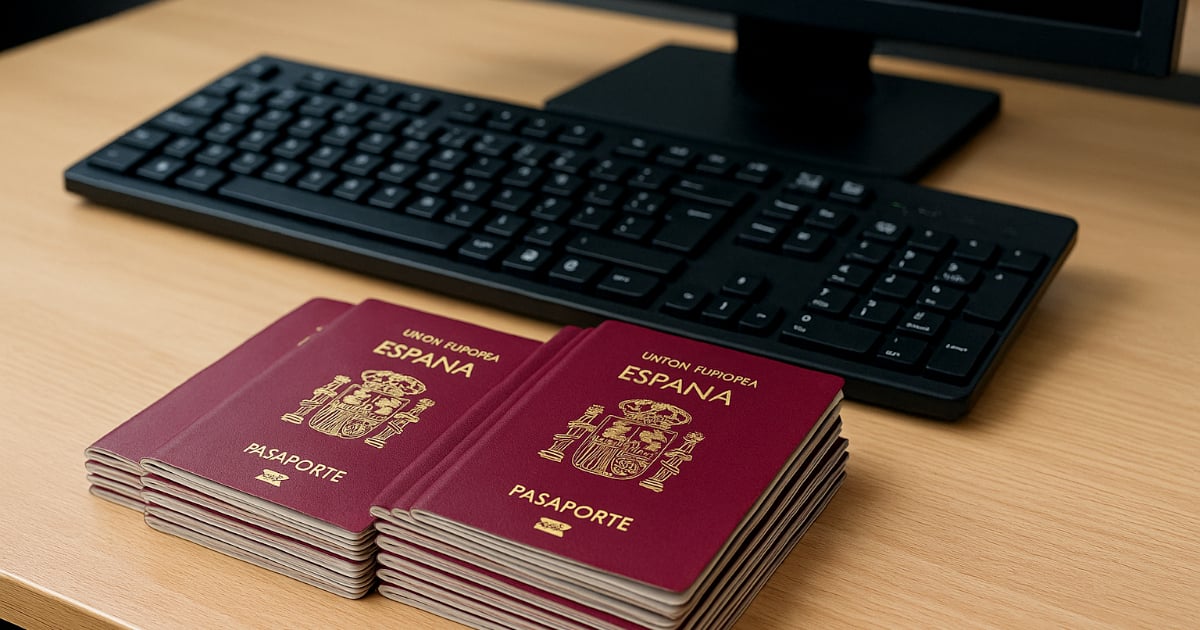
The General Council of Spanish Citizenship Abroad (CGCEE) has put forth a proposal to the Spanish government and Parliament for a reform of the Civil Code. This change would allow descendants of Spanish emigrants to apply for citizenship at any time, without limitations regarding the degree of kinship.
This proposal aims to replace the current framework under the Democratic Memory Law, which expired on October 22 after two years in effect, including an additional extension. Previously, this law permitted children and grandchildren of Spaniards to apply for a passport, but only within a restricted timeframe.
The CGCEE argues that the closure of the application period and significant administrative delays at consulates highlight the need for a more permanent regulation. Such a rule would acknowledge citizenship as a continuous right for the descendants of emigrants.
“The current system has created excessive pressure on consular offices and significant uncertainty among applicants,” warned the Council in its formal proposal, which has been sent to the Justice Committees of both the Congress and the Senate.
Structural Change in Citizenship Rights
According to La Nueva España, the advisory body’s proposal suggests integrating citizenship access permanently into the Civil Code, eliminating the "temporary windows" concept seen in recent laws recognizing descendants.
The proposal also recommends that the right to citizenship should extend to any generation of descendants who can prove the existence of a Spanish ancestor, regardless of paternal or maternal lineage.
This amendment would address historical inequalities from previous laws that made it easier for descendants of Spanish men to obtain citizenship compared to those of women who lost their nationality by marrying foreigners before 1978.
Consular Delays and Overload
Since the Democratic Memory Law took effect, over 1.5 million individuals have submitted nationality applications through the descendant route, most of them from Latin America.
Consulates in Argentina, Cuba, Mexico, and the United States are among the most overwhelmed, with waiting times exceeding two years in some instances. In Buenos Aires, the volume of applications is so high that the city could potentially become the third-largest Spanish city in terms of population, following Madrid and Barcelona.
In this context, the CGCEE finds it “unsustainable” to maintain a model based on fixed deadlines and quotas, as it leads to legal uncertainty, unequal opportunities, and a bureaucratic collapse that could last decades.
Political Support and Challenges
The reform proposal has been well-received in sectors of both the PSOE and the Popular Party, which have expressed willingness to consider a “definitive” nationality law. However, ideological differences and parliamentary fragmentation could complicate reaching a broad consensus.
The Ministry of Justice has acknowledged issues in managing the current process but has not yet announced an official stance on the reform. The Minister of Territorial Policy and Democratic Memory, Ángel Víctor Torres, has indicated that any structural change “must have broad political agreement.”
Additional Measures
Besides eliminating deadlines and expanding generational access, the CGCEE suggests altering Civil Code articles related to the involuntary loss of nationality, affecting thousands of young people born abroad.
Currently, those acquiring dual nationality must perform a “conservation act” before turning 21 to retain their Spanish status—a process many are unaware of, leading to unintended automatic losses. The Council proposes that loss should only occur through an explicit renunciation.
Toward a Permanent and Inclusive Law
The proposal, already under parliamentary review, aims to solidify a stable policy for Spanish citizenship abroad. The objective, as stated in the document submitted to Congress, is to “translate the advances of the Democratic Memory Law into a definitive regulation, without time restrictions or family line discrimination.”
If successful, Spain could become one of the few European countries with an indefinitely open system of nationality by descent, which would have an immediate impact on communities historically connected with Spanish emigration to Latin America.
Implications of the Proposed Citizenship Reform
What changes does the proposed reform bring for descendants of Spanish emigrants?
The reform proposes allowing descendants of Spanish emigrants to apply for citizenship without time limits or generational restrictions, making it a permanent right.
How might this reform affect consular services?
By eliminating fixed deadlines and quotas, the reform aims to reduce the overwhelming demand and administrative delays currently faced by consular services.
What is the political outlook for the reform's approval?
While there is support from both the PSOE and the Popular Party, ideological differences and parliamentary fragmentation may pose challenges to reaching a consensus.
What additional measures are included in the proposal?
The proposal includes measures to prevent involuntary loss of nationality by requiring an explicit renunciation rather than an automatic process.