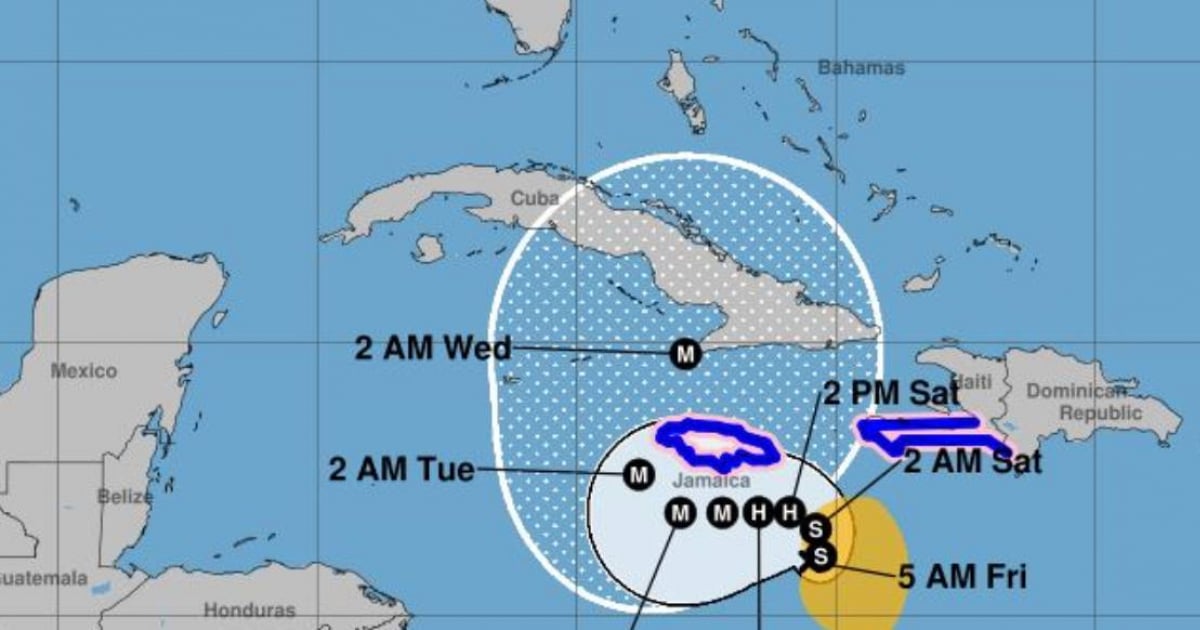
Tropical Storm Melissa is making its way through the western Caribbean at a slow pace, and it has the potential to strengthen into a hurricane before reaching the eastern part of Cuba.
The National Hurricane Center (NHC) in the United States has issued a warning that Tropical Storm Melissa could unleash heavy rains, destructive winds, and hazardous storm surges across Jamaica, Haiti, the Dominican Republic, and eastern Cuba. Current models suggest a possible direct hit by mid-next week.
The NHC's 12th advisory, released at 5:00 a.m. Eastern Time this Friday, notes that the storm is sustaining maximum winds of 75 km/h with a central pressure of 1003 millibars as it slowly moves northward over the Caribbean Sea.
Melissa's nearly stationary movement is causing prolonged rainfall, which already poses a threat of catastrophic flooding and landslides in Jamaica and Haiti.
"Intense rainfall is expected to lead to life-threatening flash floods and multiple landslides in southwestern Haiti and Jamaica," the NHC cautioned, also urging expedited preparations to protect lives and property.
Serious Threats Loom for Eastern Cuba
The report further warns that eastern Cuba could experience heavy rainfall, strong winds, and storm surges starting this weekend, with an increasing risk of a direct impact by Wednesday if the system continues to strengthen.
The most vulnerable areas include Guantánamo, Santiago de Cuba, Granma, and Holguín, where authorities are advised to begin immediate preparations for a potential hurricane scenario. However, the Cuban regime has yet to announce any concrete preventive measures or share details about evacuation plans or shelter availability.
NHC meteorologists predict that Melissa could escalate to hurricane status within the next 48 to 72 hours, fueled by the warm Caribbean Sea and favorable moisture conditions. If this occurs, it would be the second hurricane of the season with destructive potential for Cuba.
Cuban Meteorological Institute Keeps a Close Watch on Melissa
The Cuban Institute of Meteorology's Forecast Center (INSMET) confirmed Thursday night that it is closely monitoring the development of Tropical Storm Melissa. As of 8:00 p.m., the storm's center was positioned at 16.0°N latitude and 75.5°W longitude, approximately 260 kilometers south-southeast of Kingston, Jamaica.
With maximum sustained winds of 75 km/h and a slow northward movement of just 4 km/h, Melissa is situated over the warm waters of the Caribbean Sea, where conditions are highly favorable for its intensification.
INSMET has issued a warning that "this cyclonic system poses a potential danger to the geographic area," particularly south of the Greater Antilles, where it could gain strength and organization in the coming days.
Meanwhile, Cuba's weather remains under the influence of surface high pressures, with an upper-level trough (between 6 and 12 kilometers high) combining with local humidity to produce rain in the eastern and central regions of the country.
Elsewhere in the nation, rainfall has been sparse, although isolated heavy rains have been recorded along the northern coast of Guantánamo, with a maximum accumulation of 45 millimeters in the town of Jamal over the past 12 hours.
Currently, most of the country is experiencing minimal cloud cover, except for the far eastern region, where moderate to high vertical development clouds and persistent rainfall continue.
INSMET also stated that no tropical cyclonic development is expected in the remainder of the Atlantic, Caribbean Sea, or Gulf of Mexico over the next 12 to 24 hours.
The NHC underscores that "interests in Cuba should closely monitor Melissa's progress," as the risk of heavy rains, damaging winds, and storm surges "appears to be increasing."
FAQs on Tropical Storm Melissa and Its Impact on Cuba
What areas in Cuba are most at risk from Melissa?
The eastern regions of Cuba, particularly Guantánamo, Santiago de Cuba, Granma, and Holguín, are most at risk of being impacted by Tropical Storm Melissa.
When is Melissa expected to become a hurricane?
Melissa is anticipated to possibly reach hurricane strength within the next 48 to 72 hours, depending on favorable sea and moisture conditions.
What preparations should be made in response to Melissa?
Authorities and residents in the affected regions should expedite preparations to protect lives and property, including organizing evacuation plans and securing shelters.