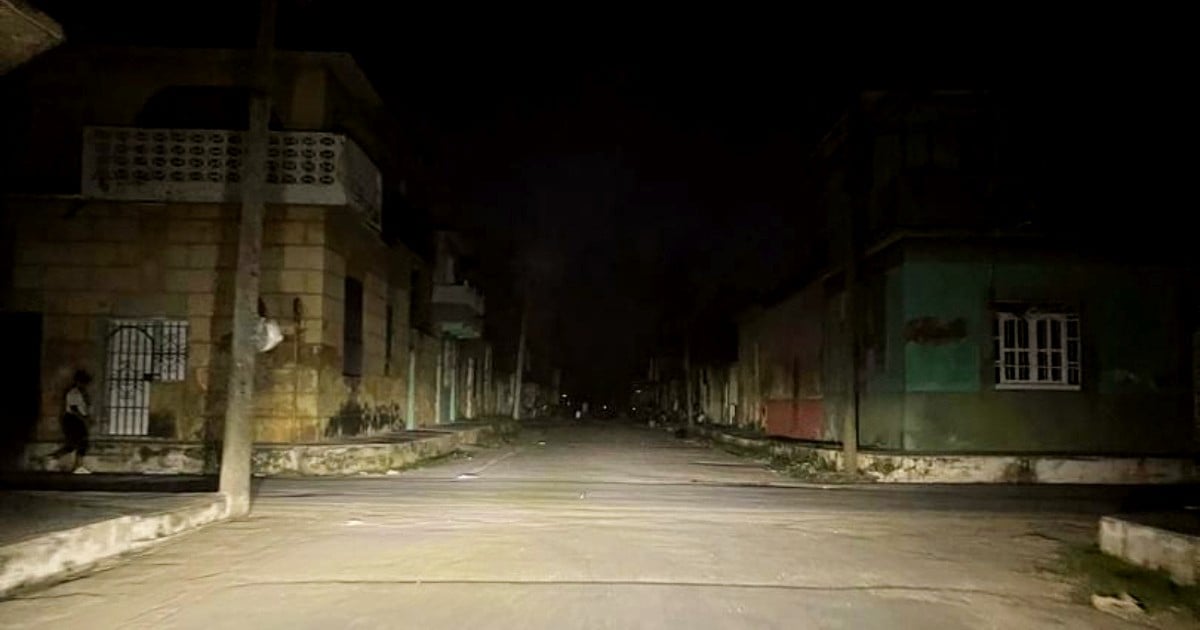
The Cuban Electric Union (UNE) announced on Thursday that the disruptions caused by an incident in the National Electric System (SEN) have been resolved, following a morning outage that left much of the nation without electricity for several hours.
“The issue related to the incident has been resolved as of 16:35 hours,” the organization stated on its official X (formerly Twitter) account, confirming the restoration of service to a significant portion of the country.
Earlier, the Ministry of Energy and Mines (MINEM) indicated that the SEN was “operating stably and fully,” with 60% of the affected circuits restored and ongoing efforts to complete the recovery process.
Massive Outages Spark Public Outcry
The event, officially referred to as a system “oscillation,” led to widespread power outages across several provinces, triggering a wave of social media backlash due to the lack of clear information about the collapse's cause.
From early morning, Cubans reported complete power cuts in large areas of the country. The UNE acknowledged a “partial disconnection of the SEN,” but its brief and vague statement only fueled public frustration.
“Leave it, since there's never any electricity anyway,” quipped one user. Another remarked, “They're practicing before the cyclone hits.”
Social Fatigue and Distrust
The flood of comments underscored the social fatigue and dwindling trust in energy authorities. “Oscillation of what and partial for whom... you have no shame,” a netizen posted, while another warned, “Now it's partial, then it gets more complicated, and bam, three days without power.”
According to figures released by the UNE, the generation deficit had reached 1,818 MW against a national demand of 2,526 MW, with only 1,550 MW available.
Underlying Causes of the Energy Crisis
The main factors include fuel shortages, breakdowns in thermoelectric plants—such as Felton, Mariel, Renté, and Santa Cruz—and the shutdown of more than 70 distributed generation units.
Power cuts, now a routine part of Cuban life, impact homes, hospitals, businesses, and industries alike. On social media, users expressed exhaustion and resignation over an energy crisis showing no signs of improvement.
Impending Tropical Threat
The grid collapse coincides with the approach of Tropical Storm Melissa, moving over the central Caribbean with sustained winds of 85 km/h.
The Cuban Meteorological Institute (INSMET) and the National Hurricane Center (NHC) have warned that the storm could intensify, bringing heavy rains and flooding to the eastern part of the country.
Amid the looming weather threat, the SEN disruption has heightened vulnerability, leaving thousands of homes without power just when they need it most for accessing information and communication.
The government's lack of transparency and the repeated message that “causes are being investigated” have eroded the credibility of the UNE and the Ministry of Energy.
Cautious Optimism Amid Power Restoration
“Fresh air messes up the SEN,” joked a user, while another sarcastically pointed out that “the power never goes out in the leaders' circuit.”
Despite the government's assurances that “the system is operating with stability,” the return of electricity is met with caution in Cuban homes: residents know it could vanish again in a matter of hours.
Questions and Answers about Cuba's Energy Crisis
What caused the power outage in Cuba?
The power outage was caused by an incident described as an “oscillation” in the National Electric System, leading to widespread blackouts across several provinces.
How did the public react to the power outage?
The public reacted with frustration and criticism on social media, expressing dissatisfaction with the lack of information and transparency from the authorities.
What are the main causes of Cuba's ongoing energy crisis?
The main causes include fuel shortages, breakdowns in key thermoelectric plants, and the shutdown of numerous distributed generation units.