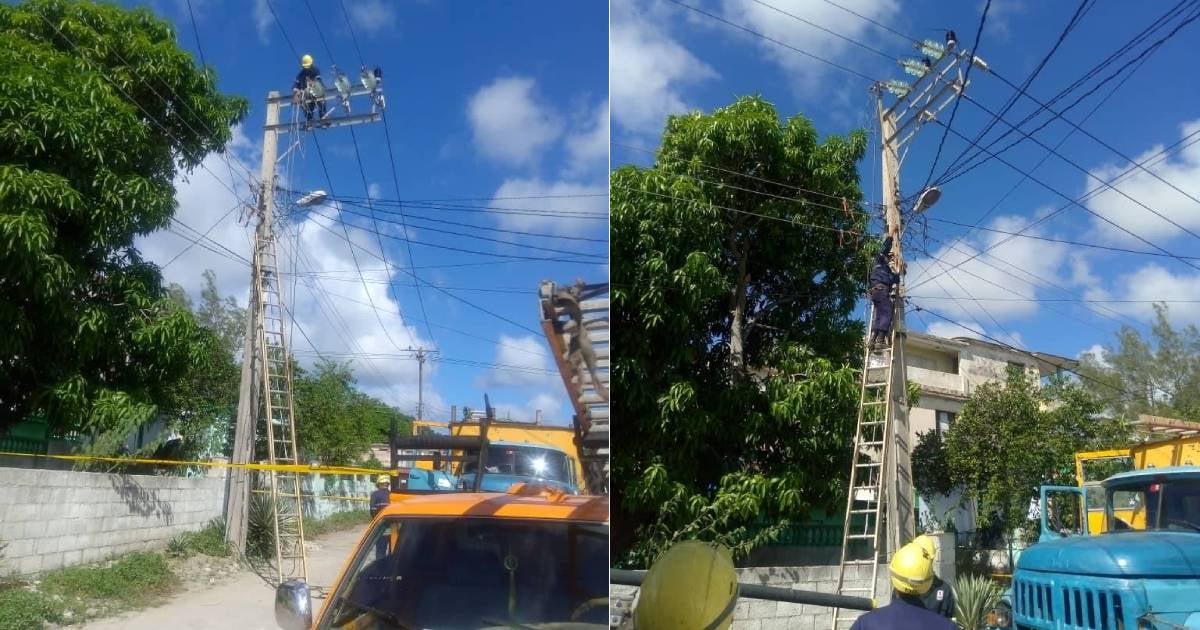
On Thursday, large portions of Havana were plunged into darkness following a partial collapse of Cuba's National Electric System (SEN). This blackout affected extensive areas of the capital and other provinces just as Tropical Storm Melissa loomed on the horizon.
Havana's Electric Company took to Facebook to announce that a “load oscillation” within the SEN triggered a DAF shutdown, impacting substations at Plaza, Tropical, Príncipe, and Naranjito. This resulted in the disruption of a "significant number of circuits." The statement was brief, devoid of specifics, and only mentioned that efforts were underway to restore service "once the causes of the unexpected event are identified."
Energy sector experts explain that a load oscillation occurs when there is a lack of synchronization between energy generation and demand, leading to abrupt frequency fluctuations in the electrical system. Such imbalances can stem from generator failures, overloading, or variations in the transmission network, often prompting automatic shutdowns to prevent further damage.
In Cuba's case, these oscillations have become increasingly common due to technical deterioration, insufficient maintenance, and fuel shortages affecting the country's thermoelectric plants.
The official response sparked a wave of criticism on social media, where hundreds of Cubans voiced their frustration and distrust over yet another massive blackout without clear explanations.
This blackout comes at a particularly sensitive time. According to the latest SEN report, the generation deficit reached 1,818 MW against a demand of 2,526 MW, pushing the system to a critical point.
Key power plants such as Felton, Mariel, Renté, and Santa Cruz remain out of service, with over 70 distributed generation stations halted due to fuel shortages or breakdowns.
Compounding the system's fragility is the threat posed by Melissa, currently a tropical storm moving slowly over the central Caribbean with sustained winds of 85 km/h and potential to intensify in the coming hours.
Understanding Cuba's Power Grid Challenges
What caused the recent power outage in Havana?
The outage was caused by a load oscillation in the National Electric System (SEN), leading to a DAF shutdown that affected several substations and disrupted many circuits.
Why are load oscillations becoming more frequent in Cuba?
Load oscillations are increasingly common due to the technical deterioration, lack of maintenance, and fuel shortages plaguing Cuba's thermoelectric plants.
How has the public reacted to the power outage?
The public response has been one of frustration and distrust, with many Cubans criticizing the lack of clear explanations for the blackout on social media.
What is the status of key power plants in Cuba?
Key power plants such as Felton, Mariel, Renté, and Santa Cruz are currently out of service, with numerous distributed generation stations also shut down due to fuel shortages or mechanical issues.