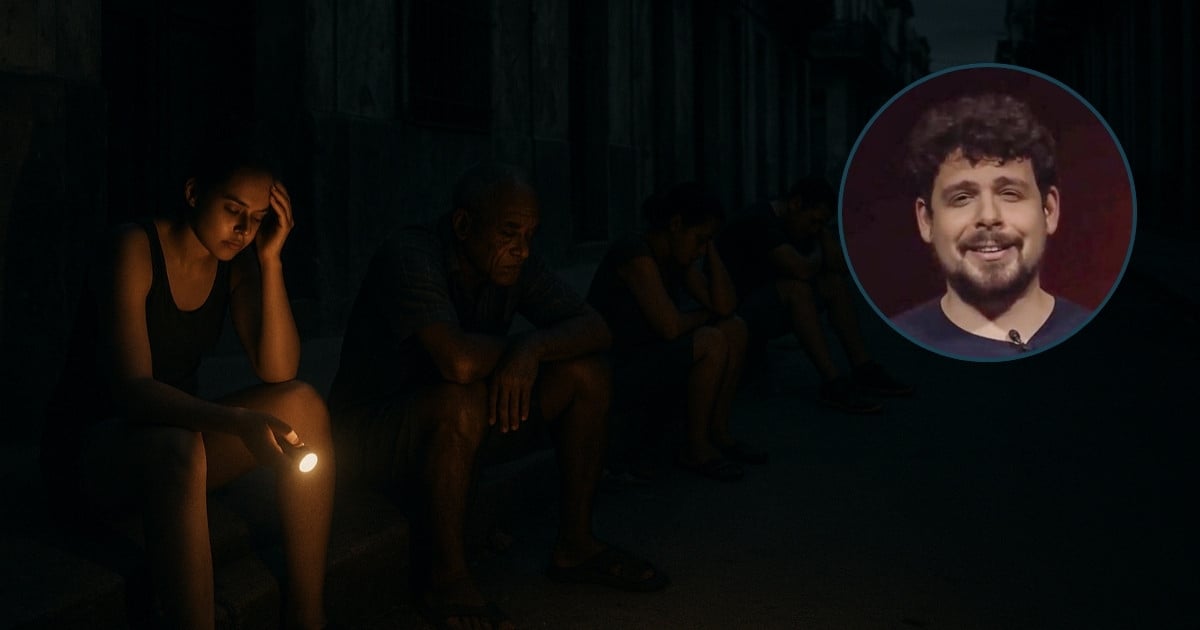
I read Michel E. Torres Corona's piece with the same mix of curiosity and revulsion as one might watch Cuban state television: the words may change, but the tune remains the same. A lot of blue, a lot of green, a lot of homeland and flag talk... and beneath it all, the same old refrain: endure, withstand, suffer with pride.
Sure, it might sound poetic. The writing is articulate, filled with imagery and references to Martí, Benedetti, and cultural icons. But in essence, it merely masks the misery with poetry, disguising resignation as virtue. He describes the blackout as though it were a heroic act, though in reality, it's a daily condemnation.
Those of us who left didn't do so out of cowardice. We left because Cuba offers only two paths: poverty or exile. I say this with the weight of someone who knows the cost of that decision. We left, bearing tremendous personal, emotional, and financial burdens. There's nothing heroic about starting from scratch, being apart from loved ones, or knowing your children will speak a different language and love another land.
My lifelong family and friends are now scattered in Miami, New York, Madrid, Asturias, London, and beyond. No one remains where they once were. Conversations with them on the phone feel like we're separated by centuries, not just miles.
This isn't a betrayal of the homeland; it's an open wound. And it hurts because it was inflicted by them: the Castros, their regime, and those like Torres Corona who defend it and try to convince us that poverty equates to purity, that blackouts signify dignity, and that imposed sacrifice is a virtue.
Torres Corona's text harbors a toxic notion: that those who stay are somehow more Cuban than those who leave. That emigrants "renounce" and "won't be happy" because we aren't part of that "grain of sand." This is false. Staying doesn't make one more Cuban, and leaving doesn't make one a coward.
Martí wrote, “There is no spectacle more odious than that of servile talents.” And that's precisely what we're witnessing: an "intellectual" using his talent to justify the powers that be. To romanticize scarcity, to turn the blackout into a symbol, while millions of Cubans endure the real darkness of despair.
Being Cuban isn't about an address; it's a way of feeling, a shared memory. It's still calling the supermarket "la bodega," or looking at the sea with the same mix of nostalgia and anger. I remain Cuban even though I live in Valencia and my children are Spanish. Neither language nor distance, much less a bureaucrat with poetic flair, can take that from me.
As Martí also said, “Tyranny is the same in its various forms, even when some are clothed in beautiful names and great deeds.” This is exactly what Torres Corona's text does: it clothes tyranny in beautiful words. It speaks of culture, duty, and homeland, but what it truly defends is the perpetuation of a system that oppresses, censors, and impoverishes.
Martí also wrote, “When a nation emigrates, its rulers are unnecessary.” And therein lies the truth that the official narrative cannot bear: the Cuban exodus is not just an escape; it is a continuous critique and condemnation of the system. Each Cuban who leaves is a living testament to the regime's failure. Each Cuban who survives abroad, who works, who raises free children, who still says "asere" or "my brother," demonstrates that homeland resides not in a territory but in dignity.
Happiness isn't found in resistance but in living independently. Martí made it clear: “The general happiness of a people rests on the individual independence of its inhabitants.” Thus, those of us who left will not be less happy. We are the ones who chose to live without a master, without fear, without slogans. We love Cuba, but not its oppressors.
I do not renounce my country. I renounce the regime that has brought it to ruin and the "poets" who justify it.
Cuba doesn't need more verses about blackouts. Cuba needs light.
Cuban Blackouts and Their Impact
Why do Cubans face regular blackouts?
Cuba's blackouts are primarily due to the country's outdated infrastructure and the government's mismanagement of resources, which have been exacerbated by economic sanctions and a lack of investment.
How do blackouts affect daily life in Cuba?
Blackouts disrupt daily activities such as cooking, working, and accessing information. They also contribute to a general sense of frustration and hopelessness among the populace.
Is leaving Cuba a common choice for its citizens?
Yes, many Cubans choose to emigrate in search of better opportunities and living conditions, as remaining in the country often means enduring poverty and lack of freedom.