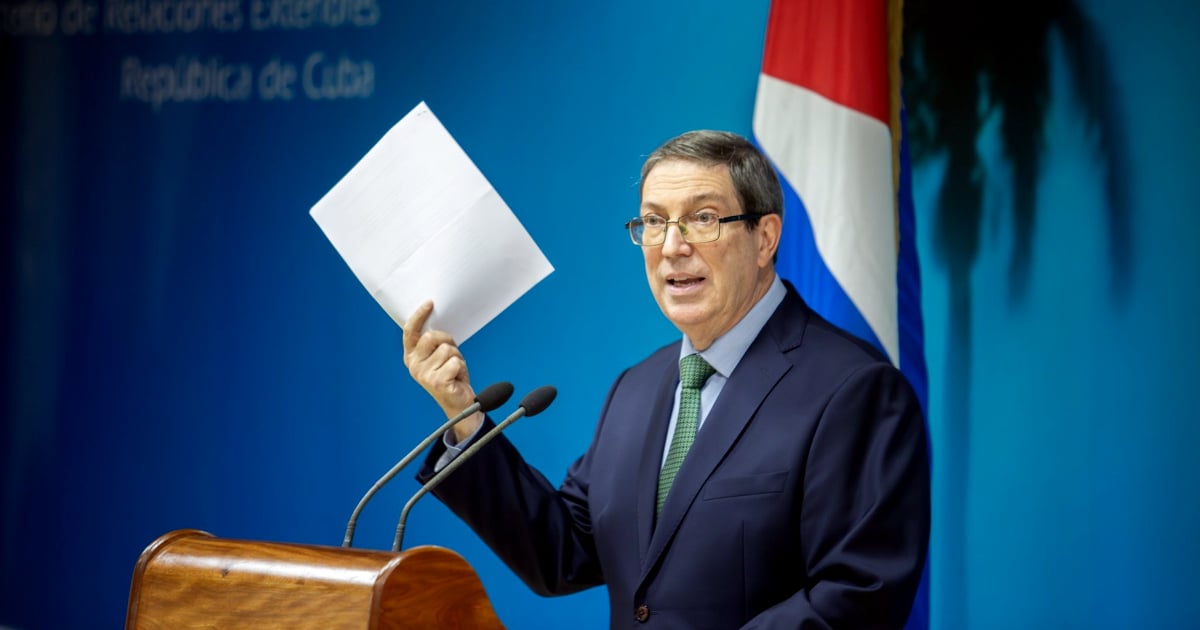
This Wednesday, Havana attempted to regain diplomatic momentum with an extensive press conference led by Foreign Minister Bruno Rodríguez Parrilla. The briefing was aimed at condemning the United States' strategy to influence the upcoming UN General Assembly vote on the embargo. Appearing visibly anxious, the Cuban regime's foreign minister called an extraordinary meeting with the international press, spending nearly an hour refuting U.S. accusations about the recruitment of Cuban mercenaries by Russia and denouncing what he termed a "campaign of blackmail and misinformation."
Rodríguez Parrilla accused Washington of exerting "brutal pressure" on Latin American and European governments to change their traditional support for Cuba. According to him, the U.S. State Department has been sending "threatening letters" to foreign ministries, urging them to vote against Havana during the October 29 session, which will once again debate the resolution titled "Necessity of ending the economic, commercial, and financial blockade imposed by the United States of America against Cuba."
A Repeated Defense with No Answers
Despite his speech being laden with ideological references and accusations against Washington, Rodríguez Parrilla avoided addressing the issues that have most tarnished the regime's international image: the involvement of thousands of Cubans in the Ukraine war serving the Kremlin. While denouncing U.S. arguments as false, the Cuban foreign minister extended his discredit and defamation to international media outlets like BBC, CNN, Deutsche Welle, Radio France, Reuters, Forbes, The Wall Street Journal, and others that, along with Ukrainian sources and the 'Quiero Vivir' project of that country's counterintelligence, have published testimonies and evidence documenting the systematic recruitment of Cuban citizens by the Russian army.
Although Rodríguez Parrilla dismissed the numbers reported — estimating between 5,000 and 20,000 Cubans enlisted in Russian forces — accumulated evidence over the last two years contradicts that denial. Ukrainian intelligence (HUR), along with organizations like Prisoners Defenders and independent media, have identified air routes from Varadero and Cayo Coco to Ryazan, contracts signed with the Russian Defense Ministry, and dozens of testimonies from recruits and their families.
International Pressure on the Upcoming Vote
Unlike previous years, when the UN vote was a routine affair with predictable outcomes, 2025 presents an unprecedented climate. The reinstated Trump administration has toughened its policy towards the Cuban regime and activated a diplomatic strategy to break the nearly unanimous consensus that has supported the resolution against the embargo for three decades.
An internal State Department cable, leaked by Reuters, instructed U.S. embassies to "convince allied governments and international partners to vote against or abstain," arguing that Cuba is the second-highest country, after North Korea, in providing foreign fighters for Russia. The document adds that Díaz-Canel's regime "has not protected its citizens from being used as pawns in the war of aggression" and that "its silence amounts to complicity."
Cuba Fears Losing Its Political Shield
The foreign minister's nervousness not only reflects the weight of the mercenary accusations but also Havana's real fear of losing its traditional support at the UN. Since 1992, the resolution against the embargo has been approved almost unanimously — 187 votes in favor in 2024 — with only the United States and Israel opposing. However, this time, the combination of factors — the war in Ukraine, human trafficking allegations, and Washington's diplomatic campaign — might fracture that majority, leaving the regime more isolated than ever.
In recent weeks, the U.S. Southern Command has increased its presence in the Caribbean, conducting joint naval maneuvers with the Dominican Republic, Barbados, and other regional partners, which Washington describes as a fight against drug trafficking and the Venezuelan state's capture by the Cartel of the Suns. However, in Havana and Caracas, these actions are perceived as an unequivocal warning.
An Exhausted Narrative
The Cuban regime continues to blame the embargo for all the island's economic woes, repeatedly citing the unverifiable figure of "more than $170 billion in losses" since 1960. However, studies from institutions like the Brookings Institution and Columbia University agree that these figures lack technical support and overlook a crucial fact: the United States remains one of Cuba's main suppliers of food and medical products.
According to the U.S. Department of Agriculture (USDA), Cuba imported $370 million in food and medicine from the United States in 2024, including frozen chicken, wheat, corn, and pharmaceutical supplements. Additionally, Cuban state and private companies have acquired American agricultural machinery, refrigerators, and industrial parts through authorized intermediaries, demonstrating that there is no "total blockade," but rather a financial and commercial sanctions system — primarily affecting businesses tied to the regime's GAESA umbrella — with clear humanitarian exceptions.
The contradiction between the rhetoric and the economic reality is increasingly visible. While Rodríguez Parrilla denounces a "genocidal siege," dozens of Cuban small and medium enterprises continue to import containers of U.S., European, and Latin American products, which are then resold in the domestic market at triple their purchase price.
FAQs on Cuba's Diplomatic Challenges
What is the significance of the upcoming UN vote for Cuba?
The upcoming UN vote is crucial for Cuba as it traditionally garners international support against the U.S. embargo. However, increased international pressure and allegations against Havana could alter this dynamic, potentially isolating the regime further.
How has the U.S. changed its approach to the Cuban embargo under the Trump administration?
Under the Trump administration, the U.S. has intensified its diplomatic efforts to break the longstanding consensus supporting Cuba at the UN by encouraging allies to vote against or abstain from the resolution condemning the embargo.