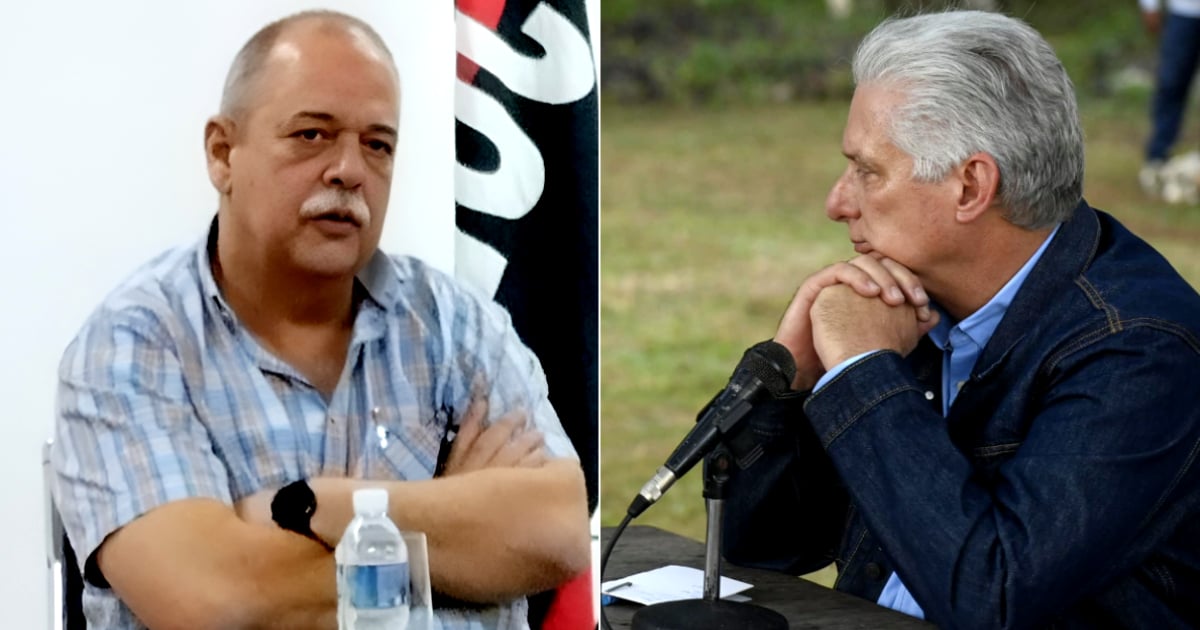
Since Vicente de la O Levy assumed the role of Minister of Energy and Mines on October 17, 2022, Cuba has experienced persistent electrical instability. His appointment was touted as a technical move aligned with the "continuity" narrative championed by Miguel Díaz-Canel, suggesting that the nation was tackling its crisis with skilled leadership. However, three years later, the reality paints a starkly different picture. The National Electric System (SEN) has undergone its worst period of blackouts and breakdowns since the notorious "Special Period."
During his tenure, the SEN has endured five national blackouts, energy deficits exceeding 1,700 megawatts, and concurrent failures at the country's major thermoelectric plants. De la O Levy has blamed these issues on fuel shortages, overdue maintenance, and "financial constraints," yet the outcome remains the same: an outdated, fractured grid incapable of meeting demand. What was once a declining system has now become a fully collapsed energy model.
The Disconnect: From Structural Blackouts to 'Bearable' Outages
De la O Levy's statements reveal a significant disconnect between government officials and the everyday realities of Cuban citizens. In May 2024, he claimed on television that "blackouts are now more bearable," a comment that sparked public outrage as it coincided with one of the year's most severe weeks—when some regions experienced power outages lasting up to 20 hours daily. This was not a metaphor but rather an uncomfortable normalization of suffering, framed under a narrative that valorizes endurance as a virtue.
In the months that followed, his rhetoric became predictable: partial acknowledgments, promises of recovery, and subsequent failures. By September 2024, he declared the system "weak, but not on the verge of collapse." Yet, just a month later, the SEN completely failed, leaving the entire island in darkness. By September 2025, he once again justified the situation, stating, "Without the solar parks, things would be worse."
Technical Demagoguery as a Political Tool
Few figures in the current Cuban cabinet wield the art of empty technocratic language as deftly as De la O Levy. During the International Renewable Energy Fair in September 2024, he made a now-famous statement: "Producing 30% of energy from renewable sources is no easy feat. It involves millions of photovoltaic solar panels, hundreds of millions of screws, nuts, washers, steel structures... thousands upon thousands of pilings to drive."
Rather than offering a concrete plan, the minister consistently resorts to rhetoric emphasizing scale and difficulty, as if an overload of figures justifies inaction. The "tubes," "nuts," and "pilings" have become involuntary symbols of a bureaucratic system that confuses quantity with efficiency. Meanwhile, thermoelectric plants crumble, and the public listens in disbelief to explanations more suited to a theatrical performance than a ministerial report.
The Illusion of Renewable Energy Solutions
De la O Levy has attempted to position himself as a champion of an "energy transition," yet renewable sources contribute less than 10% to national generation, with most solar parks operating without storage batteries. Each newly inaugurated project is heralded as a historic success, despite its negligible impact on a structural deficit amounting to thousands of megawatts.
In his vision, Cuba's energy future is perpetually five to ten years away. In 2024, he promised that by 2030, the country would produce 30% of its energy from clean sources. However, these goals lack financial and technological backing and clash with the reality of a state unable even to ensure diesel supply for its distributed generators. The so-called "energy transition" is merely a narrative crafted to buy time and quell social unrest.
Numbers That Define the Crisis
The Ministry of Energy and Mines (MINEM) itself has acknowledged that thermal generation is in a permanent state of crisis. Power plants like Guiteras, Renté, Felton, and Nuevitas operate well below their nominal capacity; maintenance is performed with recycled materials, and technical staff work without basic resources. The Cuban oil they consume has a high sulfur content, leading to frequent shutdowns for cleaning and maintenance.
In 2025, blackouts once again spread across the country, with the SEN experiencing its fifth national collapse in less than a year. Recently, the minister admitted that "fuel is insufficient for the entire month" and that many units remain idle due to a "lack of parts." The paradox is glaring: while oil is exported or resources are diverted to propaganda projects, the country fails to keep even half of its electrical grid running. The SEN persists not through engineering, but inertia.
Ramiro Valdés: A Heavy-Handed Approach Without Light
Amidst this scenario, the regime turned to an iconic figure: Ramiro Valdés Menéndez, a historical commander, former Minister of the Interior, and one of the architects of the country's harshest political repression. His appointment as a supervisor of the electrical sector was portrayed as an effort to "ensure discipline and efficiency," but in reality, it underscored the civil government's inability to resolve a technical crisis and its reliance on fear and coercion for results.
Valdés is neither an engineer nor an energy specialist. His presence serves another purpose: control. Known for his stern demeanor, his history as head of the Ministry of the Interior (MININT), and his role in digital censorship make him a figure of formidable authority within the regime, yet irrelevant in salvaging a collapsed electrical system. His involvement signals a political maneuver: when technique and management fail, power turns to coercion. Instead of repairing plants and modernizing infrastructure, the crisis becomes militarized, transforming what should be an energy policy into an exercise in obedience.
Social Impact: Living in the Dark
More than a technical event, blackouts have become a daily experience. The lack of electricity affects health, education, and food. Hospitals suspend operations, schools interrupt classes, and neighborhoods endure days without functioning water pumps. Lines form at the few places with power, and empty refrigerators have become symbols of domestic collapse.
CiberCuba has documented spontaneous protests across virtually all provinces. Neighbors shout "We want light!" and bang pots while local authorities dispatch patrols to suppress the discontent. Each prolonged blackout not only extinguishes a bulb but also ignites awareness of the state's failure.
Impunity as a Model
Vicente de la O Levy has neither been removed nor sanctioned. His continued leadership at the MINEM is a political choice by Miguel Díaz-Canel, who values loyalty over efficiency. The minister serves as the technical face of a policy that prioritizes control over results. In Cuba, positions are maintained through obedience, not performance.
Thus, the problem extends beyond the official. The root of the energy collapse lies in a centralized model that stifles any entrepreneurial initiative and reduces management to an act of propaganda. There are no independent audits or transparency in figures. Each time the system fails, the government promises a "new beginning," yet nothing essential changes.
Ultimately, Cuba's energy collapse is neither a mere accident nor solely the result of external factors. It is the direct consequence of years of neglect, underinvestment, and political exploitation of public resources. Vicente de la O Levy, with his rhetoric of pipes, screws, and endurance, embodies a continuity of failure that Díaz-Canel manages with resignation and propaganda.
While the government repeats its mantra of "creative resistance," the population remains in the shadows, trapped between material decay and misinformation. The blackout has become permanent not only in homes but also in the public sphere. And although promises or slogans may change, darkness remains the most accurate metaphor for power in Cuba.
Understanding Cuba's Energy Crisis
What has been the impact of Vicente de la O Levy's leadership on Cuba's energy system?
Vicente de la O Levy's tenure has been marked by persistent instability in the National Electric System (SEN), with frequent blackouts and system failures that have severely affected daily life in Cuba. His leadership has not brought about the promised improvements, and the energy system continues to face significant challenges.
How has the Cuban government responded to the energy crisis?
The Cuban government has largely responded with rhetoric and promises rather than substantial action. Figures like Vicente de la O Levy have used technocratic language to understate the crisis, while political figures like Ramiro Valdés have been brought in to exert control rather than implement technical solutions.
What role does renewable energy play in Cuba's energy strategy?
Renewable energy in Cuba contributes less than 10% to the national grid, and many solar parks lack storage capabilities. While the government promotes a transition to renewables, the impact remains minimal due to insufficient financial and technological support.
Why is the energy crisis in Cuba considered a political issue?
The energy crisis in Cuba is seen as a political issue because it stems from systemic neglect, lack of investment, and the political manipulation of resources. The government's focus on control and propaganda over genuine solutions has exacerbated the situation, making it more of a policy failure than a purely technical problem.