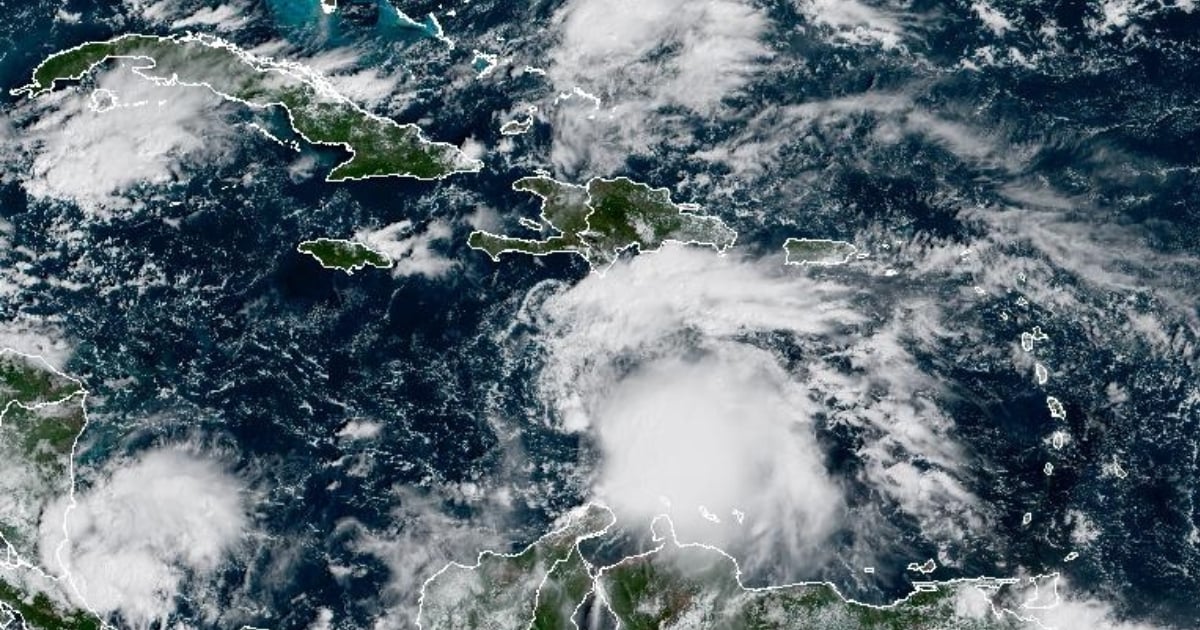
On Tuesday, Tropical Storm Melissa emerged in the Caribbean Sea, introducing a new weather system that is expected to impact the region's climate over the coming days. This phenomenon developed after days of monitoring an active tropical wave in the warm waters of the central Caribbean.
The National Hurricane Center (NHC), through its official account on X, announced that advisories on Melissa would commence at 11:00 AM Eastern Time (15:00 UTC). The agency reported that the storm's center is located at latitude 14.3 north and longitude 71.7 west, approximately 480 kilometers south of Port-au-Prince, Haiti.
Melissa is currently sustaining maximum winds of 85 kilometers per hour, with higher gusts, and has a central minimum pressure of 1003 millibars. The storm is moving westward at a speed of 22 kilometers per hour, and projections suggest it could strengthen over the next 48 hours as it progresses through the central Caribbean.
Warnings and Watches Issued
The NHC has issued a hurricane watch for the southern peninsula of Haiti, stretching from the border with the Dominican Republic to Port-au-Prince. Additionally, the government of Jamaica has declared a tropical storm watch for the entire island. These alerts indicate that hurricane or tropical storm conditions might be experienced within the next two days.
While Cuba is not currently within the direct path's cone in the initial hours, meteorological authorities advise heightened awareness in the eastern region of the country due to potential heavy rains, swells, and gusty winds if the system veers further north.
Potential Impact on Cuba
The projected path includes areas near Jamaica and Haiti between Wednesday and Thursday, with the potential to reach hurricane strength before the weekend if atmospheric conditions remain favorable. Long-term forecasts suggest that Cuba should remain vigilant as it could experience impacts from the storm.
In a previous update, the NHC noted that a large area of low pressure organizing in the central Caribbean Sea was on the verge of becoming a tropical storm with significant impact potential for several Caribbean islands, including Cuba.
Forecast Models and Observations
According to the bulletin issued at 8:00 AM Eastern Time, the tropical system classified as AL98 was projected to evolve into Tropical Storm Melissa on the same day, marking the thirteenth storm of the current hurricane season. Meteorological models indicate that Cuba is within the range of possible paths, increasing the likelihood of heavy rainfall, strong winds, and flooding in the coming days.
Early Tuesday, Canadian model forecasts (GEPS) suggested various scenarios, including a possible direct impact on the island, with an estimated minimum pressure as low as 982 millibars, indicating a strong tropical storm or even a hurricane. Satellite, radar, and surface observations revealed that the system had a well-defined center, a crucial feature in the transition from low pressure to a tropical storm.
Additionally, it was already producing sustained winds of up to 45 miles per hour (72 km/h), exceeding the minimum threshold required for classification as a tropical storm (39 mph or 63 km/h).
Frequently Asked Questions About Tropical Storm Melissa
What areas are currently under a hurricane watch due to Tropical Storm Melissa?
The National Hurricane Center has issued a hurricane watch for the southern peninsula of Haiti, from the border with the Dominican Republic to Port-au-Prince.
Is Cuba expected to be directly impacted by Tropical Storm Melissa?
While Cuba is not currently in the direct path's cone, there is a possibility of heavy rains, swells, and strong winds, especially in the eastern region, if the system shifts further north.
What is the current strength and movement of Tropical Storm Melissa?
Melissa is sustaining maximum winds of 85 kilometers per hour and is moving westward at 22 kilometers per hour. It is expected to strengthen over the next 48 hours.