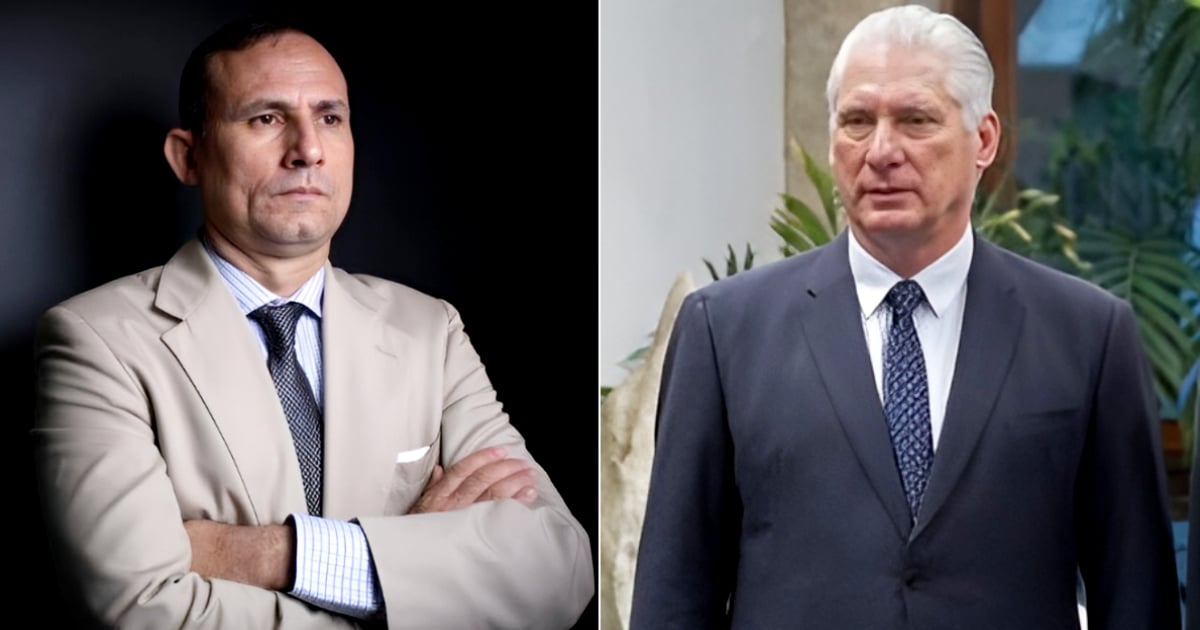
Recently arrived in Miami after enduring years of imprisonment and repression in Cuba, Cuban opposition leader José Daniel Ferrer García has issued a scathing critique of Miguel Díaz-Canel and the power structure still ruling the island. In a statement shared on his social media, the founder of the Patriotic Union of Cuba (UNPACU) argued that the current head of state didn't inherit the presidency due to Raúl Castro's detachment from power. Instead, Ferrer claims it was a strategic move to make Díaz-Canel the face of the Castro regime's ultimate failure.
“Raúl Castro certainly didn’t hand over the presidency to Díaz-Canel out of a desire to step back from power. No, no, no. He did it so Díaz-Canel would be remembered as worse than Fidel and Raúl themselves; as more ruthless and incompetent, as the one responsible for the nation’s collapse and for imprisoning and torturing the most dissidents and unhappy citizens,” Ferrer wrote.
With these remarks, Ferrer described what he considers a "political trap" laid by the Castro brothers to safeguard their legacy while shifting the historical burden of the regime's downfall onto Díaz-Canel. "The Castros have set him up for failure," he asserted.
The Face of Collapse
Since arriving in exile, Ferrer has ramped up his public statements, directly targeting those who maintain control over Cuba's political and economic spheres. His latest message aligns with this critical approach.
Ferrer believes that Díaz-Canel, officially introduced as a civilian successor to the Castro regime, is actually a "sacrificial pawn" within the power network overseen by Raúl Castro and the generals of GAESA. According to Ferrer, the regime orchestrated the transition so that the blame for the economic, political, and social crisis would fall on Díaz-Canel, while the true power holders retreated into the background.
“When the people say: ENOUGH!, his only option will be to flee far away, to Moscow or Beijing,” Ferrer warned, suggesting that Díaz-Canel, seen as a puppet of the Castros, might end up escaping like other communist leaders did when their systems collapsed.
A Parallel with the Soviet Collapse
Ferrer drew a direct parallel between the current situation in Cuba and the Soviet Union in the late 1980s. “If I were him, I’d gather all the courage I could and do what Gorbachev did in Russia. There’s no better option,” Ferrer suggested, comparing the Cuban leader to the last head of the USSR, whose reform efforts precipitated the dissolution of the communist system.
Ferrer’s reference to Gorbachev is no accident. He believes only real reform—economically, politically, and socially—could prevent a larger upheaval in Cuba. However, he expressed doubt that Díaz-Canel possesses the independence or bravery required to pursue such a path.
Critique of Castroism's Continuity
Ferrer has repeatedly emphasized that the real power in Cuba remains concentrated among the old military guard and the business interests of the GAESA conglomerate, controlled by the Castro family. In recent statements from Miami, he reiterated, “Raúl Castro has not retired, and Díaz-Canel merely carries out orders, trying to sustain an unworkable system.”
Having been a prominent political prisoner during the "Black Spring" of 2003 and founder of UNPACU, Ferrer endured years of persecution, harassment, and torture. His release in 2025 came with the condition of accepting exile, a tactic the regime uses to neutralize critical voices within the country.
Nevertheless, Ferrer has made it clear that his exile does not equate to abandoning the struggle: “The fight for Cuba’s freedom continues, both inside and outside the island,” he has repeatedly stated.
A Message to Cubans and the World
Ferrer’s new message to Díaz-Canel is part of a broader communication strategy aimed at reigniting the debate on the nature of power in Cuba and the role of the presidency in a system still dominated by the Castro family. Ferrer appeals to both the Cuban people and the international community to “not be fooled by changes in facade” and to recognize that the repression remains unchanged, even if the faces do.
A Voice Resurgent from Exile
After years of enforced silence, José Daniel Ferrer’s media resurgence confirms that exile has rekindled his activism. From Miami, he continues to send messages to the island and maintains contact with UNPACU networks and other opposition groups and organizations.
His analysis of Díaz-Canel’s role within Castroism offers a stark perspective: the regime hasn’t transitioned power, but rather transferred responsibility. In this scenario, Ferrer asserted, the outcome seems inevitable. “The Castros have set him up for failure. They left him in charge of a ship that’s already sinking,” wrote the opposition leader, encapsulating in one sentence what could be his definitive reading of Cuba’s political moment.
Díaz-Canel's Role and Cuba's Future
What is José Daniel Ferrer's view on Díaz-Canel's presidency?
Ferrer believes Díaz-Canel is a "sacrificial pawn," set up by the Castros to take the blame for the regime's failures and eventual collapse.
How does Ferrer compare the current Cuban situation to the Soviet Union?
Ferrer draws a parallel between Cuba’s current state and the Soviet Union's collapse in the late 1980s, suggesting Díaz-Canel should emulate Gorbachev's reformist approach.