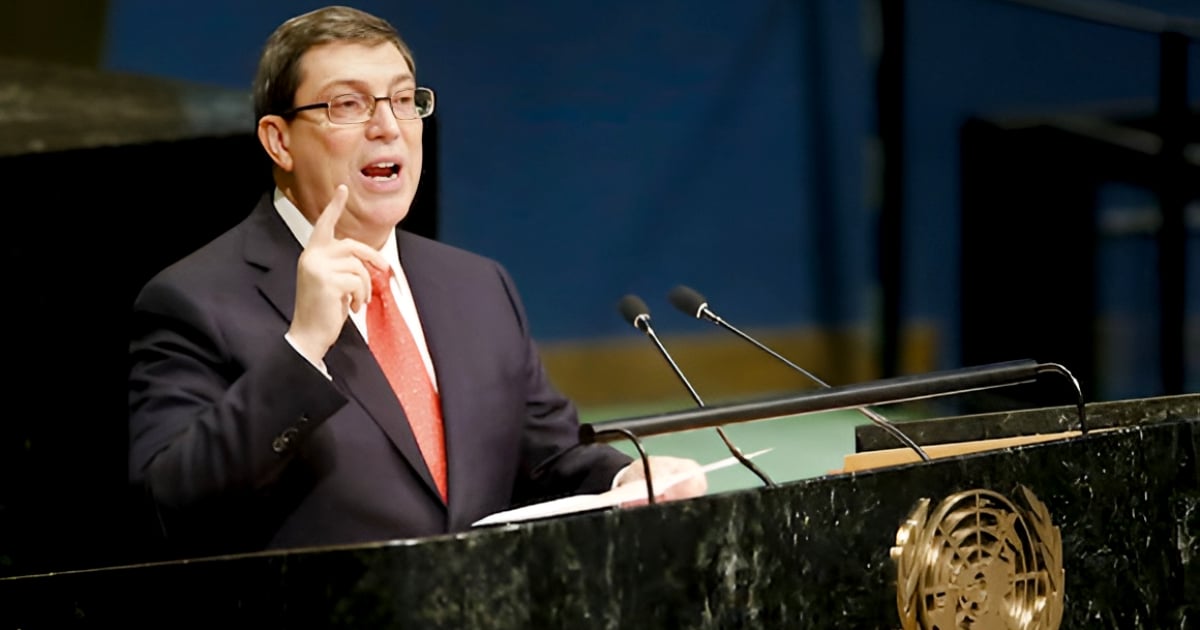
The Cuban regime has reignited its diplomatic machinery for another symbolic vote at the United Nations. On October 24, the Cuban Association of the United Nations (ACNU)—an organization under the control of the Ministry of Foreign Affairs (MINREX)—will host the XXI Forum of Cuban Civil Society Against the Blockade. This event is part of the customary prelude to the annual resolution calling for an end to the U.S. embargo.
In its official statement, the Cuban Foreign Ministry reiterates the familiar narrative: the embargo "violates fundamental human rights," "hinders development," and has caused "losses of $7.556 billion in the last year" and "accumulated damages of $170.677 billion at current prices, equivalent to $2.1 trillion at gold value." However, no independent source has been able to verify these figures, and the Cuban regime has never published a methodology to substantiate them.
The alleged "accumulated losses" are based on internal calculations mixing historical prices, hypothetical growth rates, and conversions to gold value, lacking academic support or transparency.
Challenging the Data
Academic reports and international organizations dismantle parts of this narrative. A study by the Latin American Studies Center at Columbia University (2022) estimated that the embargo might reduce Cuba's annual GDP growth by between 0.5 and 1 percentage point. However, it highlighted that the primary causes of economic stagnation are internal: low productivity, lack of structural reforms, state centralization, and disinvestment.
Similarly, the Brookings Institution (2021) concluded that even without sanctions, "the Cuban economic model would remain inefficient due to the dominance of state enterprises and limited openness to foreign capital."
Despite the rhetoric of a "total blockade," Cuba maintains a steady trade volume with the United States, particularly in food and medicine. According to the U.S. Department of Agriculture (USDA), U.S. exports to Cuba exceeded $370 million in 2024, mainly in frozen chicken, soybeans, corn, and wheat. The United States is currently one of the top five food suppliers to the Cuban market.
Reality of Cuban Trade
Additionally, the State Department has reiterated that the embargo does not prevent the sale of food, medicines, or humanitarian equipment, provided the Cuban government pays in cash. In 2023, the U.S. embassy in Havana reported that medical exports to the island exceeded $800 million, double that of 2021, debunking the argument that sanctions block access to pharmaceuticals.
The State Department emphasized in August 2025 that "Cuba's real problem is not the embargo but the country's political system," noting that U.S. sanctions target primarily the regime's military and security apparatus, not the Cuban people. This policy is reflected in the updated list of restricted entities as of February 2025, which bans transactions with companies controlled by the armed forces and the GAESA conglomerate but does not restrict private trade by so-called Mipymes or humanitarian imports.
Diplomatic and Propaganda Offensive
The forum convened by ACNU is part of the annual propaganda cycle culminating in the Cuban resolution vote at the UN General Assembly. Every year, Havana mobilizes its "civil society" organizations—all under state control—to project the image of a nation besieged by an unyielding enemy.
Foreign Minister Bruno Rodríguez Parrilla insists the embargo "violates the human rights of the Cuban people" and causes "an unquantifiable psychological suffering." Yet, he neglects to mention that 80% of Cubans born under socialism also did so under an inefficient, centrally planned economic system that stifles private initiative and maintains state dependency.
Washington Shifts Its Focus
This year, the Donald Trump administration has decided to break the diplomatic tradition that since 1992 has given Cuba a symbolic victory at the UN. An internal State Department cable, leaked to Reuters, instructed U.S. embassies to persuade allied countries to abstain or vote against the Cuban resolution, arguing that Havana can no longer present itself as a victim but as an accomplice of Russia in its war against Ukraine.
The document claims that "after North Korea, Cuba is the largest contributor of foreign troops to Russian aggression," with between 1,000 and 5,000 Cubans integrated into Moscow's military units.
The True Blockade
In the halls of MINREX, the "blockade" remains a sacred term. Year after year, with calendar-like precision, the Cuban diplomatic apparatus revives the crusade against the U.S. embargo as if it were a national cause. And every year, the regime repeats the same choreography: inflated figures, victimizing speeches, and "civil society" forums where no one dissents.
Havana needs to keep this external enemy alive. Without it, the nakedness of a system that no longer convinces even its own would be exposed. The narrative of the "blockade" functions as the mirror where power projects its historical justification: if there's hunger, it's the embargo's fault; if there are blackouts, it's the blockade; if the youth leaves, it's the same. Anything but its own failure.
However, reality imposes itself harshly. While Foreign Minister Bruno Rodríguez denounces a "genocidal economic war" at the UN, the regime itself purchases food, medicines, agricultural machinery, and industrial equipment from the United States, its supposed enemy.
The real blockade—the one that hurts, suffocates, and drives millions of Cubans into exile—is not signed in Washington but in Havana. It is the blockade of fear, censorship, and double standards; the blockade of a system that refuses to relinquish power even as the country crumbles around it.
Understanding the U.S. Embargo on Cuba
What is the primary goal of the U.S. embargo on Cuba?
The primary goal of the U.S. embargo is to pressure the Cuban government to improve human rights and democratic reforms by restricting trade and economic activities.
How does the embargo affect Cuban citizens?
While the embargo targets the Cuban government's military and security apparatus, it indirectly affects Cuban citizens by limiting economic opportunities and access to goods, although essential items like food and medicine are exempt.
Has the U.S. embargo been effective in achieving its goals?
The effectiveness of the embargo is debated. While it has put pressure on the Cuban government, it has not resulted in significant democratic reforms, and critics argue it may fortify the regime's control by providing a scapegoat for economic issues.