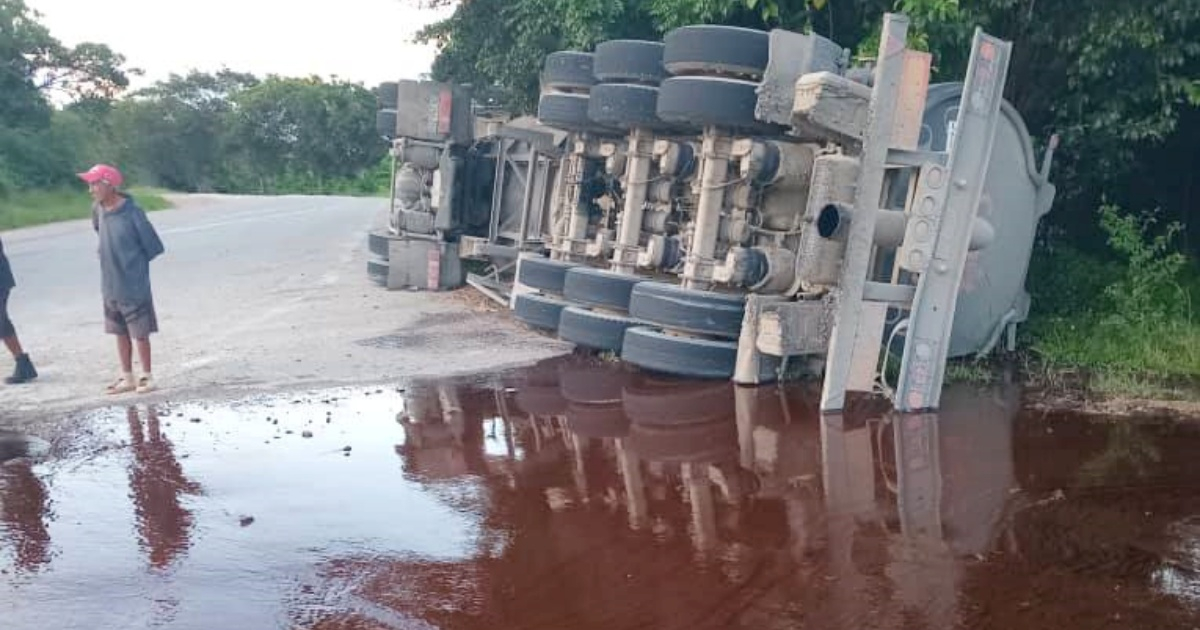
A tanker truck owned by the state-run company TRANSCUPET overturned on the afternoon of October 20, 2025, along the Vía Blanca near the turn-off to Puerto Escondido in Mayabeque province. This incident led to a spill of more than 31,000 liters of crude oil. According to a statement from Cuba Petróleo (CUPET) on their official Facebook page, the event took place around 6:40 p.m. when the driver of the vehicle, a trailer with the license plate B 256192, lost control while merging onto the secondary road leading to the coastal town.
The driver, who was transporting fuel from the wells to the Puerto Escondido battery, sustained injuries but is not in life-threatening condition. He was promptly taken to a medical facility in Santa Cruz del Norte for specialized care.
Emergency Response to Oil Spill
The impact resulted in the complete overturn of the truck and the subsequent oil spill on the road. Within minutes, specialized teams from CUPET were dispatched to contain the leak and recover some of the spilled fuel. Representatives from the Ministry of the Interior (MININT) and senior officials from the oil company arrived at the scene to oversee cleanup efforts and investigate the causes of the accident, which are still under official review.
The company stated that they are "working on mitigating the consequences caused by the spill," although specific details about the environmental impact in the area have not been disclosed yet.
Public Reactions and Concerns
CUPET's announcement prompted numerous comments online, with many expressing relief for the driver's survival, although criticisms about road conditions and vehicle maintenance were also prevalent. "The most important thing is that there were no human losses," wrote one user, echoing a common sentiment. Another added, "The best part is that life was preserved," while many offered thanks and prayers: "Thank God the driver was unharmed. Lord, have mercy on our Cuba."
Nonetheless, some users questioned the training of drivers and the technical condition of state-owned transportation. "I believe drivers lack the proper qualifications to handle vehicles carrying liquids; it's different from static loads," one commented. Another noted, "This only happens due to speeding," while someone suggested, "Check the GPS and see what speed he was going, because he was carrying over thirty tons."
Issues with Roads and Driver Fatigue
A significant part of the discussion focused on the poor state of Cuban roads, particularly in the Mayabeque region. "Given how bad the road is and how worn those tires are, it's a relief the damage wasn't worse," remarked one person. Another added, "The causes are the bad conditions of Cuba's streets and roads... you can see a pothole filled with crude right there," highlighting also the exhaustion drivers face after long shifts: "They drive all day, and when they get home, they can't rest, with no power, heat, and mosquitoes."
Others recalled that this isn't the first time a similar accident has occurred in that area. "Common accidents on that stretch; I worked for the company, and we lost colleagues under the same conditions," shared one user. "There's a massive pothole there," agreed another, while someone noted that "the tires couldn't be more worn out."
Amidst the concern, several comments reflected the ironic and resigned tone with which many Cubans face the energy crisis. "In a country that doesn't have even a bit of oil to light charcoal, it's incredible that an entire tanker is allowed to spill," lamented one user.
This isn't the first such incident in the area. Drivers and former workers in the petroleum sector point out that the Puerto Escondido zone is particularly hazardous due to deteriorating pavement, deep potholes, and lack of signage. According to accounts on social media, accidents are frequent, and transporters must endure long routes, poor rest, and minimal vehicle maintenance, all factors that increase the risks.
As of the close of this report, CUPET has not provided further details regarding the causes of the accident or the material losses. The company confirmed that recovery and cleanup efforts continue to eliminate the risks associated with the spill. The case is under joint investigation by the Ministry of the Interior and oil company technicians, who will determine whether the accident resulted from mechanical failure, speeding, or human error.
Frequently Asked Questions about the Oil Spill in Cuba
What caused the tanker truck to overturn?
The tanker truck overturned when the driver lost control while merging onto a secondary road. The exact cause is under investigation, but factors such as road conditions, vehicle speed, and driver fatigue are being considered.
What is being done to manage the oil spill?
Specialized teams from CUPET have been deployed to contain the leak and recover some of the spilled oil. Cleanup efforts are ongoing to mitigate the environmental impact.
How have the public reacted to the incident?
Public reactions have included relief for the driver's safety and criticism of road conditions and state transport maintenance. Concerns about driver training and vehicle conditions have also been raised.