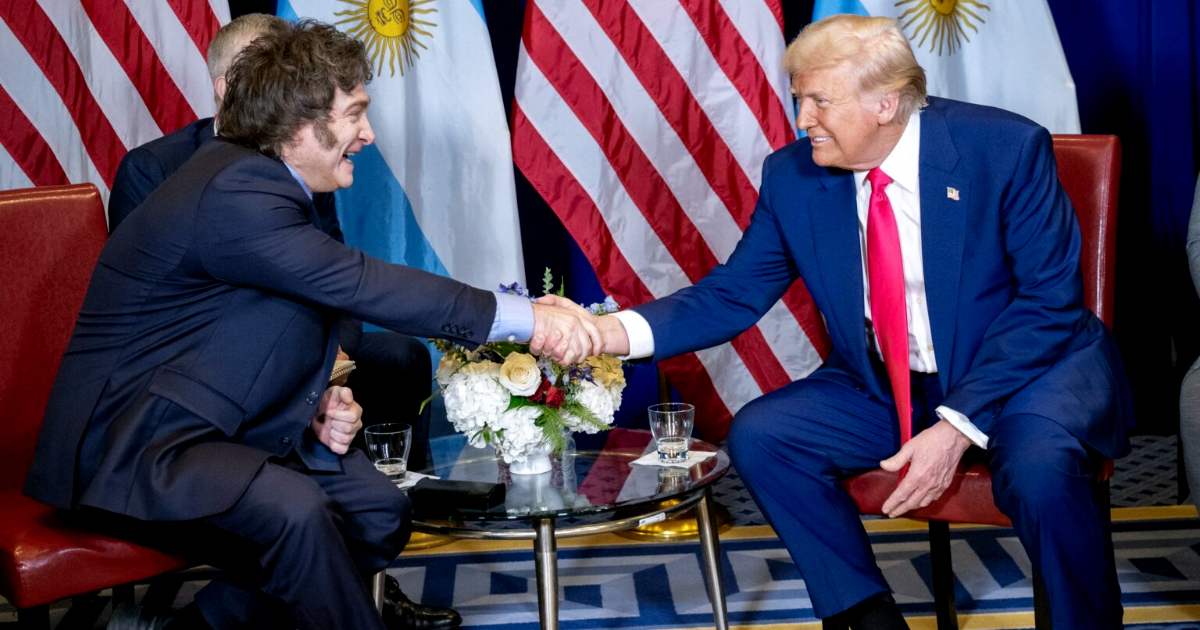
On Sunday, U.S. President Donald Trump revealed that his administration is contemplating the importation of Argentine beef as part of a strategy to decrease domestic market prices and ease the inflation impacting American consumers. According to the Associated Press, Trump made this announcement aboard Air Force One during his return flight from Florida to Washington.
"We might buy some beef from Argentina," stated the President. "If we do, that will bring down meat prices here," he added. A few days prior, Trump had pledged to take measures to control inflation, which has been driven by the rising costs of essential goods like food.
Addressing the Meat Price Hike
Meat prices in the United States have remained high due to droughts affecting livestock and a reduction in imports from Mexico, where a cattle plague has forced export limitations. The proposal to import Argentine beef aims not only to stabilize the U.S. market but also to politically support President Javier Milei, who is grappling with a severe economic crisis and the devaluation of the Argentine peso.
Trump has been advocating for a $20 billion credit line agreement with Buenos Aires, alongside additional financing from sovereign and private sector funds, to support Milei's government before Argentina's midterm legislative elections.
Implications of a Policy Shift
The potential purchase of Argentine beef would mark a shift in U.S. trade policy, which has traditionally protected its domestic beef industry. However, Trump emphasized that "the priority is the American people's wallets," and any decision "will be made with the consumers and price stability in mind."
If realized, this measure could have a dual effect: aiding Milei in stabilizing his economy through foreign currency inflows and providing relief to American consumers amid the rising cost of living.
Political and Financial Context
In September, U.S. Treasury Secretary Scott Bessent stated that Washington was prepared to take necessary steps to support the Argentine economy and President Javier Milei. His comments came amid a tense political and financial atmosphere in Argentina, following Milei's party, La Libertad Avanza (LLA), suffering a significant defeat in the Buenos Aires provincial legislative elections on September 8.
Bessent remarked, "Argentina is a systemically important ally for the U.S. in Latin America, and the Treasury Department is ready to do what is necessary within its mandate to support the country. All stabilization options are on the table," he wrote on his official X account.
Recently, during a visit by Javier Milei to the White House, President Trump confirmed a $20 billion economic rescue for Argentina. However, he set a condition: the support hinges on the election outcome in the South American nation. "If he loses, we will not be generous with Argentina," Trump declared in front of the cameras, highlighting that the support is conditional and politically motivated.
Exploring the Impact of Argentine Beef Imports
Why is the U.S. considering importing beef from Argentina?
The U.S. is considering importing beef from Argentina to help lower domestic meat prices and alleviate inflation affecting American consumers.
What challenges are contributing to high meat prices in the U.S.?
High meat prices in the U.S. are driven by droughts affecting livestock and a decrease in imports from Mexico due to a cattle plague.
How could importing Argentine beef affect the U.S. market?
Importing Argentine beef could stabilize the U.S. market by reducing prices and providing relief to consumers amidst rising living costs.