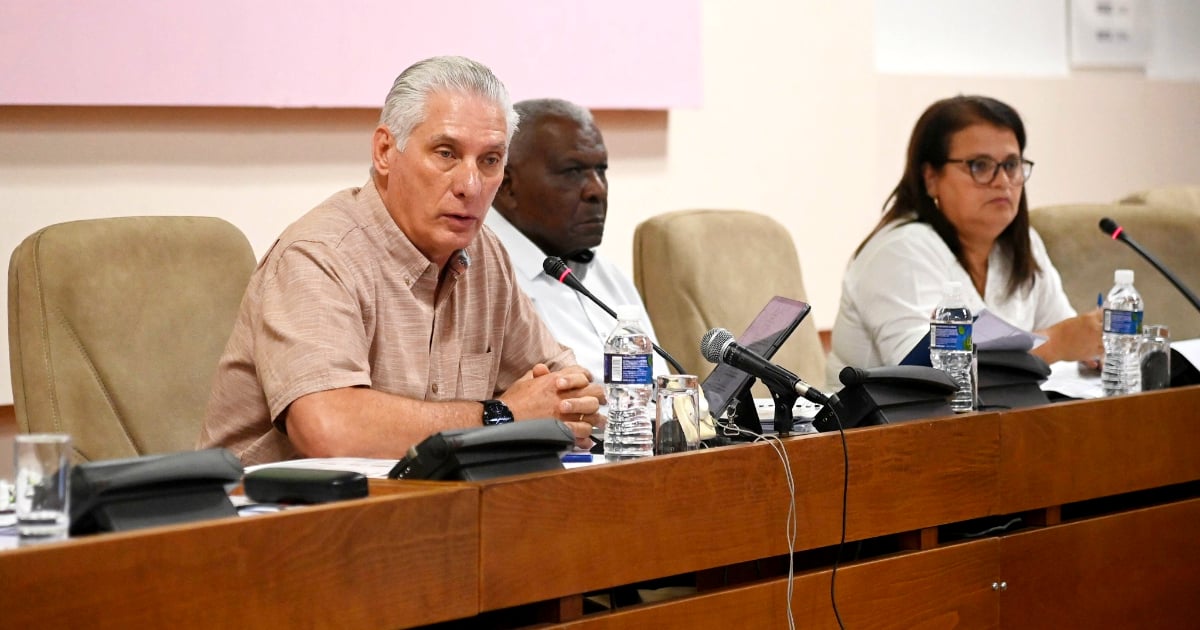
A recent announcement from the Cuban government, delivered with an air of enthusiasm, introduced an "offensive for a better capital," spearheaded by President Miguel Díaz-Canel, aiming to enhance essential services in Havana. The message, articulated by Leticia Martínez Hernández, the head of press at the Presidential Palace, described this initiative as a coordinated effort involving the State, the Communist Party, local agencies, and "the people of Havana" to restore the city's image and improve residents' quality of life.
However, upon a closer examination of both the content and the tone of this announcement, it appears less as a genuine management report and more as a propaganda exercise. This aligns with the Cuban regime's longstanding communication strategy: glorifying the leader, deflecting responsibility to lower levels, and projecting an image of efficiency even amidst systemic failure.
The figures presented in the announcement seem crafted to uphold this narrative rather than provide transparent information. It claims 32,484 individuals have recently benefited from improved water supply, and 267,787 cubic meters of solid waste have been collected in the capital. Nonetheless, the report lacks context, failing to specify the timeframe for these achievements, the prior conditions, or how the sustainability of these actions is assessed.
The Discrepancy Between Announcement and Reality
The announcement itself acknowledges that in several municipalities, water distribution cycles exceed ten days—a statistic that would trigger immediate crisis intervention in any other city, demanding urgent solutions from the populace.
In the energy sector, the official message mentions "better planning of blackouts," yet omits details about the frequency, duration, or impact of these outages on Havana's daily life. Recent reports from the Electric Union and independent media confirm ongoing daily outages, even in central areas, due to generation deficits and transformer failures. While the claim of improved planning might be technically accurate—perhaps the blackouts are announced more systematically—it doesn't imply that the issue has been resolved. On the contrary, it highlights the Cuban government's perception of its management: Díaz-Canel presents a "better-planned blackout" as an effective management solution to the energy crisis.
A Political Spin on Infrastructure Issues
The language used in the announcement underscores its political nature. Terms like "offensive," "checks," "rigor," and "priority" echo the military-style approach historically used by the Cuban State to convey control and discipline in civil management.
Díaz-Canel's prominence as the central figure, accompanied by top Party officials, aligns with the triumphant narrative: the leader directs, oversees, and demands results with authority, while subordinates rectify errors. Martínez Hernández's message highlighted collective effort and the ongoing oversight of the top leader, yet omitted a crucial element: concrete results.
There was no mention of resource shortages, infrastructure obsolescence, or the inefficiency of state-run service companies. Nor were the structural causes of the problems addressed, ranging from administrative centralization to corruption and the decline of public investment. In this context, the announcement served a distinctly political function: managing the perception of the crisis.
Propaganda or Genuine Progress?
The "offensive" is not merely a material operation but a discursive mechanism aimed at reclaiming narrative initiative amid deep public dissatisfaction. The staging of meetings, checks, and directives seeks to convince the population that the State remains in control, even as living conditions continue to deteriorate.
The text lacks a genuine accountability report or a verifiable description of events. Instead, it offers a carefully constructed story to uphold the legitimacy of leadership and the notion that resolution once again hinges on work, discipline, and loyalty to the Party.
The unintended conclusion from Martínez Hernández is that the Cuban regime persists in using its old political propaganda tactics to mask structural deficiencies. Rather than acknowledging the magnitude of Havana's service crisis, the official discourse prefers to emphasize the rhetoric of effort and oversight. Yet the narrative of constant action doesn't replace actual results: streets remain littered with garbage, blackouts persist, and water supply remains inconsistent.
The "offensive" might be vigorous in the media landscape, but in the everyday reality of Havana's residents, the capital still awaits improvements that have yet to materialize.
Insights on Havana's Infrastructure Crisis
What is the "offensive for a better capital" in Cuba?
The "offensive for a better capital" is a government initiative, led by President Miguel Díaz-Canel, aimed at improving essential services in Havana, such as electricity, water supply, waste collection, and urban maintenance.
Why is the Cuban government's announcement considered propaganda?
The announcement is viewed as propaganda because it emphasizes the leadership's efforts and control while lacking transparency about the actual progress and challenges, thus maintaining a narrative of effectiveness amidst ongoing systemic failures.
How does the government justify the ongoing blackouts in Havana?
The government claims improved planning of blackouts, suggesting better organization in announcing them, but does not address the underlying issues causing the energy crisis, such as generation deficits and infrastructure failures.
What are the structural problems affecting Havana's public services?
Havana's public services suffer from structural issues like administrative centralization, corruption, outdated infrastructure, and inadequate public investment, leading to persistent service disruptions and inefficiencies.