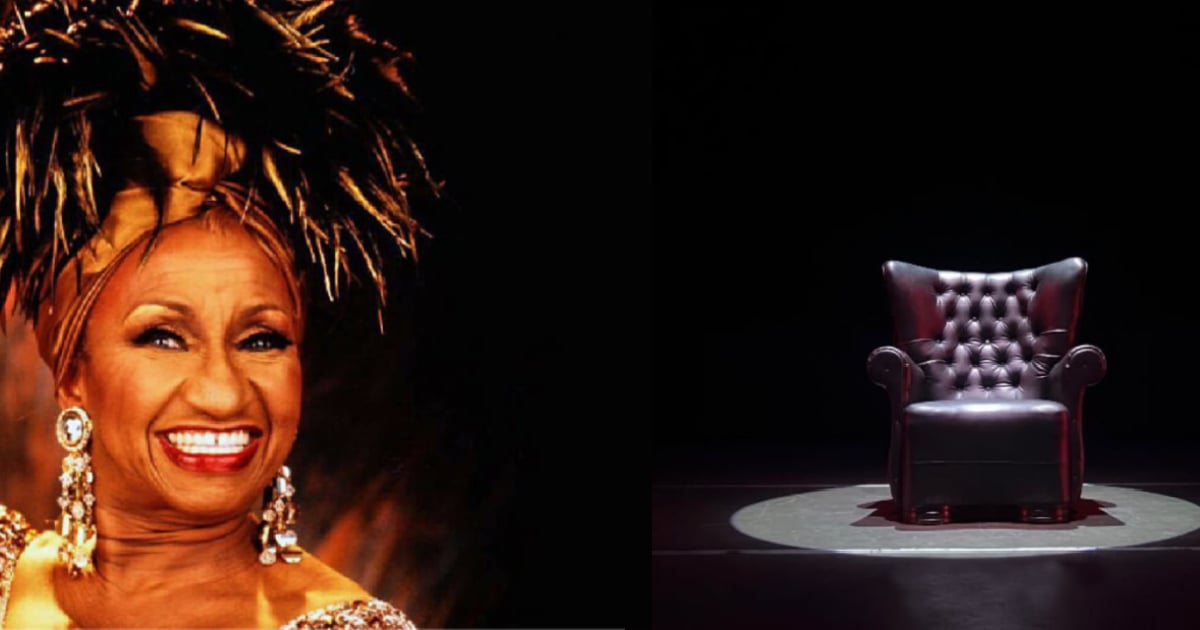
In a powerful statement against state censorship, the Cuban Art Factory (FAC) responded to the suppression of a Celia Cruz tribute with an empty chair, an hour of complete silence, followed by a DJ playing music by the Queen of Salsa. The unusual protest was shared on FAC's Facebook page, featuring an image of an illuminated chair accompanied by the text, "An artwork that never was, a chair, silence, and the art of resistance... Celia lives," coinciding with Cuban Culture Day on October 20.
Rosa Marquetti, a scholar and biographer of Celia, elaborated that during the time the censored play "Celia" by Teatro El Público was supposed to be staged, there was instead "an hour of absolute silence and a lit chair." She added that afterward, a DJ played music from "The Queen, La Guarachera de Cuba, the Queen of Salsa, the most universally recognized Cuban."
Artistic Censorship in Cuba
Last Thursday, it was revealed that the tribute planned by Teatro El Público, led by Carlos Díaz, in collaboration with FAC to honor Celia Cruz's centenary (1925-2003) was abruptly canceled by the National Center of Popular Music. In a brief Facebook post, the institution announced that "the performance by Teatro El Público, scheduled for Sunday the 19th, would not take place," without providing a reason or mentioning the artist being honored.
The last-minute cancellation came as a shock to the organizers and participants who had rehearsed diligently for days to pay homage to the Queen of Salsa. According to Rosa Marquetti, some involved were personally summoned, issued with unappealable orders, and warned of potential repercussions for non-compliance. Marquetti described the cancellation as "a new chapter in Cuba's cultural censorship history," condemning the use of "political commissar methods" to silence an artistic celebration.
She emphasized that "for 60 years, they have feared her voice, terrified by its power to gather people," and criticized the longstanding misogyny and plantation-era racism that have influenced many cultural decisions and policies, while Celia Cruz stood as the greatest symbol of Cuban identity, beloved and celebrated worldwide.
Public Outcry and Reaction
On social media, reactions were swift. Sergio Benvenuto Solás, director of the Gibara International Festival of Poor Cinema, criticized the authorities for not even daring to mention the Queen of Salsa: "They couldn't even put her name? Shameful," he stated. Critic Sergio Rafael Vidal likened the action to 20th-century totalitarian methods, stating, "Stalin and Goebbels, wherever they are, must be proud of having such outstanding students."
Hundreds of users expressed their outrage and sorrow. "How long will the censorship and disrespect continue towards the greatest and most universal artist Cuba has produced," wrote Dianna Rosa. For many, the suppression of the tribute underscores the regime's ongoing fear of a figure who, over two decades after her passing, remains a potent symbol of Cuban identity and freedom.
Rosa Marquetti poignantly noted, "Celia does not need any government's permission to be who she is: it is us, the people, who need her to rebuild a country that seems irredeemably sinking." This incident of censorship coincides closely with October 20, Cuban Culture Day.
Meanwhile, on August 9, hundreds gathered at New York's Central Park Summer Stage to celebrate Celia's centenary with a concert that affirmed the enduring presence of the "queen of salsa," even as her legacy is officially overlooked in Cuba.
Understanding Celia Cruz's Legacy and Cuban Censorship
Why was the tribute to Celia Cruz canceled?
The tribute was canceled by the National Center of Popular Music without a clear explanation, reflecting ongoing cultural censorship by the Cuban regime.
How did the Cuban Art Factory respond to the censorship?
FAC responded by staging an hour of silence with an empty, illuminated chair, followed by a DJ playing Celia Cruz's music as a form of silent protest.
What is the significance of Celia Cruz in Cuban culture?
Celia Cruz is a symbol of Cuban identity and freedom, celebrated globally as the Queen of Salsa, representing the cultural richness and resilience of the Cuban people.