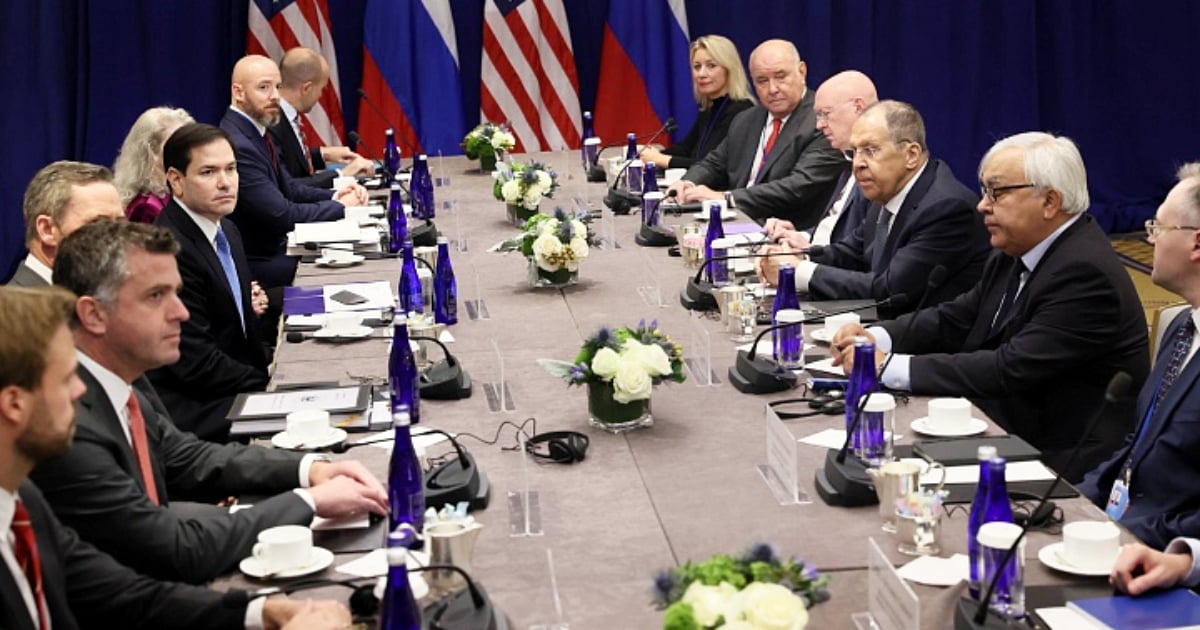
President Donald Trump has appointed Secretary of State Marco Rubio to lead upcoming negotiations with Russia in Budapest, a decision that reshapes American diplomacy and may signal a shift in the ongoing conflict in Ukraine. As reported by The Wall Street Journal, this choice sidelines the previous special envoy, Steve Witkoff, whose efforts in past talks, particularly after the Alaska summit, were deemed ineffective by European and Ukrainian allies.
This shift is significant. For the first time since the conflict began, the U.S. will have its top diplomat directly managing interactions with Moscow. The White House is hopeful that Rubio's authoritative presence, along with his reputation as a pragmatic yet firm politician against autocratic regimes, will steer negotiations that have so far benefited the Kremlin more than Kyiv.
Trump, who recently praised Rubio's handling of the Gaza ceasefire mediation, trusts that his Secretary of State can apply this experience to the more complex dynamics with Vladimir Putin. Sources cited by the Wall Street Journal suggest that the president aims to support his personal diplomacy with a robust structure capable of exerting greater pressure on Russia.
Strategic Diplomacy Returns with Rubio
Rubio’s appointment is not merely about a change in personnel but signifies a shift in political orientation. It marks a return to structured, professional diplomacy driven by national interests, contrasting with the personal and reactive style that had prevailed in earlier talks.
During his tenure as a senator from Florida and chairman of the Foreign Relations Committee, Rubio championed a traditional vision of U.S. foreign policy: upholding democratic values, containing authoritarian powers, and asserting hemispheric leadership.
Rubio has consistently warned for over a decade that regimes in Cuba, Venezuela, and Nicaragua are part of a network of influence sustained by Russia, China, Iran, and North Korea, which he often describes as a coalition of autocracies threatening democratic order and hemispheric security. His new role in negotiations with Putin can therefore be seen as a move extending beyond Europe.
Revamping U.S. Diplomatic Strategy
One frequently mentioned critique among analysts is that U.S. diplomacy has lacked a genuine operational process. Samuel Charap from the RAND Corporation summarized it in the Wall Street Journal, stating, "Trump's impatience hadn't allowed the process to evolve at a working group level, making it hard to determine if the issue was truly Putin's intransigence."
With Rubio, this shortcoming might be rectified. His methodical, institutionally-focused style is directed toward results, and his legislative experience has accustomed him to detailed negotiations and technical agreement assessments.
In contrast, Witkoff faced criticism for oversimplifying negotiation terms and presenting the White House with an unrealistic view of Russian commitments. His departure, according to European diplomatic sources, was inevitable after the Alaska debacle.
Rubio inherits a complex situation: Ukraine demands security guarantees and long-range weaponry, while Russia insists on retaining control over parts of the eastern provinces it occupies. Trump, striving to maintain his image as a "mediating president," seeks an agreement that allows him to claim credit for peace without appearing weak before Putin.
Sending a Message to Moscow and the Caribbean
Beyond European dynamics, Rubio's presence at the negotiating table signals a broader geopolitical message. In Washington, his appointment is seen as reaffirming U.S. hemispheric leadership against regimes aligned with Moscow. From Havana to Caracas, Russian influence has manifested in military cooperation, intelligence sharing, and financial support to governments opposing the West.
Rubio is well-acquainted with this network, having denounced it for years, viewing it as part of Russia's strategy to project power in the Western Hemisphere and promote autocracy over democracy.
His presence in Budapest aims not just to stabilize the Ukrainian front but also to guide the redefinition of Washington's global role against its historical adversaries. In this context, the new diplomatic leadership could restore strategic coherence to the White House: a foreign policy combining pressure, alliances, and moral clarity.
Trump and Rubio enter Budapest with different yet complementary goals. Trump is eager to secure a deal that enhances his reputation as an effective negotiator, while Rubio is determined to ensure that the agreement does not undermine U.S. power or strengthen Moscow and its allies. Should they successfully align these objectives, Budapest could become more than just a peace summit: it might be the stage where the U.S. reclaims its classic power doctrine and reorganizes the global geopolitical landscape.
Key Questions on U.S.-Russia Negotiations
Why is Marco Rubio leading the negotiations with Russia?
Marco Rubio was chosen to lead the negotiations due to his experience, pragmatic approach, and reputation for being firm against autocracies. His leadership is expected to bring structure and effectiveness to U.S. diplomatic efforts with Russia.
What impact could Rubio's leadership have on U.S. diplomacy?
Rubio's leadership could revitalize U.S. diplomacy by introducing a more structured, results-oriented approach, potentially leading to more effective negotiations and a stronger position against Russia and its allies.
How might this affect Russia's influence in Latin America?
Weakening Russia in Ukraine could reduce its political, financial, and military influence in Latin America, where it has supported authoritarian regimes. This strategic shift could help the U.S. counteract Russian influence in the region.