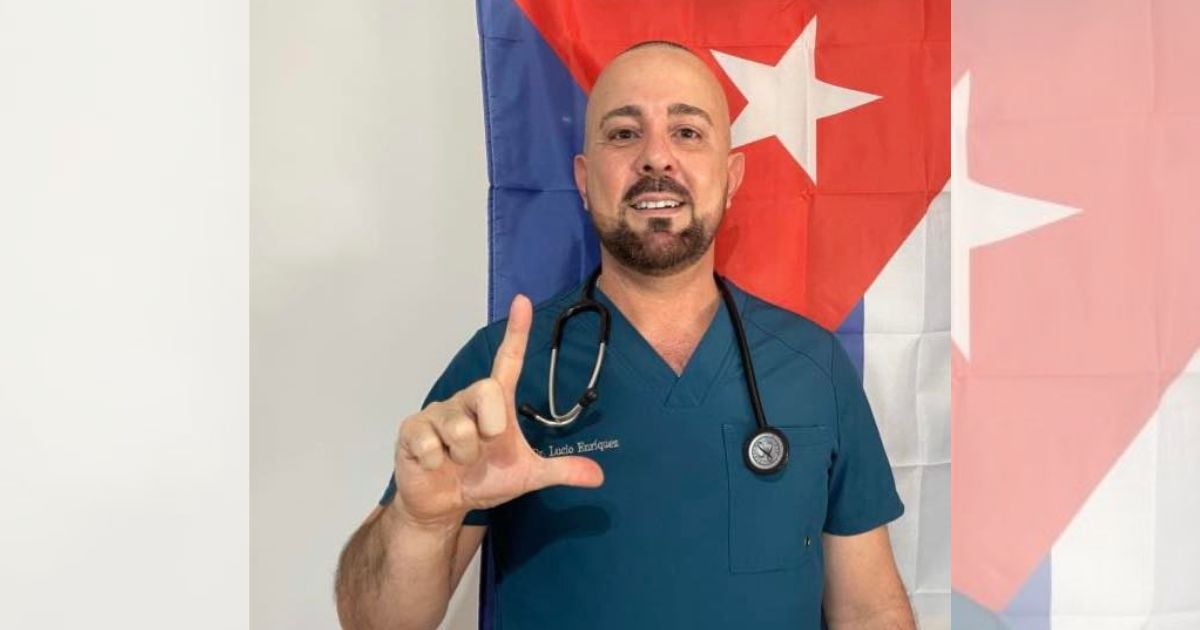
Cuban-Spanish physician Lucio Enríquez Nodarse has delivered a scathing response to the regime's recent propaganda campaign that brands Cuban doctors who have emigrated and criticize the healthcare system as "traitors" and "ungrateful." On his Facebook profile, Enríquez Nodarse, a vocal critic of the regime, dismantled the official narrative and fiercely defended his right to speak freely—something many doctors on the island are unable to do due to being silenced, prohibited from traveling, monitored, and threatened for dissenting opinions.
The doctor's message was posted shortly after the state-run TV Santiago, echoing the Public Health Union's narrative, published an article titled "Don't Spit on the Plate That Trained You," accusing emigrant doctors of disloyalty and ingratitude toward Cuban medicine. Enríquez Nodarse's statement emerged as a direct response to this attack and quickly went viral on social media for its clarity, strength, and personal testimony.
"The MINSAP accuses me of 'spitting on the plate that trained me.' No, I don't spit on the plate... I spit on the dirty hand that served it," he declared, taking a direct shot at the regime and its oppressive leadership. In his post, the doctor emphasized that his criticism is not aimed at the medical school or its professors, many of whom he describes as "silent martyrs of the system, underpaid, watched, and punished for thinking differently." He holds them in eternal respect. His criticism—and his denunciation—is directed at the dictatorship that hijacked medicine and turned doctors into propaganda tools and slaves whose labor abroad fills the regime's coffers.
Enríquez Nodarse challenges the official narrative that portrays medical training as an act of dignity. He highlights that many universities were inherited from the Republic, there were exiled educators who refused to indoctrinate, students threatened for not marching, and professionals restricted from leaving the country.
He also touches on medical missions, where the Cuban state takes 80% of the salary and forces doctors into political work, exposing them to precarious conditions and silencing their voices. "The Cuban state sells doctors as commodities. It uses them, exposes them, silences them, and when they die abroad, their families don't even know how or where," he lamented. He adds harshly, "They should include this in their propaganda too: 'We save lives... but we lose souls.'"
Enríquez Nodarse dismantles the regime's self-proclaimed "moral beacon." He asserts that this light only illuminates the halls of power while leaving hospitals without water, medicine, or essential supplies in darkness. He concludes, "Yes, I was trained in Cuba. And precisely because of that, I know what's behind the facade. The real betrayal is not denouncing the misery; it's staying silent while people die waiting for a turn or an antibiotic."
With his testimony, the doctor reaffirms that speaking out is not betrayal but a defense of the truth. "I don't bite the hand that fed me, I bite the one that stole my food, my freedom, and my voice. And I will do so until the end."
Cuban Healthcare System and Exiled Doctors: Questions and Answers
What prompted Lucio Enríquez Nodarse's response?
Lucio Enríquez Nodarse responded to a propaganda campaign by the Cuban regime that labeled emigrant doctors as "traitors" and "ungrateful." His response was a defense of his and others' right to speak freely about the deficiencies of the Cuban healthcare system.
What are some of the criticisms Enríquez Nodarse has about the Cuban healthcare system?
Enríquez Nodarse criticizes the regime for using doctors as propaganda tools and for exploiting them in medical missions where they are underpaid and forced into political work. He highlights the lack of essential supplies in hospitals and the oppressive conditions faced by healthcare professionals.
How does the Cuban state benefit from medical missions abroad?
The Cuban state retains about 80% of the salaries earned by doctors on medical missions abroad, using these funds to support the regime while keeping the doctors in precarious conditions and silencing their voices.