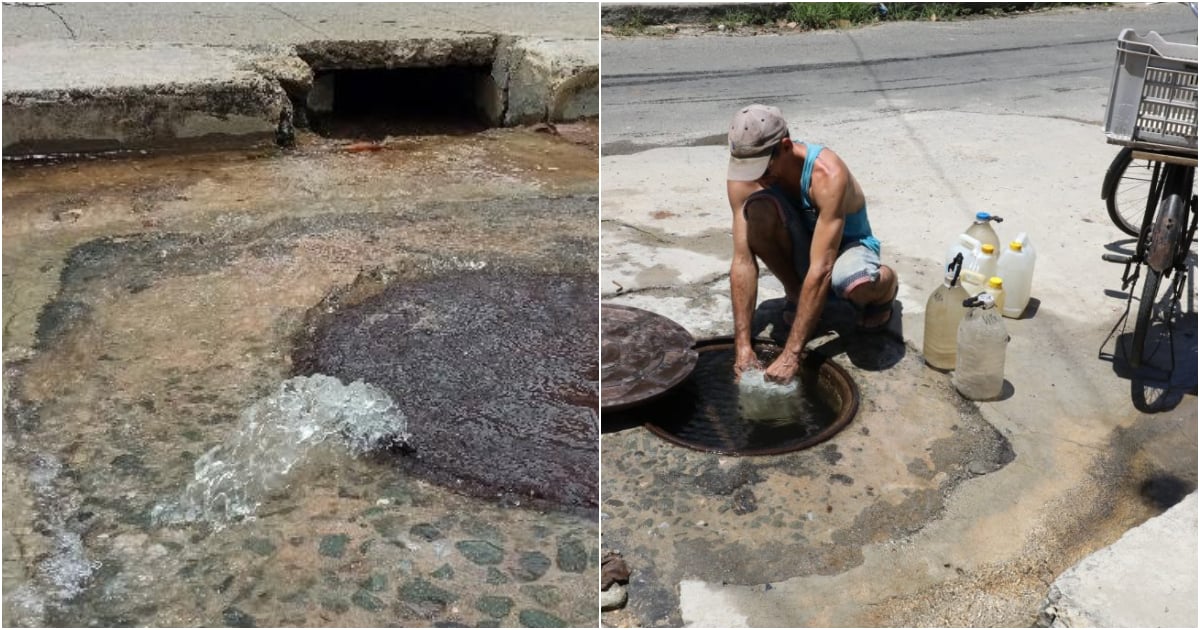
A prolonged malfunction in a distribution valve has turned a busy corner of Cienfuegos into a continuous water wasteland, with thousands of gallons of potable water being wasted amid the local authorities' disregard.
A photo report from the official newspaper 5 de Septiembre captures an image that epitomizes the decay of public services in Cienfuegos: a broken valve, located at the intersection of Santa Elena and Cuartel streets (Avenue 60 and Street 43), has been releasing water uncontrollably for months, water that was meant for the city's supply.
This persistent leak is visible at all times, creating a steady stream that turns the pavement into a miniature spring. These water losses occur precisely during the hours designated for public supply, drastically reducing pressure in nearby homes and forcing many residents to carry water in buckets and containers.
The surrounding area has become a muddy expanse, several square meters wide, never paved with asphalt or concrete, hindering the passage of pedestrians and vehicles alike. Despite numerous complaints, the issue remains unresolved. "Many complaints, a few visits, but nothing conclusive... in the end, the waste continues, and that crucial water is lost, beyond recovery," the report laments.
Meanwhile, the scarce and essential liquid is squandered daily, emblematic of official neglect in a country where abandonment seeps through even the pipes. This occurs as several Cuban provinces endure a dry period, necessitating extended supply cycles that sometimes stretch for months without receiving this vital resource through the hydraulic networks.
Moreover, hundreds of thousands of Cubans rely on water delivery by tanker trucks, also hampered by pumping failures due to prolonged power outages and equipment breakdowns. Yorgi Luis Gómez Solano, the deputy director of the Water and Sewer Company in Ciego de Ávila, indicates that approximately 30% of water is lost in the main lines due to the poor condition of the network, built in the early 20th century and further affected by sediment from underground water.
The formation of true lagoons from water wastage in the streets is not only a sign of inefficiency but poses a serious risk as Cuba faces an epidemiological crisis due to the circulation of several viruses, including dengue, chikungunya, oropuche, and hepatitis. Mosquitoes, the vectors for many of these diseases, breed in any water accumulation, including puddles and drains, a situation worsened by inadequate sanitation and hygiene services.
Key Issues with Water Management in Cienfuegos
What is causing the water waste in Cienfuegos?
The water waste in Cienfuegos is primarily due to a malfunctioning distribution valve at a central intersection, which has been left unrepaired for months, leading to uncontrolled water leakage.
How does the water leakage affect local residents?
The leakage reduces water pressure in nearby homes, forcing residents to manually collect water with buckets and containers, and creates muddy conditions that complicate pedestrian and vehicle movement.
What are the broader implications of this water wastage?
The water wastage contributes to a larger public health risk by creating breeding grounds for mosquitoes, which can spread diseases like dengue and chikungunya, exacerbating the existing epidemiological crisis in Cuba.