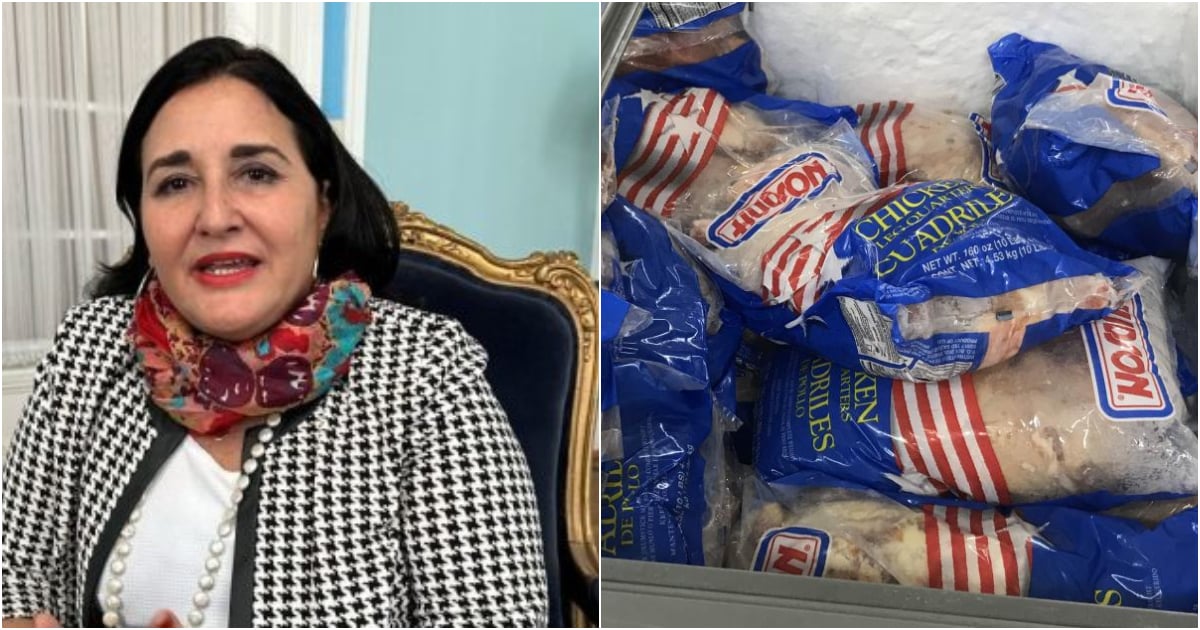
Johana Tablada, the deputy director for the United States at Cuba's Foreign Ministry, has admitted that Cuba's inability to purchase food from the United States is due to a lack of liquidity, despite the fact that the embargo laws technically allow such transactions. She attributed this to financial sanctions that, according to the island's regime, hinder the country from generating income. "This government's policy leaves us penniless and then says, 'Come here and buy all the food you want.' How nice," the diplomat sarcastically remarked during a conference entitled “Cuba Facing Extermination: A Hope That Must Not Die. An Update on the Impact of the Blockade and its Relations with the U.S.”
Tablada likened the situation to "someone stealing your wallet and then inviting you to shop." She argued that financial sanctions, along with the persecution of banks, transfers, remittances, and service exports, prevent Cuba from generating the necessary income to make purchases, even those that are legally permissible.
However, her statements as the newly appointed second-in-command of the mission abroad overlook the internal production and financial collapse that prevents the country from paying for its imports, as well as the inefficiency of a highly centralized economic system whose failed policies and bureaucratic hurdles prevent Cuban farmers from realizing their full productive potential and freely marketing their products.
The diplomat also failed to mention the hundreds of thousands of hectares of idle or marabú-infested land in Cuba, or the tens of thousands of tons of produce that rot annually in fields and collection centers due to state-controlled agriculture's bureaucracy and constraints.
U.S. Embassy Refutes Official Cuban Narratives
Recently, the U.S. Embassy in Havana confirmed that Cuba can buy food, medicine, and medical equipment without restrictions from Washington, contradicting the official narrative from Havana that blames the “blockade” for the lack of basic supplies.
In August, Tablada acknowledged during an interview with the officialist videopodcast Alma Plus that the country can purchase “all the chicken it wants” from the United States. “On the street, they say there's no blockade because Cuba can buy all the chicken it wants from the U.S., and I'd say, it's true, Cuba can buy all the chicken it wants from the U.S.,” she conceded. However, she justified that the conditions imposed make such purchases an “onerous” and limited process, requiring prepayment and incurring high additional costs.
Rising Dependence on U.S. Agricultural Imports
These transactions occur under the Trade Sanctions Reform and Export Enhancement Act (TSREEA) of 2000, which authorizes agricultural and humanitarian sales to the Island. Between January and May 2025, Cuba imported food from the U.S. valued at over $204.9 million, with chicken being the primary product.
One of the most notable figures in May was the purchase of an unprecedented amount of powdered milk, valued at $7,357,388. Additionally, sanitary products were imported for $52,281, along with $1.1 million in rice, $3.8 million in pork, and nearly $480,000 in coffee. Even eggs are purchased.
In June, U.S. food and agricultural product purchases increased to $38.4 million, up 10% from $34.9 million in the same month of 2024, and $37 million in June 2023. These products, once locally produced, now underscore the country's growing food dependency.
Since the act was enacted in December 2001, Cuba has spent more than $7,885 million on food imports from the United States, according to data from the U.S. Department of Agriculture.
During the interview, Tablada also acknowledged that the Cuban regime withholds a portion of the salaries of doctors on international "missions" and assured that the professionals "know it from the start" because it is in their contracts.
Frequently Asked Questions About Cuba's Economic Situation
Why can't Cuba purchase food from the United States despite the embargo laws allowing it?
Cuba is unable to purchase food from the U.S. due to a lack of liquidity. Financial sanctions impede the country from generating the necessary income to make these purchases, even when legally permitted.
What role do financial sanctions play in Cuba's economic challenges?
Financial sanctions hinder Cuba's ability to conduct banking activities, transfer funds, and export services, which significantly impacts the country's ability to generate income and pay for imports.
How has Cuba's food dependency on the United States changed over the years?
Over the years, Cuba's dependency on U.S. food imports has grown, as evidenced by the significant amounts of agricultural products imported annually, highlighting the country's increasing reliance on external food sources.