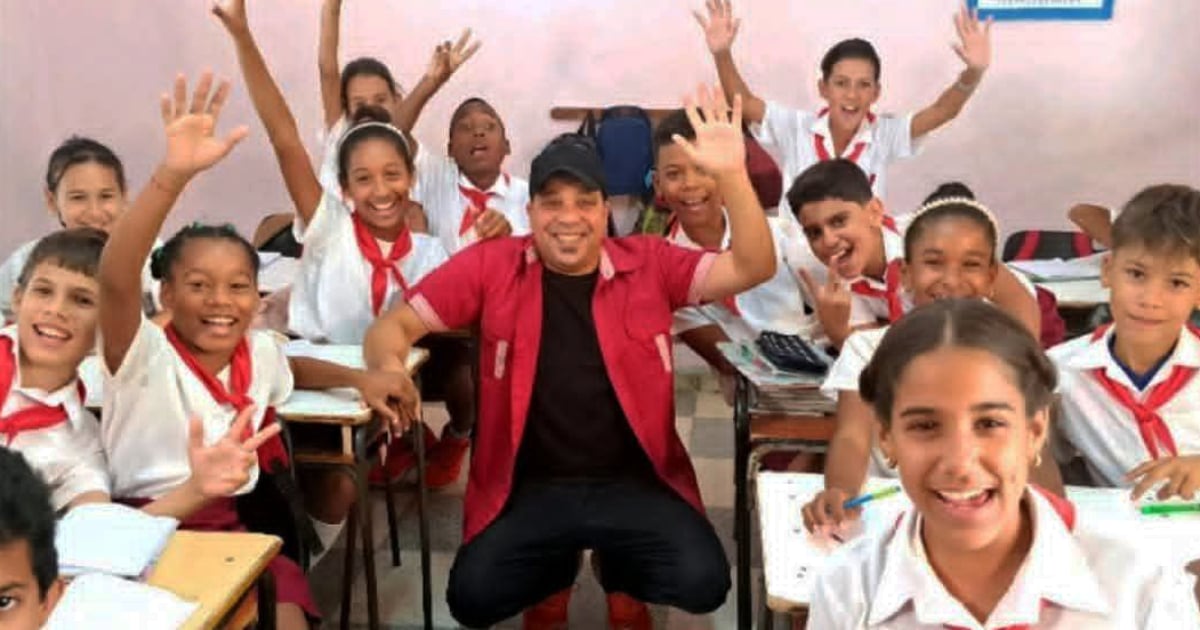
As public outrage over images of children sleeping in the gardens of the Muthu Hotel in Havana escalates, pro-government musician Arnaldo Rodríguez Romero has resurfaced on social media. His recent post is perceived by many as an attempt to "polish the regime's image." Known for his unwavering support of the Cuban government, Rodríguez shared photos of himself surrounded by school children wearing red neckerchiefs in a classroom that appears well-maintained. The smiling, uniformed children were accompanied by a caption thanking the “government” for providing him free education.
“Thank you, my mother, for everything. Thank you, Government, for granting me the right to attend school for free, regardless of my skin color, economic status, or religious affiliation,” Rodríguez Romero wrote on his Facebook page, concluding his message with the word “Moral.”
This post comes amid independent media reports and Cuban citizens highlighting child neglect and extreme poverty, following the release of images showing six minors sleeping on the ground outside the Muthu Hotel, located at the intersection of 1st and 70th in Havana's Playa neighborhood. The incident prompted an unusual acknowledgment of institutional failures from an official deputy and even a response from Leticia Martínez Hernández, press chief for Miguel Díaz-Canel, who has been tasked with deflecting criticism of the regime's many shortcomings.
Contrasting Realities
While large segments of the population express concern about the deteriorating child protection system, the musician chose to highlight the regime's “educational achievements,” echoing state propaganda narratives. In the images shared by Rodríguez, he is depicted in a primary school classroom with cheerful children, amidst Cuban flags shaped like hearts, projecting an atmosphere of harmony that starkly contrasts with the harsh realities reported by journalists and locals.
Many online users view the artist's post as a deliberate part of a counter-propaganda strategy, meant to distract from the Muthu case and reinforce the narrative that “no child is left behind in Cuba.”
The Official Narrative
In his post, Rodríguez attempted to separate family responsibility from state obligations by sharing anecdotes from his childhood in the 1980s. He recounted how his mother insisted on his attendance in school, reprimanded him for not studying, or encouraged him to improve. “It was my mother who sent me, not the government,” he repeated, emphasizing the role of families in ensuring children's welfare, thus absolving the regime of escalating child vulnerability on the island.
The contradiction in his message—thanking the state while crediting his mother for his education—did not seem to catch the attention of numerous followers who praised his post. They echoed the indoctrinated mindset: exonerating the government for the abandonment of many young people in Cuba, holding families accountable for their well-being, and simultaneously thanking the “revolution” for its so-called social and equality policies.
Context and Contradictions
Rodríguez's message unfolds amidst a severe social crisis. According to the Cuban Observatory for Human Rights, 89% of households live in extreme poverty, and 9% of children experience food poverty. International organizations warn of an increasing number of minors begging, searching for food, or living on the streets.
In this context, Rodríguez Romero's post appears to be another display of political opportunism and disconnection, characteristic of his recent actions. The musician, businessman, and member of the National Assembly of People's Power (ANPP)—who has received accolades from the Ministry of the Armed Forces and been awarded for his “devotion to the Revolution”—has taken on the role of a regime propaganda spokesperson in recent years, celebrating official events while avoiding addressing the country's real issues.
As the images of the children at the Muthu Hotel continue to spark outrage and calls for change, Rodríguez Romero persists in portraying an idyllic Cuba where all children attend school and no one is left behind, except those considered victims of neglect and the "degeneracy" of non-integrated, dysfunctional families. His publication, however, seems to have backfired, highlighting the gap between official propaganda and the real lives of Cuban children.
Understanding the Cuban Education and Child Welfare System
How does the Cuban government portray its education system?
The Cuban government often highlights its educational system as a significant achievement, emphasizing free access to education for all children regardless of their background.
What are the criticisms of Cuba's child welfare system?
Critics argue that the child welfare system in Cuba is failing, as evidenced by instances of child neglect, poverty, and an increasing number of minors living on the streets.
What is the significance of the Muthu Hotel incident?
The Muthu Hotel incident has drawn significant attention to the issues of child neglect and poverty in Cuba, sparking outrage and calls for reform.