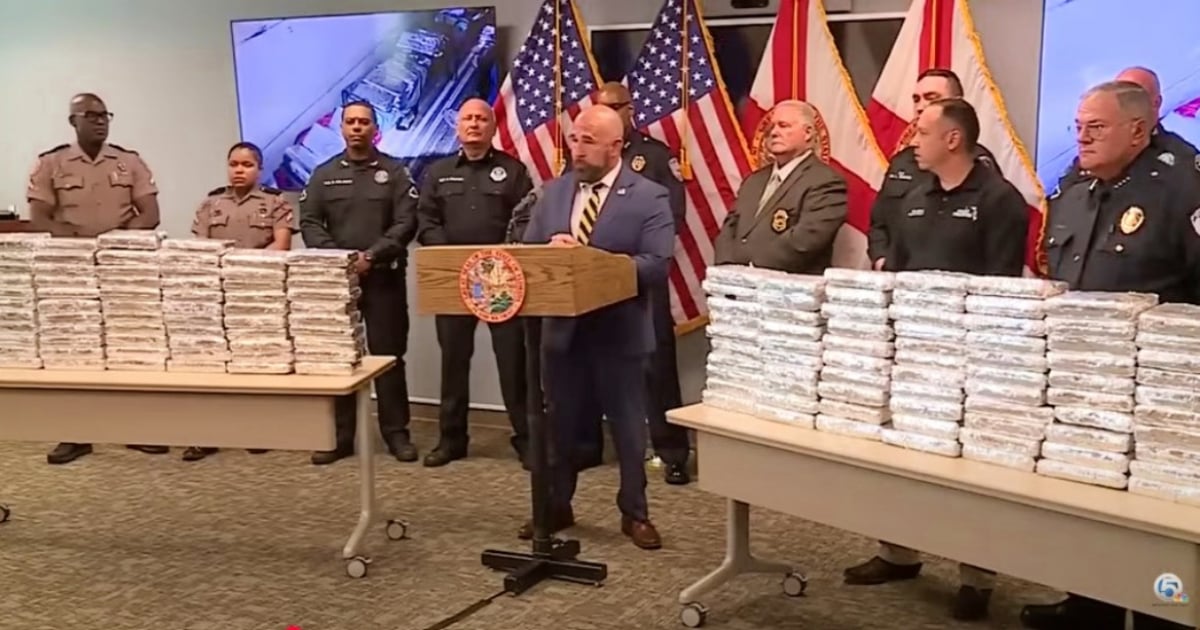
A collaborative operation between the Florida Highway Patrol (FHP) and the U.S. Drug Enforcement Administration (DEA) led to the seizure of a staggering 173 kilograms of cocaine, valued at $14.7 million. The drugs were found in a truck stopped on the Florida Turnpike in the southern part of the state. Although the bust took place on October 5, 2025, it was officially announced ten days later by Governor Ron DeSantis' office, highlighting the operation as a key component of his "zero tolerance" policy towards illegal drugs.
The DEA's West Palm Beach office initially flagged the situation, alerting the FHP about intelligence concerning a suspicious semi-truck believed to be transporting narcotics from the Mexico-Texas border to southern Florida.
Discovery and Inspection
FHP's Criminal Interdiction Unit (CIU) agents spotted the vehicle heading south and conducted a lawful traffic stop on the highway. During the inspection, officers found a "hidden hatch containing multiple duffel bags filled with cocaine," according to an official statement.
The truck's occupants were detained and taken into federal custody. It was revealed that one of the individuals had previously been deported from the United States. Their identities have not been released due to the ongoing federal investigation.
The magnitude of the find—equivalent to 381 pounds of cocaine—was notable, especially since the drugs were concealed in a hidden compartment, a tactic frequently used by criminal organizations to bypass road checks.
"These types of seizures are possible with interagency coordination," stated Lieutenant Governor Jay Collins.
Political Message: Drugs, Border, and Law
The authorities have showcased the operation as a demonstration of effective police work and federal-state collaboration, aligning with the current administration's security rhetoric. "Under Governor Ron DeSantis' leadership, Florida remains a state of law and order," the official statement emphasized, adding, "When we work together, we stop dangerous drugs before they reach our streets."
Lieutenant Governor Jay Collins was clear in his message: "To drug traffickers, our message is unequivocal: do not bring your poison to our state. We will find you, arrest you, and always stand on the front lines to protect Floridians."
The governor's office also drew attention to national immigration and border policies, attributing increased pressure on cartels to use riskier land routes due to supposed "security at the southern border." "With the southern border closed, transnational drug cartels can no longer simply smuggle weapons, drugs, and human couriers across," declared Dave Kerner, the FHP's executive director. "This allows us to investigate the supply chain back to its origin and target the root of the evil: the criminal cartels and their resources."
Florida: A Key Drug Trafficking Route
This case is not an isolated incident. Official data reveals that since 2019, the FHP has seized over 14,000 kilograms of illegal drugs in various highway operations. Among these seizures are 925 kilograms of cocaine, 23.5 of fentanyl, 14 of heroin, 9,600 of marijuana, and 19 of MDMA.
The Florida Turnpike, a heavily traveled corridor for interstate transport in the south of the state, has been identified as a critical secondary route for traffickers looking to bypass reinforced border controls along the Mexico-Texas line. These land routes have become focal points for anti-drug operations, with traffickers using sophisticated concealment techniques like false compartments in cargo vehicles, complicating routine inspections.
The detainees remain under federal investigation and could face charges of interstate and international drug trafficking, along with related charges such as illegal reentry into the country in the case of the deported individual. The case might pave the way for broader investigations into transnational criminal networks operating between Mexico and the southern United States. Authorities are focusing not only on confiscation but also on tracing the supply chain back to its origins.
"Florida will continue to lead with decisive action, unwavering law enforcement, and robust interagency cooperation to dismantle drug trafficking operations and ensure criminal organizations find no refuge in the Sunshine State," the official statement concluded.
Key Details of the Florida Drug Bust
How much cocaine was seized in the Florida operation?
The operation resulted in the seizure of 173 kilograms of cocaine, equivalent to 381 pounds, valued at $14.7 million.
What agencies were involved in the cocaine seizure?
The Florida Highway Patrol (FHP) and the U.S. Drug Enforcement Administration (DEA) were involved in the operation.
What method did the traffickers use to conceal the drugs?
The traffickers used a hidden hatch in the truck to conceal duffel bags filled with cocaine, a common technique to evade road checks.
What impact does this bust have on drug trafficking in Florida?
The bust highlights the significance of interagency coordination in disrupting drug trafficking routes and emphasizes Florida's commitment to law and order.