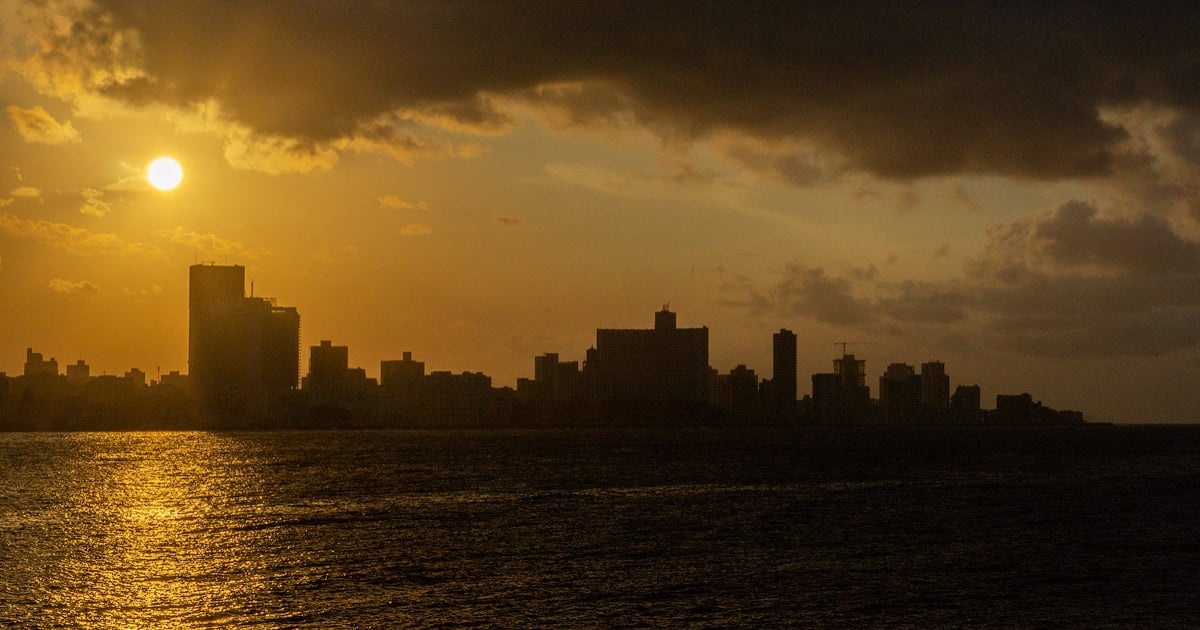
The Cuban Electric Union (UNE) announced on Friday that, despite ongoing issues with the National Electric System (SEN), Havana experienced no power outages on Thursday. This contrasts with other provinces across the island that continue to struggle with power generation shortages. According to an Information Note dated October 17, 2025, the greatest impact due to generation capacity deficit was recorded at 1,384 megawatts (MW) at 7:30 p.m. on Thursday, resulting in widespread power cuts throughout the country.
However, the Havana Electric Company confirmed that the capital maintained uninterrupted service. They did share, though, a schedule of expected disruptions for Friday. As of 6:00 a.m. on Friday, the SEN had an available capacity of 1,813 MW compared to a demand of 2,320 MW, leaving a shortfall of 512 MW. UNE projects that a 700 MW deficit will affect daytime hours, and during peak times, a shortfall of 1,297 MW could lead to disruptions of up to 1,367 MW.
Breakdowns and Maintenance Issues
The statement highlights that key thermal units, including Unit 2 of the Felton Thermoelectric Plant, Unit 8 in Mariel, and Unit 3 of the Renté Thermoelectric Plant, are currently out of service due to malfunctions. Additionally, Unit 2 of the Santa Cruz Thermoelectric Plant and Unit 4 of the Carlos Manuel de Céspedes Thermoelectric Plant in Cienfuegos are undergoing maintenance. There are also 452 MW of capacity hindered by thermal limitations, with an additional 501 MW unavailable due to fuel and lubricant shortages across 50 distributed generation stations.
Solar Energy: Growing Contribution but Still Lacking
The UNE emphasized the role of 32 new photovoltaic solar parks, which generated 2,934 megawatt-hours (MWh) during the day, reaching a peak output of 536 MW. While this marks progress in the adoption of renewable energy, it remains insufficient to meet the growing national demand, exacerbated by a lack of maintenance and fuel in thermal plants.
For the evening, the UNE plans to add 100 MW by bringing distributed generation engines back online, which are currently idle due to fuel shortages. They also aim to activate Turbine 1 of Energás Jaruco (30 MW) and complete the combined cycle with an additional 60 MW. Should these projections be met, total availability would reach 2,003 MW against a maximum demand of 3,300 MW, putting the country at high risk of widespread blackouts, except in Havana where the state company claims to have maintained stable electricity service.
Protests in Baire Over Power Outages
While Havana avoided blackouts, the eastern region of Cuba faces a dire situation not only due to prolonged power outages but also due to food and water shortages. On Thursday night, residents of Baire took to the streets to demand freedom and the end of the dictatorship. They marched through their darkened town, banging pots in protest against the regime.
Understanding Cuba's Power Challenges
What is causing the power outages in Cuba?
The power outages in Cuba are primarily due to a deficit in power generation capacity, exacerbated by maintenance issues and fuel shortages in thermal power plants.
How is Havana managing to avoid blackouts?
Havana has managed to avoid blackouts by maintaining a stable electricity service, despite the overall generation deficits affecting other regions.
What role does solar energy play in Cuba's energy mix?
Solar energy contributes to Cuba's energy mix through photovoltaic solar parks, which generated significant power recently, though it is still not enough to cover the full demand.