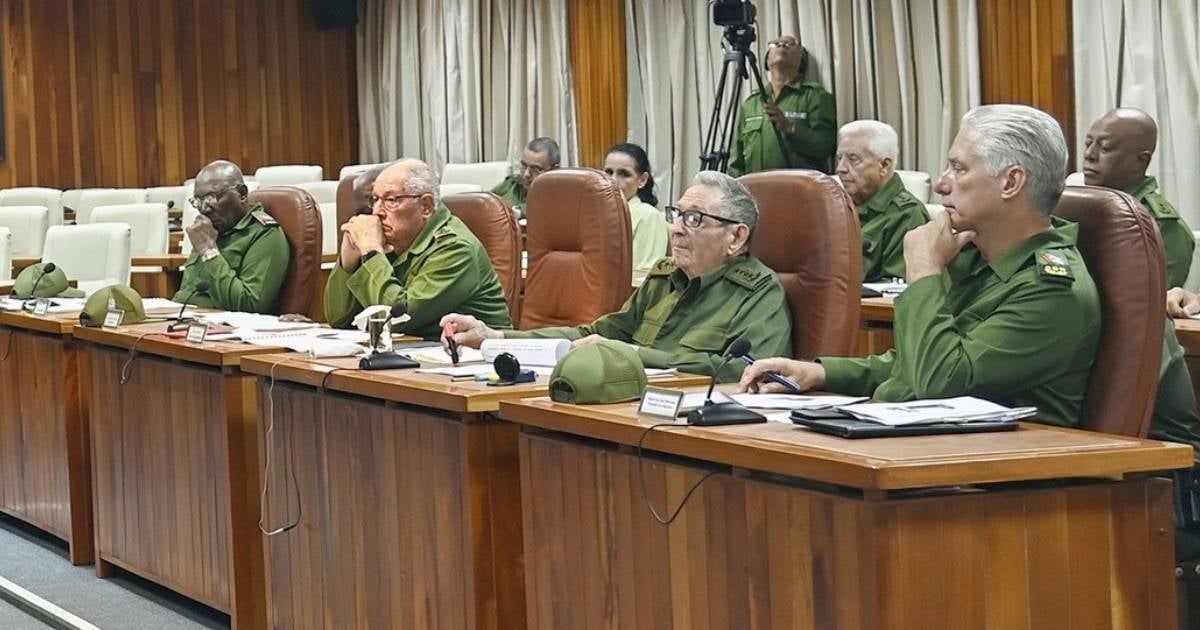
At 94 years old, General Raúl Castro Ruz has once again emerged at the forefront of Cuba's power structure by presiding over a session of the National Defense Council (NDC) held on Wednesday at the Ministry of the Revolutionary Armed Forces (MINFAR), as reported by the official newspaper, Granma. The brief note from the Communist Party's publication stated that the meeting's purpose was to "approve the decisions and plans of its working and support organs" and that the event was led by General Raúl Castro Ruz, the head of the Revolution, alongside the President of the Republic, Miguel Díaz-Canel Bermúdez.
Nevertheless, Castro's leadership at the meeting appears to contravene Article 219 of the Cuban Constitution, which explicitly dictates that "the National Defense Council is composed of the President of the Republic, who presides over it and appoints a vice president and other members as determined by law." Granma's own wording confirms that Díaz-Canel did not lead the council, a legal mandate, highlighting a direct breach of the constitutional text and underscoring who truly wields power on the island.
The gathering took place at MINFAR, a historical stronghold of Raúl Castro's influence, with his grandson, Raúl Guillermo Rodríguez Castro (nicknamed "El Cangrejo"), and senior leaders from the Armed Forces and the Ministry of the Interior accompanying him. Despite his announced political retirement in 2021, the military leader continues to play a pivotal role in the state's control mechanisms, especially in the defense sector and the GAESA business conglomerate, which remains under Castro's influence.
Portraying the general as the "head of the Revolution" instead of as a "historic leader" or "former president" bolsters the perception that Raúl Castro has not truly stepped away from power and that his influence still heavily impacts the decisions of the Díaz-Canel government. Amidst the severe economic crisis, power outages, and widespread social discontent plaguing the country, this public appearance sends a resounding message to both the Cuban populace and the international community: the general and the military apparatus retain control over Cuba, beyond official titles and promises of transition.
The Impact of Raúl Castro's Continued Influence in Cuba
Why is Raúl Castro's presence at the National Defense Council significant?
Raúl Castro's presence is significant as it suggests a breach of the Cuban Constitution and highlights his enduring influence over the country's power structure, despite his supposed retirement.
What does the Cuban Constitution state about the leadership of the National Defense Council?
The Cuban Constitution stipulates that the President of the Republic should preside over the National Defense Council, appointing a vice president and other members as defined by law.
How does Raúl Castro's role affect the current government of Díaz-Canel?
Raúl Castro's role undermines the authority of President Díaz-Canel, emphasizing that real power remains with Castro and the military, influencing government decisions and limiting Díaz-Canel's autonomy.