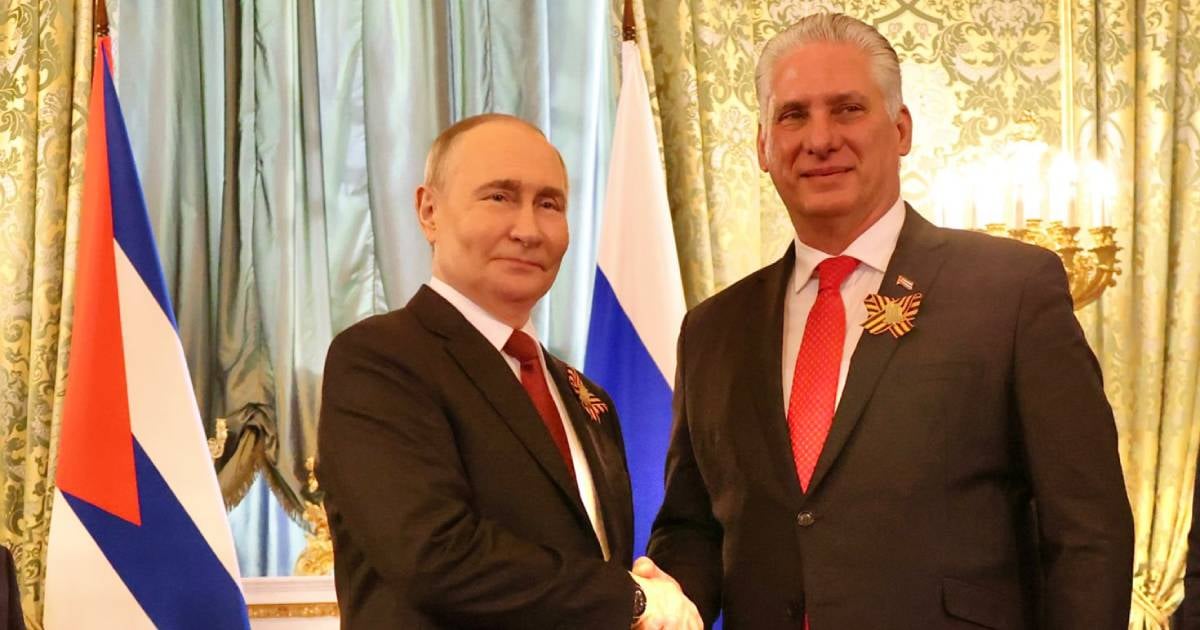
Russian President Vladimir Putin has officially endorsed a military cooperation agreement with the Cuban regime, cementing a strategic partnership amidst the ongoing war in Ukraine and rising allegations of Cuban citizens being sent to fight for the Russian army. The law, signed this Wednesday in Moscow, formalizes the intergovernmental agreement initially signed in March in both Havana and the Russian capital.
As reported by the state-affiliated Russia Today (RT), the agreement aims to "strengthen military collaboration between the two nations" and "safeguard the interests of Russian citizens working under Cuban jurisdiction." Previously, the treaty had been approved by both the State Duma and the Federation Council, the lower and upper chambers of the Russian parliament. With Putin's ratification, the military alliance between Moscow and Havana is now officially established.
Amidst Allegations of Cuban Fighters in Ukraine
The formalization of this treaty emerges as the United States and Ukraine raise concerns over the involvement of Cubans fighting for the Kremlin. According to Ukrainian military intelligence (GUR), cited by the Kyiv Independent, at least 1,076 Cubans have fought or are currently serving in the Russian army, with 96 reportedly killed or missing in action.
The GUR claims that recruits receive a mere two weeks of training in Moscow before being dispatched to the front lines, primarily in assault or infantry units. Many were lured by false job offers posted on social media, unaware they would end up in combat. Despite mounting evidence, Miguel Díaz-Canel's regime denies involvement in the recruitment process, asserting that "Cuba does not participate with military personnel in foreign conflicts."
However, reports from international outlets like Forbes and EFE suggest that between 20,000 and 25,000 Cubans may have been recruited or are in the process of enlisting, potentially with the implicit complicity of island authorities.
Reviving Cold War Ties
The ratification of this military agreement strengthens the bond between two governments historically allied since the Soviet era. Analysts point out that while the pact may have limited operational significance, it holds substantial propagandistic value for both regimes: for Putin, it serves as a show of support in Latin America amid international isolation; for Havana, it provides a means of political and economic backing during the country's most severe internal crisis in three decades, characterized by shortages, inflation, and power outages.
This Russo-Cuban military rapprochement also unfolds within a context of confrontational rhetoric with the West. Moscow has hinted at times its interest in deploying weapons or military presence in allied territories, reviving echoes of the Cold War and the 1962 missile crisis.
With this move, Putin officiates an agreement that deepens Havana's reliance on Moscow, as thousands of Cubans — caught between poverty and hopelessness — continue to be drawn into a war that is not their own.
Key Questions About the Russia-Cuba Military Alliance
Why has Russia formalized a military alliance with Cuba?
The formalization of the military alliance between Russia and Cuba aims to strengthen military collaboration and safeguard Russian interests in Cuba. It also serves as a strategic partnership amidst international tensions and isolation faced by Russia.
What are the allegations regarding Cuban citizens fighting in Ukraine?
There have been allegations that Cuban citizens are being recruited to fight for the Russian army in Ukraine. Reports suggest that many Cubans have been misled by false job offers and end up in combat, with some casualties reported.
How does this agreement impact Cuba's relationship with Russia?
This agreement solidifies Cuba's dependency on Russia for political and economic support, especially during Cuba's internal crises. It also revives historical ties dating back to the Soviet era, reinforcing their alliance.