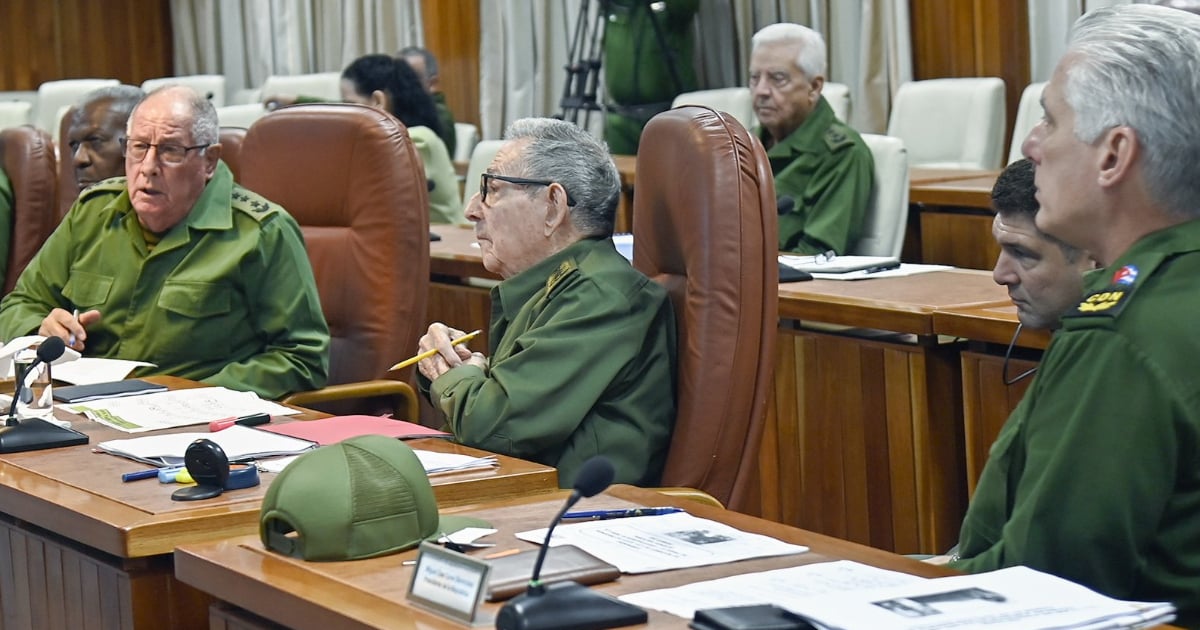
At the age of 94, Army General Raúl Castro Ruz chaired a session of the National Defense Council (CDN) at the Ministry of the Revolutionary Armed Forces (MINFAR) on Wednesday. He was prominently referred to as the "leader at the helm of the Revolution," accompanied by his grandson Raúl Guillermo Rodríguez Castro, known as "El Cangrejo," and flanked by Cuba's current head of state, Miguel Díaz-Canel.
The gathering aimed to "approve the decisions and plans of its working and support bodies," as reported by the Cuban Presidency on the social media platform X. However, what has drawn significant attention, both domestically and internationally, is the official portrayal of the seasoned leader as the "leader at the helm of the Revolution." This description underscores that Raúl Castro remains the true power behind Cuba, despite his supposed political retirement in 2021.
The official account of the Cuban Presidency stated, "The activity was presided over by Army General Raúl Castro Ruz, leader at the helm of the Revolution, and the President of the Republic, Miguel Díaz-Canel." This statement reaffirms what many Cubans have believed for years: while Díaz-Canel holds the title of president, he does not wield actual power. Raúl continues to be the highest military and political authority in Cuba, even after formally stepping down from his official roles over four years ago.
The Man Who Never Truly Left
Raúl Castro, the younger brother of Fidel Castro, has held the most senior positions in the Cuban state since 1959. His roles included Minister of the Revolutionary Armed Forces (1959–2008), First Vice President of the Council of State (1976–2008), President of Cuba (2008–2018), and First Secretary of the Communist Party (2011–2021).
Although his departure from power was portrayed as an "orderly transition," the military's control structure, particularly the GAESA conglomerate, which dominates a large portion of the national economy, remains under his and his military circle’s direct influence. This recent public appearance and his description as the "leader at the helm of the Revolution" send two strong messages to the world. Firstly, it dispels rumors about the general's health and alleged death. Secondly, it indicates that Raúl Castro does not trust even his political heir with the country's leadership.
An Underlying Message
The use of this phrase in an official statement, rather than terms like "historic leader" or "Army General," has been interpreted by analysts and citizens as a reaffirmation of the military's dominance, amid economic crisis, social unrest, and growing distrust in Díaz-Canel's administration.
As the nation grapples with blackouts, inflation, and mass migration, Raúl's presence at the forefront of MINFAR serves as a reminder that the true power in Cuba remains with the military and, ultimately, with Raúl Castro and his commanders.
Understanding Raúl Castro's Continued Influence in Cuba
Why is Raúl Castro still considered a leader in Cuba?
Despite officially retiring, Raúl Castro remains the true power behind the scenes in Cuba, as evidenced by his recent leadership role at MINFAR. His influence persists through his control over military and economic structures.
What roles has Raúl Castro held in the Cuban government?
Raúl Castro has held several key positions, including Minister of the Revolutionary Armed Forces, First Vice President of the Council of State, President of Cuba, and First Secretary of the Communist Party.
What is GAESA and why is it significant?
GAESA is a military-controlled conglomerate that dominates large parts of the Cuban economy. It remains under Raúl Castro's influence, highlighting his continued control over the nation’s resources.
How has Raúl Castro's presence impacted Cuba's current political climate?
Raúl Castro's ongoing influence underlines the military's grip on power, affecting the political climate amidst economic hardships and social dissatisfaction, and overshadowing Díaz-Canel's leadership.