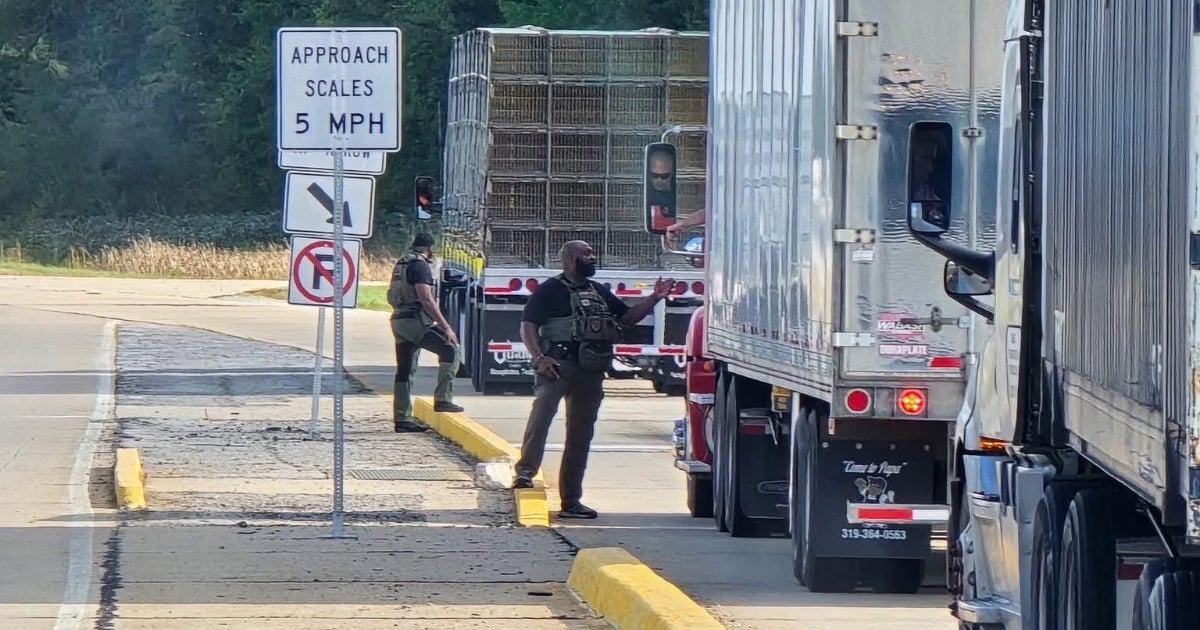
A Cuban national operating a truck without a commercial license was apprehended during a sweep conducted by U.S. Immigration and Customs Enforcement (ICE) and the Oklahoma Highway Patrol (OHP), according to official sources. The Cuban truck driver, who lacks legal status in the United States, was among more than 120 undocumented immigrants captured during the joint operation carried out by the two agencies between September 22 and 25, as stated in a release published on ICE's official site this Tuesday.
The arrest of the driver, whose identity remains undisclosed, occurred following a routine traffic stop on Interstate 40 (I-40) in western Oklahoma, where the special operation was executed over three days as part of ICE's 287(g) program. This policy enables law enforcement across the nation to collaborate directly with immigration agents to identify and detain individuals residing illegally.
ICE's report highlights that during the intensive patrol, 120 undocumented foreigners were detained for immigration violations, with 91 operating a commercial vehicle with a Commercial Driver's License (CDL) and 29 without it. Furthermore, 27 other undocumented individuals were apprehended in passenger vehicles during routine traffic checks, and two were captured at a nearby marijuana cultivation site.
ICE confirmed that the 120 illegal migrants arrested had previous convictions for offenses such as driving under the influence (DUI) - some with two or more charges, illegal reentry into the U.S., money laundering, human trafficking, assault, conspiracy to distribute cocaine, and possession of controlled dangerous substances. According to agency data, among the 91 undocumented individuals operating a commercial vehicle with a CDL, 10 overstayed their authorized period in the country, 80 entered illegally or with humanitarian parole, have pending asylum applications or immigration hearings, and one person has a final deportation order.
Of the 29 individuals discovered driving without a license (one from Cuba, three from China, 10 from Guatemala, and 15 from Mexico), 23 had entered the U.S. between 2020 and 2024. "Illegal immigrants have no business driving 18-wheelers on American highways. Our roads are now safer as these illegal aliens are no longer behind the wheel," stated Madison Sheahan, ICE's deputy director. "We encourage more state and local law enforcement to sign 287(g) agreements to help eliminate threats to public safety."
These arrests come weeks after fatal accidents caused by illegal immigrants while driving 18-wheelers on U.S. roads. One of the most tragic incidents involved Cuban Alexis Osmani González Companioni, 27, in late June when he allegedly fell asleep at the wheel and crashed the truck he was driving into a line of vehicles on Interstate 20, Texas, resulting in the deaths of five people, four from the same family. González, a former youth leader of the Cuban regime, emigrated to Spain in 2020 and later entered the U.S. with an ESTA visa. After the crash, it was revealed that he had a CDL to work as a driver, but it was unclear whether he was in the U.S. illegally or had regularized his immigration status.
In August, another controversial case reignited the debate over issuing commercial driving licenses to individuals without U.S. citizenship. In Florida, Harjinger Singh, a 28-year-old truck driver residing illegally since 2018, caused a fatal accident on the Turnpike in Fort Pierce, resulting in three deaths.
U.S. Tightens Requirements for Issuing Commercial Driving Licenses to Non-Citizens
In September, the U.S. Department of Transportation (DOT) tightened requirements for non-citizens obtaining Commercial Driver's Licenses (CDL) following three fatal accidents this year caused by immigrant truckers who "should not have been licensed," as warned by the authority. An official statement indicated that states must halt issuing CDLs to non-citizens until they can prove compliance with the new rules, which limit eligibility to three visa types (H-2A, H-2B, and E-2), require verification of immigration status against a federal database, and set a maximum validity of one year (or less, if the visa expires sooner).
Transportation Secretary Sean Duffy announced a drastic limitation on who can apply for Commercial Learner's Permits (CLP) and CDL for non-residents.
Types of CDL Licenses in the United States
There are three main classes of CDL based on vehicle type and weight:
Class A: Allows operation of combined vehicles with a Gross Combined Weight Rating (GCWR) of 26,001 pounds (11,793 kg) or more, as long as the towed vehicle weighs more than 10,000 pounds. Examples include trailers, tractor-trailers, large tank trucks, and double trailers.
Class B: Permits driving a single vehicle with a Gross Vehicle Weight Rating (GVWR) of 26,001 pounds or more, or towing a vehicle weighing less than 10,000 pounds. Examples include buses, large delivery trucks, garbage trucks, and medium tank trucks.
Class C: For vehicles designed to transport 16 or more passengers (including the driver) or hazardous materials (hazmat) in quantities requiring placarding. Examples include passenger vans, small buses, and courier vehicles carrying hazardous materials.
General Requirements for Obtaining a CDL
Applicants must be at least 21 years old (some states allow intrastate driving from age 18), possess a valid regular driver's license (Class D), pass a medical exam and obtain a certificate from the Department of Transportation (DOT), and pass:
- A theoretical exam (covering traffic laws, safety, and cargo handling).
- A practical exam (vehicle inspection, basic control, and road driving).
Understanding the Impact of ICE Operations on Undocumented Truck Drivers
What is the 287(g) program?
The 287(g) program allows state and local law enforcement agencies to collaborate directly with ICE to identify and detain undocumented immigrants.
What are the new CDL requirements for non-citizens?
Non-citizens must have one of three specific visa types (H-2A, H-2B, and E-2), verify their immigration status against a federal database, and their CDL's validity is limited to one year or less, depending on visa expiration.
How many undocumented immigrants were detained in the recent ICE operation?
Over 120 undocumented immigrants were detained, including 91 with a CDL and 29 without one.