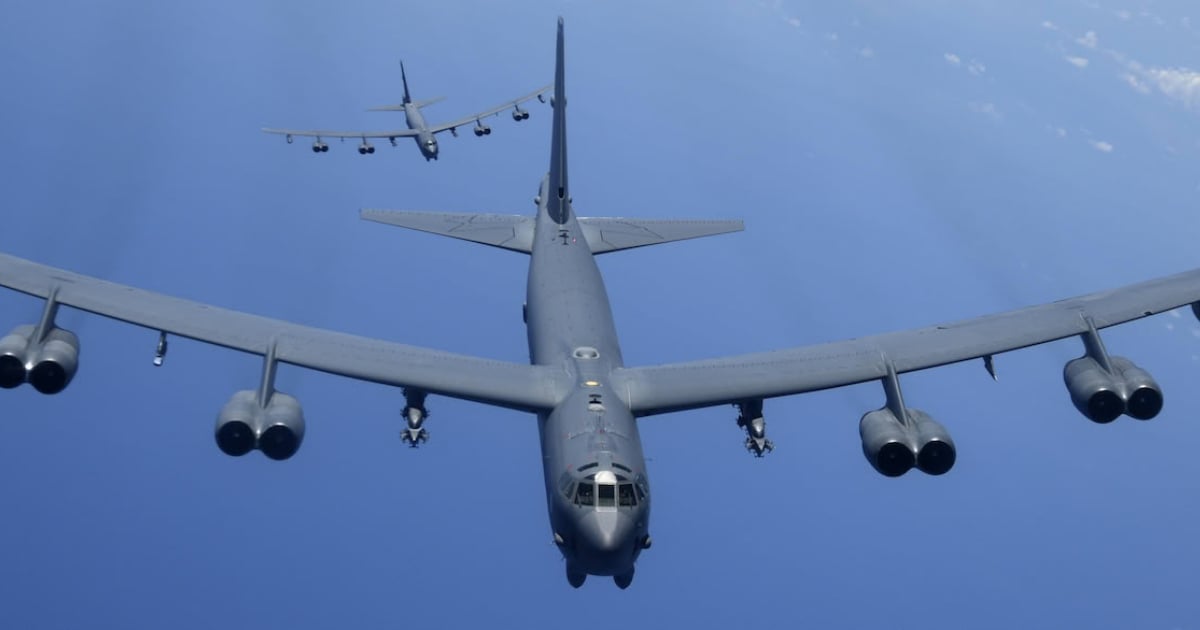
On Wednesday, official sources from the United States confirmed that two strategic B-52 bombers belonging to the U.S. Air Force conducted a flyover in the Caribbean Sea near the Venezuelan coastline. This maneuver was part of anti-narcotics military exercises orchestrated by the U.S. Southern Command (SOUTHCOM).
Renowned for their extensive range and significant payload capacity, these aircraft participated in joint exercises with the USS Iwo Jima Amphibious Ready Group. They were accompanied by AH-1Z Cobra and UH-1Y Venom combat helicopters from the 22nd Marine Expeditionary Unit, deployed in the region to "disrupt illicit drug trafficking and safeguard national territory."
The Southern Command's statement emphasized that these operations are coordinated with the Department of Defense and align with the strategic priorities set by President Donald Trump. During his second term, Trump has called for enhanced naval and aerial capabilities in the Caribbean.
Aerial tracking data confirms that the bombers remained strictly within international airspace, without infringing upon Venezuelan territory. Nonetheless, the visible flight path on monitoring platforms has sparked speculation on social media due to its apparent trajectory near areas governed by Nicolás Maduro's regime.
This aerial deployment occurs amidst escalating tensions between Washington and Caracas, just a day after President Trump announced a military operation against a vessel linked to drug trafficking in international waters adjacent to Venezuela. Trump reported that the operation, carried out under his executive authority, resulted in six fatalities, identified as members of a "designated terrorist organization."
The U.S. president asserted that intelligence confirmed the vessel's involvement in narcoterrorism networks and its passage through a known drug trafficking route. "There were no American casualties," he stated on his official social media channels.
Washington describes these initiatives as part of a broader strategy to apply pressure against the so-called "Maduro cartel," a criminal organization purportedly shielded by the Venezuelan state. In 2020, the United States had already filed narcoterrorism charges against Nicolás Maduro and several top officials of his administration.
The Venezuelan government condemned the U.S. maneuvers as an "armed aggression" and announced the activation of the "Independence 200" defense plan along coastal and border areas, deploying troops, militias, and reservists. Interior Minister Diosdado Cabello claimed that Washington's actions aim to "enforce regime change and seize Venezuela's natural resources."
State television in Venezuela broadcasted footage of internal military exercises, featuring messages of support for Maduro from the Bolivarian Armed Forces and representatives of ALBA-aligned countries, including Cuba, Nicaragua, and Bolivia. Vice President Delcy Rodríguez labeled the attacks on vessels as "extrajudicial and summary executions" and called for United Nations Security Council intervention. Other regional countries, such as Colombia, have also opposed the U.S. military presence in the area.
Key Questions About U.S. Military Exercises Near Venezuela
What was the purpose of the B-52 bombers flying over the Caribbean?
The B-52 bombers were part of anti-narcotics military exercises organized by the U.S. Southern Command (SOUTHCOM) to disrupt illicit drug trafficking and protect national security.
Did the B-52 bombers enter Venezuelan airspace?
No, the B-52 bombers remained within international airspace and did not enter Venezuelan territory.
How has the Venezuelan government responded to these U.S. military actions?
The Venezuelan government has denounced the U.S. maneuvers as an "armed aggression" and has implemented the "Independence 200" defense plan, mobilizing troops, militias, and reservists.