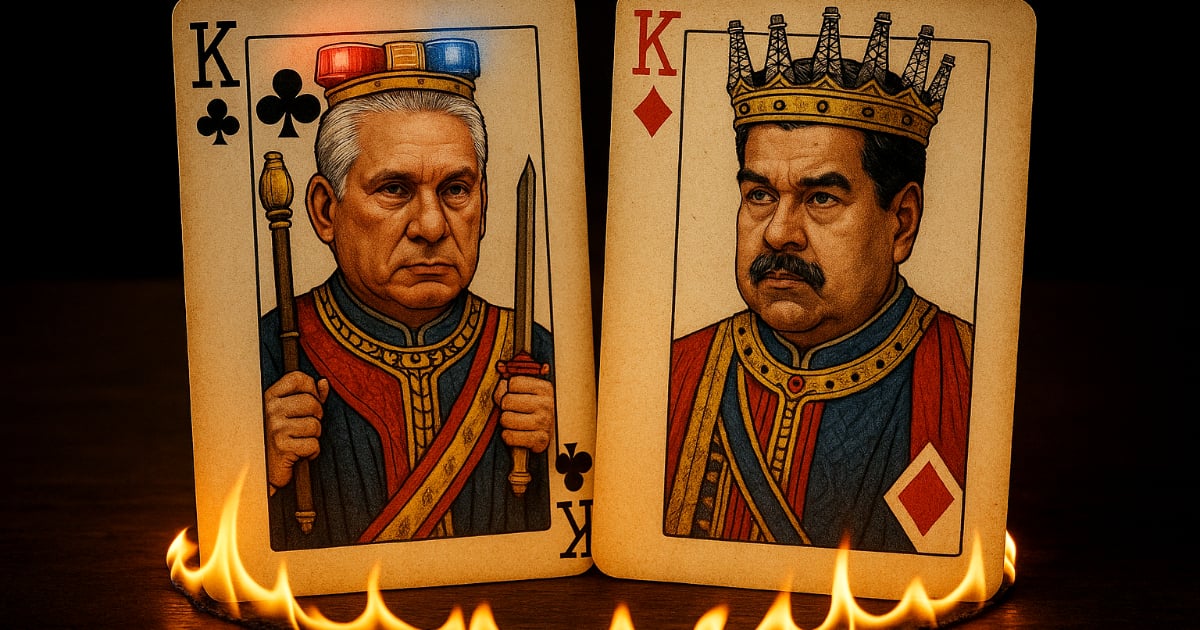
Esteemed American journalist Daniel Allott has issued a stark warning that reverberated across the region: "Venezuela is collapsing... and Cuba is not far behind." In an opinion piece for The Hill, the former editor of a prominent Washington publication described a parallel crisis threatening to unravel two authoritarian regimes that have endured for over two decades, sustained by corruption, drug trafficking, and political repression.
As Nicolás Maduro's government struggles under global pressure, Miguel Díaz-Canel's regime faces a structural breakdown surpassing the hardships of the Special Period. Widespread blackouts, rampant inflation, economic decline, and mass exodus depict a national disaster that Allott referred to as "a slow but inevitable fall of the Cuban system." "If Venezuela is teetering, Cuba is beginning to crumble," summarized the analyst, highlighting that the island is enduring its worst crisis in six decades, with a stagnant economy, a worthless currency, and a weary society.
Blackouts, Hunger, and Mass Exodus: Signs of Collapse
The Hill's article presented shocking statistics to its audience, though they are part of daily life for Cubans, including the fifth national blackout within a year on September 10. The power grid, deteriorating and poorly maintained, has collapsed a dozen times over the last 14 months. In many towns, Cubans are cooking by candlelight, charging phones at work, and sleeping on rooftops to escape the heat.
The energy crisis is dragging the rest of the country along with it. Venezuelan oil shipments, once the Cuban regime's economic lifeline for two decades, have plummeted from 56,000 barrels per day in 2023 to less than 8,000 by June 2025. Havana now relies on emergency shipments from Russia or Mexico, which are insufficient to meet domestic demand.
The consequences are dire: the Cuban peso hovers around 450 per dollar on the informal market, state wages are less than $20 per month, and tourism — once an economic powerhouse — has plummeted by over 50% in the last decade. Simultaneously, sugar production has fallen below 150,000 tons, the lowest since the 19th century. “Today, Cuba imports sugar, a tragic irony for a country that was once an agricultural giant,” Allott noted.
Adding to this is an unprecedented demographic crisis: over two million Cubans, nearly 20% of the population, have fled the island in just four years. The country is losing doctors, engineers, and teachers at a pace that makes any internal recovery impossible.
Interlinked Decline of Twin Dictatorships
The Hill's analysis also underscored the interdependence between Havana and Caracas. For 25 years, these regimes have propped each other up: Venezuela paid in oil, Cuba in intelligence, medical professionals, and political control systems. However, this "revolutionary" alliance is crumbling.
"Cuba and Venezuela are two exhausted revolutions clinging to a shattered ideology," wrote Allott. The journalist quoted Cuban dissident Óscar Biscet, who described both governments as "twin dictatorships sustained by corruption and transnational crime." According to Biscet, the Cuban regime "effectively occupies Venezuela's political and military institutions," using its influence to export repression and drug trafficking.
Hemisphere-Wide Implications of a Collapse
The article's final warning was directed at Washington. A collapse of the Cuban regime, just 90 miles from Florida, could have immediate repercussions: new waves of migration, a power vacuum, and the threat of foreign intervention. "The flickering lights in Havana — Allott warned — could be the hemisphere's next alarm."
This analysis comes as the United States strengthens its military presence in the Caribbean, as documented by CiberCuba in recent weeks, and as Venezuelan opposition leader María Corina Machado calls for a regional alliance "to free Cuba, Venezuela, and Nicaragua from communism."
If Venezuela's downfall is already in plain sight, Cuba's is happening in slow motion, under an official silence that cannot hide the catastrophe. As Allott concluded, "the pillars of Cuban socialism — energy, tourism, sugar, health, and education — are all collapsing simultaneously." And this time, neither Raúl Castro nor Maduro's oil can prop them up.
Understanding the Cuban and Venezuelan Crises
Why is Cuba facing such severe blackouts?
Cuba is experiencing widespread blackouts due to a deteriorating and poorly maintained power grid, which has collapsed multiple times in recent months.
How has Venezuela's oil supply to Cuba changed?
Venezuelan oil shipments to Cuba have dramatically decreased from 56,000 barrels per day in 2023 to less than 8,000 by mid-2025, severely impacting Cuba's energy supply.