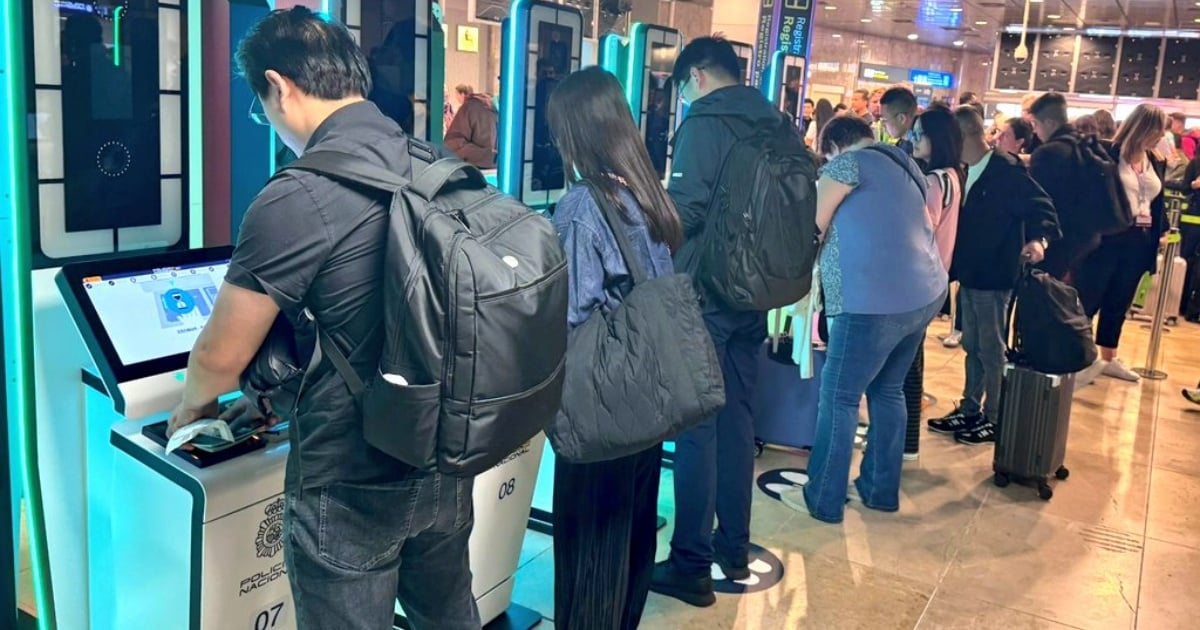
As of October 12, Cubans traveling to Europe must now comply with a new requirement: the Entry/Exit System (EES). This digital tool, now operational in several airports, significantly alters the process of entering and exiting the Schengen Area. The familiar passport stamp has been replaced by a biometric record that includes fingerprints, facial images, and other personal information.
While this change affects all non-European Union citizens, Cubans may find themselves particularly impacted. The automated system complicates one of the most common methods of migration—entering as a tourist and overstaying the permitted duration.
Understanding the EES: Transforming Border Experiences
Replacing the old manual passport-stamping process, the EES introduces a biometric and digitalized control system. From now on, travelers who lack European nationality or that of associated countries (Iceland, Norway, Switzerland, or Liechtenstein) must electronically register each time they cross an external Schengen border, whether by air, sea, or land.
Upon their first entry after the system's launch, travelers are required to provide a facial image, four fingerprints, and passport details, all of which will be stored in a database. European authorities claim that this system will ensure "accurate traveler identification" and significantly reduce wait times at border controls via self-service kiosks, though the initial process might be more time-consuming.
Travelers who have previously submitted their biometric data—such as during a visa application at a European embassy—won't need to repeat the process at the entry point, as their information will be integrated into the system.
A Real-Time Tracker for Your Stay
One of the most notable changes introduced by the EES is its capability to monitor each traveler's legal stay duration in real-time. The Schengen Area regulations allow short stays of up to 90 days within a 180-day period, accumulated across all countries applying the EES. This calculation, once obscure and prone to manipulation, will now be automatically managed by the system, notifying any time excess.
A spokesperson from the European Commission noted, "The passport stamp was a solution from the last century. This system will provide us with real-time data and reduce gray areas."
The aim of reducing these "gray areas"—such as the border routes used for unauthorized continental entry—is one of the main objectives of the new mechanism. For Cuban migrants who have traditionally entered on tourist visas and then overstayed, this automation presents a significant barrier. If a traveler overstays, the EES will record it, leading to potential fines, future entry restrictions, or even an automatic denial when attempting to re-enter Europe.
Gradual Implementation and Timeline
Although the EES is already operational, its implementation will be gradual. In the initial six-month phase, at least one border crossing per country must be equipped with the system, coexisting with the old passport-stamping method at ports and land crossings. High-traffic airports, such as those in Spain—a primary European destination for Cubans—are among the first to activate it.
The European Union plans for the system to be fully functional at all entry points by April 10, 2026, when the use of passport stamps will be completely phased out, and the EES will apply to all eligible travelers with biometric passports.
Distinguishing EES from Other European Systems like ETIAS
It is crucial not to confuse the EES with the European Travel Information and Authorization System (ETIAS), another mechanism that will be implemented later. ETIAS will require travelers to obtain a prior electronic authorization, similar to the U.S. ESTA system, and will apply to citizens of visa-exempt countries like the United States or Canada. However, it does not directly affect Cubans, who already need a visa to travel to Europe.
Implications for Cubans: Stricter Control, Fewer Opportunities for Irregular Migration
For many Cubans, the Schengen visa has long been a means to settle in Europe. Once inside the common area, and facing challenges in regularizing their status from the island, some opted to stay beyond the permitted time and either seek asylum or find informal residence solutions. With the introduction of the EES, this strategy becomes riskier.
The new system not only records when a person enters but also when they leave. If the system detects overstaying, it can permanently record the violation, complicating future access to Europe, even if the person tries to return with a valid visa. Moreover, the system does not currently allow exceptions for humanitarian reasons or family reunification during this implementation phase.
Cubans with dual Spanish nationality or European residency permits can still process invitation letters for relatives, but those visitors will be subject to biometric control and time limitations like any other third-country traveler.
The EES is part of a broader European Union plan to create "smart borders," where migration flows are controlled, and security threats can be detected more efficiently. According to the EU Council, expected benefits include enhanced internal security, combating identity fraud, and improved cooperation between European information systems.
Key Questions About the Schengen Area Entry/Exit System
What is the Entry/Exit System (EES)?
The EES is a digital system that replaces the traditional passport stamping process with a biometric record, including fingerprints and facial images, to monitor entry and exit from the Schengen Area.
How does the EES impact Cuban travelers?
The EES makes it more challenging for Cuban travelers to overstay their visas, a common method of migration, by automatically tracking and recording their entry and exit times.
Is the EES related to the ETIAS system?
The EES is separate from ETIAS, which is an upcoming system requiring electronic travel authorization for visa-exempt countries. EES focuses on biometric entry/exit tracking, while ETIAS involves pre-travel authorization.