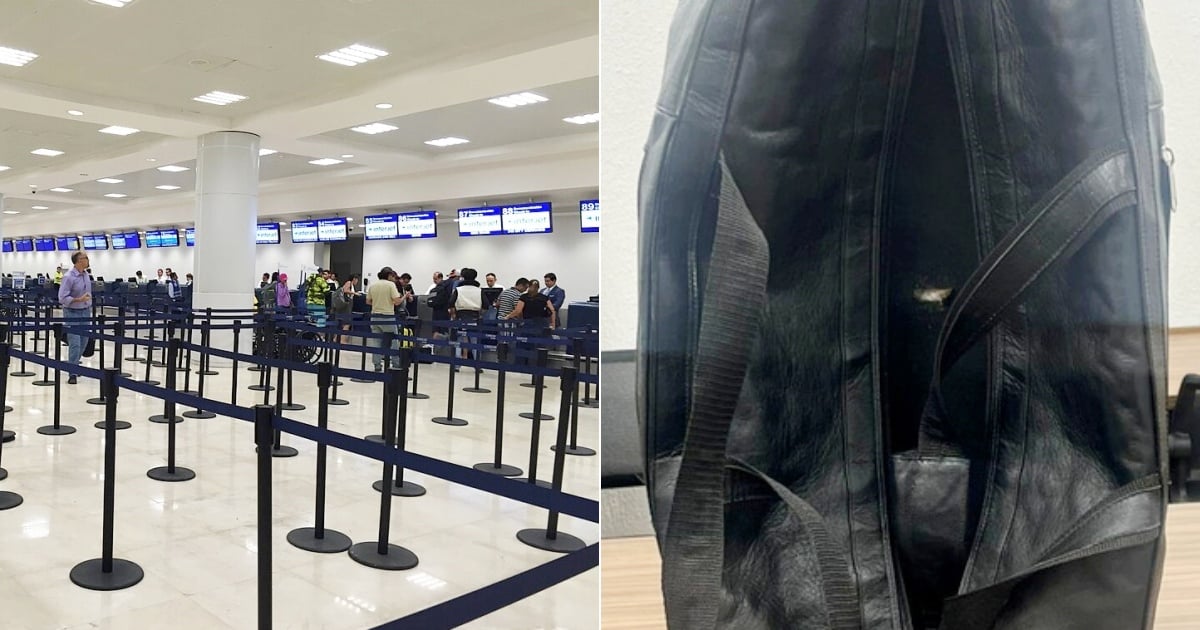
A traveler attempting to board a flight from Cancún to Havana was apprehended for carrying cocaine hidden in a false bottom of his luggage. The discovery was made by the National Guard in collaboration with specialized canine units, as part of their surveillance operations at the Cancún International Airport in Quintana Roo.
The arrest occurred when National Guard members, following Mexico's National Security Strategy, were alerted by X-ray personnel about anomalies detected in a leather suitcase. The bag, located on the last waiting room's conveyor belt, belonged to a traveler preparing for a flight to Havana.
In response to the alert, agents conducted an inspection operation with the aid of a drug-detection canine unit. According to the official statement, the dog "gave a positive indication for the presence of a white powder, consistent with cocaine."
During a thorough examination of the suitcase, officers discovered "a false bottom containing a package," which underwent testing with specialized equipment to identify illegal substances. Tests confirmed the substance was cocaine hydrochloride.
The traveler was immediately detained. He was read his rights according to the Rights of Persons in Detention Card, and his registration in the National Detention Registry was formalized. Both he and the seized luggage and narcotics were handed over to the Federal Public Prosecutor's Office, which will determine his legal status and potential charges related to drug offenses.
Escalating Drug Smuggling Attempts to Cuba
This incident highlights ongoing attempts to smuggle drugs into Cuba using increasingly ingenious methods. Recently, Customs has reported discovering substances hidden in electric showers, water pumps, tuna cans, religious figures like Eleguá, clothing soaked in liquid cocaine, gummies, and even within travelers' bodies.
Authorities emphasize that these findings demonstrate the effectiveness of X-ray technology and staff training. However, details about detainees or involved networks are seldom disclosed, leaving the public with the official narrative reinforcing a "zero tolerance" stance on drugs. Recently, a Spanish police team arrived in Havana to train Customs personnel in combating drug trafficking.
This collaboration is part of a bilateral agreement aimed at enhancing Cuba's capabilities in detecting and countering drug trafficking, including cocaine, heroin, cannabis, and synthetic drugs.
Cocaine Smuggling Incidents and Legal Consequences
How was the cocaine discovered in the traveler's luggage?
The cocaine was detected by a specialized canine unit during a routine inspection at Cancún International Airport, following an alert from X-ray personnel about a suspicious suitcase.
What legal actions were taken against the traveler?
The traveler was detained and his rights were read according to the Rights of Persons in Detention Card. His case was transferred to the Federal Public Prosecutor's Office to determine his legal status and potential charges.
What measures are being taken to prevent drug smuggling into Cuba?
Cuba is enhancing its capabilities to detect and combat drug smuggling through collaboration with international partners, such as the recent training provided by Spanish police to Customs personnel.