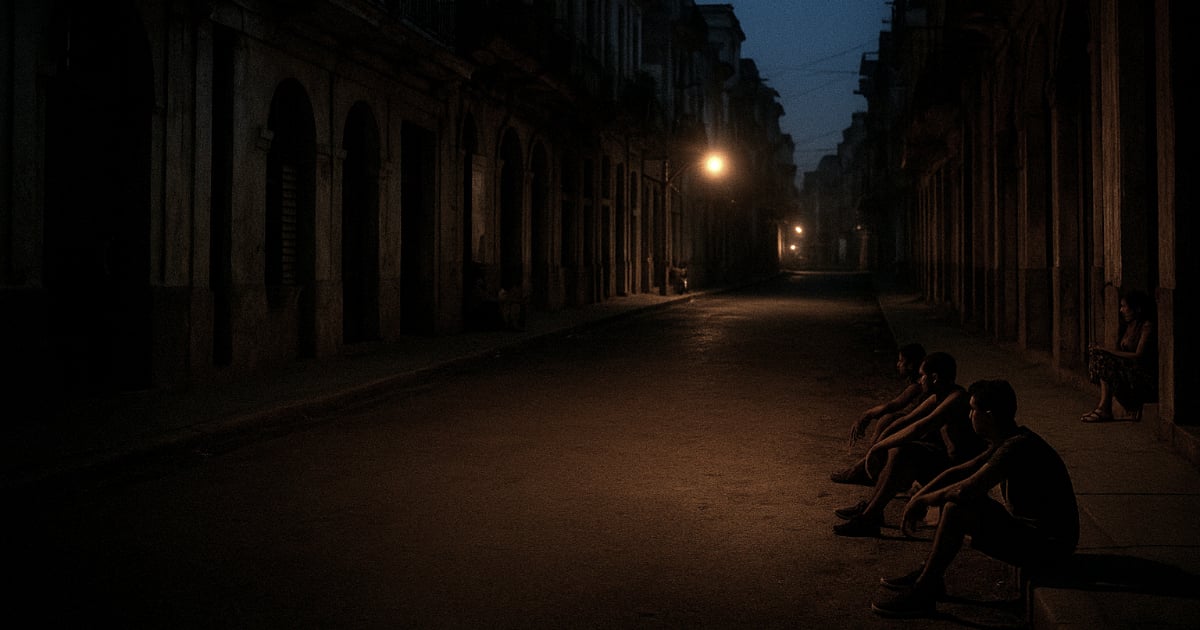
Cuba woke up in darkness once more. Despite repeated assurances from the regime to stabilize the national electrical grid, the country remains ensnared in a relentless cycle of blackouts that exceed 20 hours daily in several regions, as the energy sector's deterioration worsens.
According to the official report from the Unión Eléctrica (UNE) on Tuesday, it is anticipated that around 50% of the nation will be without power during the peak demand period at 7:50 PM. The maximum demand is estimated at 3,350 MW, while only 1,750 MW is available, resulting in a deficit of 1,600 MW and an expected impact of 1,670 MW.
The UNE itself admitted that services were disrupted throughout the entire day on Sunday and remained unrestored into the early hours of Monday, confirming that blackouts have not only persisted but have become a national norm. The energy report specifies that the availability of the National Electrical System (SEN) at 6 AM stood at 1,620 MW, against a requirement of 2,600 MW, with 993 MW impacted due to generation shortages.
During daylight hours, an average impact of 1,250 MW is projected, prolonging outages across most provinces. The state company identified several causes of the collapse, including malfunctions in Unit 8 of the Mariel CTE, Unit 5 of the Diez de Octubre CTE, Units 1 and 2 of the Felton CTE, and Unit 3 of the Renté CTE. Additionally, maintenance is underway on Unit 2 of the Santa Cruz CTE and Unit 4 of the Carlos Manuel de Céspedes CTE in Cienfuegos.
Compounding these structural failures are thermal limitations of 326 MW and a fuel shortage that has left 43 distributed generation plants offline, with 322 MW halted, plus another 172 MW unavailable due to a lack of lubricant, bringing total disruptions from this cause to 494 MW.
The official report notes that for peak hours, 50 MW might be added through distributed generation engines and another 30 MW with the activation of turbine 5 at Energás Jaruco. Yet, even with these additions, the deficit remains severe and systemic.
Far from improving, the island's energy situation has deteriorated under the present administration, which continues to promise "stability" while Cuban families endure entire days without electricity, water, or refrigeration amid oppressive heat and disease outbreaks. Social media and citizen reports reveal growing desperation as blackouts disrupt daily life, work, and food supplies.
In provinces like Holguín, Santiago de Cuba, Villa Clara, and Pinar del Río, power cuts lasting from 18 to 22 hours have become the norm, while in the capital, UNE's so-called "programming blocks" are no longer adhered to. Solar production, touted by the regime as an energy alternative, remains insufficient. The 32 new photovoltaic parks generated merely 2,103 MWh in the latest report, with a peak capacity of 446 MW, a negligible figure compared to system demands.
While the government attempts to showcase renewable energy advancements, the population confronts total blackouts, empty refrigerators, and spoiled medications, a scenario that underscores the failure of energy policies and the lack of infrastructure investment.
Understanding Cuba's Energy Crisis
What is causing the frequent blackouts in Cuba?
The blackouts are primarily due to a combination of structural failures in power plants, maintenance issues, thermal limitations, and a significant shortage of fuel.
How long are the blackouts lasting in Cuban provinces?
In some provinces, blackouts can last from 18 to 22 hours, severely affecting daily life and essential services.
What measures is the Cuban government taking to address the energy crisis?
The government is attempting to incorporate additional power through distributed generation engines and new renewable energy projects, but these efforts have yet to significantly alleviate the crisis.