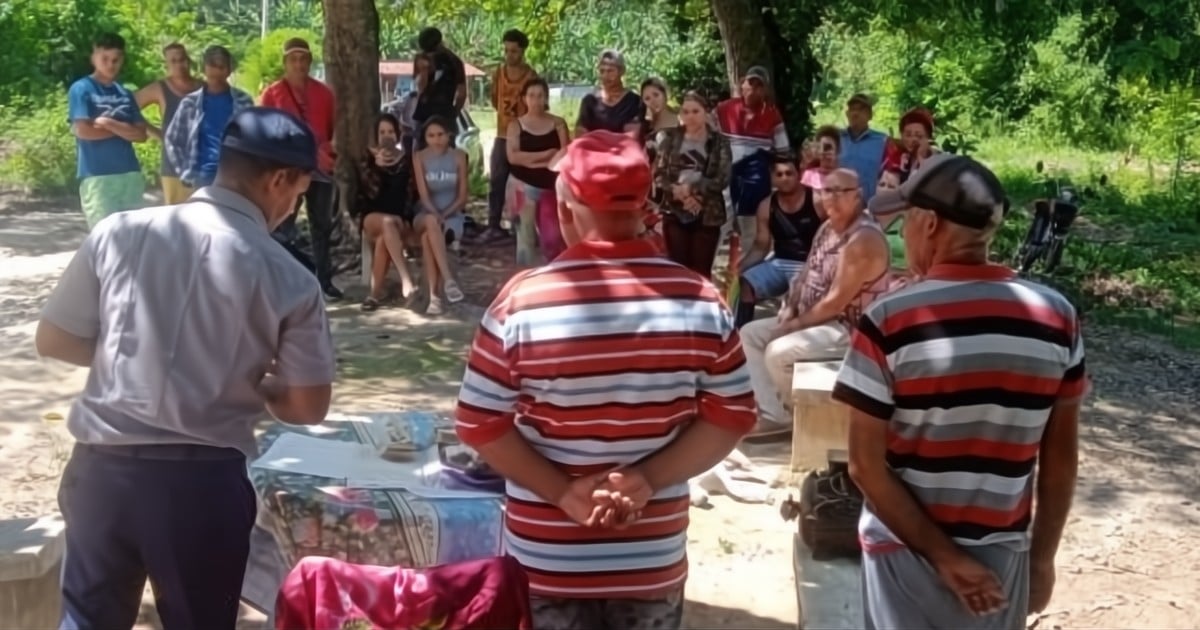
The Ministry of the Interior (Minint) staged a public event to return over 500,000 pesos to a resident of La Nenita, a town in the Guisa municipality of Granma province. This event appeared more like a propaganda operation than a straightforward act of justice. The restitution of the funds was reported on Sunday by Entérate con Aytana Alama, an official regime spokesperson and frequent Minint mouthpiece, who hailed the event as a remarkable achievement.
"What joy for the Guisa resident who received more than 500,000 pesos that had been stolen," wrote Alama, alongside photos of the event, which turned into a propaganda spectacle. The event, lacking details on how the case was resolved or who committed the theft, focused on the message that “the regime delivers.” Locals, seemingly gathered as part of the event, attended the ceremony.
Images shared from the event depict officers and civilians witnessing the money's return, as if it were a ceremonial occasion. This incident highlights a growing trend in the Cuban regime’s narrative: transforming basic state functions—such as investigating a crime and returning stolen property—into social media content to bolster the image of institutional effectiveness.
The Propaganda Machine at Work
Actions that should be the bare minimum for authorities are presented as feats worthy of public applause, contrasting with the government’s usual inaction. The spectacle, with locals as spectators and celebratory media coverage, demonstrates the regime's eagerness to capitalize on any event that can be portrayed as a triumph of the system. However, these “happy endings” are rare compared to the many unresolved cases under the regime’s repressive apparatus, making these incidents ripe for a Cuban crime novel narrative.
Public Skepticism and Criticism
On social media, some users reacted with skepticism and irony towards the Minint’s public event in Guisa. “Is all this fuss really necessary just to return that money? Please...,” commented Yoli Rosales, critiquing the unnecessary show for fulfilling a basic duty. Others highlighted that not all cases receive the same “media treatment.”
“They need to come to Río Cauto and find the batteries stolen from the hospital plant,” wrote Aymara García Reyna, pointing to the neglect of other complaints. José Luis Marañón Rodríguez sarcastically referenced a popular saying, “Thief who steals from a thief has 100 years of pardon,” referring to the double standard perceived by many Cubans when actions that shouldn’t require applause are celebrated.
A Pattern of Propaganda
The use of public events like the one organized by the Minint in Guisa is not new. In Cuba, returning stolen items has been turned into propaganda scenes, where the focus is on narrative rather than justice. In September, the police organized a political rally to return a bicycle and a mobile phone in Villa Clara, complete with flags, slogans, and speeches, as if catching a thief were an epic achievement.
Meanwhile, most crimes remain unsolved. Recently, the organization Cubalex reported that children and adolescents in Cuba suffer from arbitrary detentions, institutional violence, and neglect, with no access to justice or support, highlighting the disconnect between official discourse and the reality of the most vulnerable.
Even symbolic acts like sweeping leaves at the Palace of the Revolution have been used to create images of proximity and humility. Díaz-Canel was photographed sweeping the government gardens, a trivial gesture magnified by official media while Cubans wait in line for hours to obtain a piece of bread or basic medicine. Simultaneously, the anniversary of the CDR was celebrated with a bicycle named “Patria,” showcased as a symbol of resilience in a country where public transportation has collapsed, making daily travel an odyssey for millions.
These staged events reinforce a propaganda strategy that seeks to mask institutional decay with superficial gestures.
Frequently Asked Questions about Cuban Propaganda
What was the purpose of the Minint's public event in Granma?
The event was organized to return over 500,000 pesos to a resident of La Nenita, but it appeared more like a propaganda effort than a straightforward act of justice.
How did the public react to the Minint's event?
Many reacted with skepticism and irony, questioning the necessity of such an elaborate display for fulfilling a basic duty.
Has the Cuban regime used similar propaganda tactics in the past?
Yes, the regime has frequently used public events to create propaganda, focusing on narrative rather than justice.