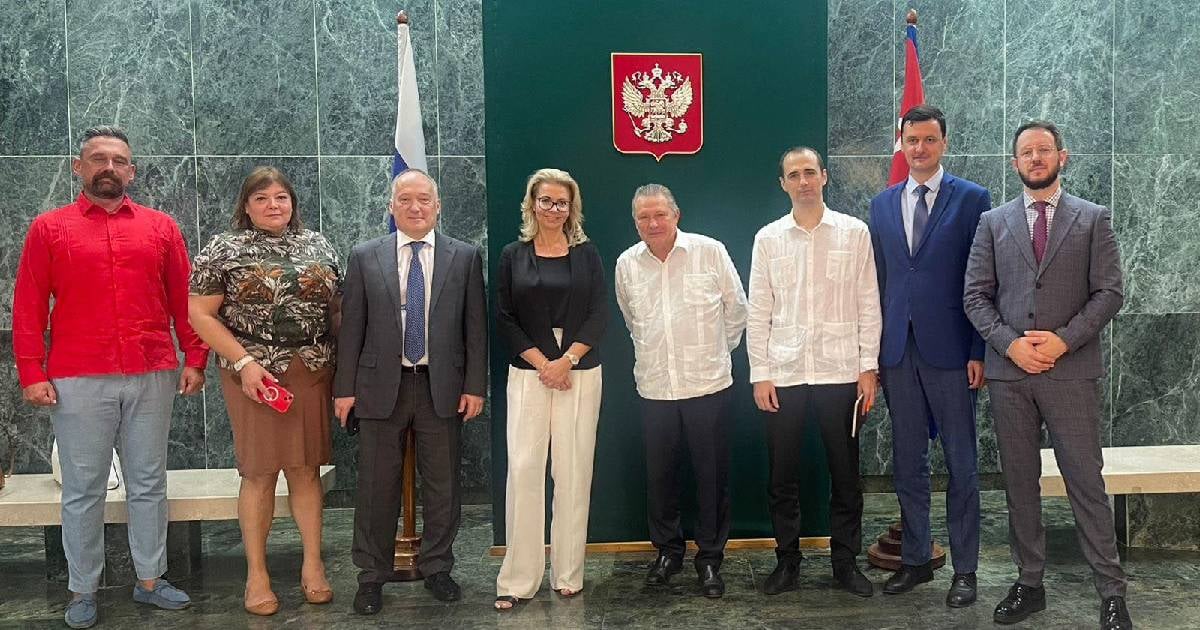
The Russian Ambassador to Cuba, Victor Koronelli, recently convened with Elena Gueorguieva, chairwoman of Novikombank's board, in Havana. This meeting aimed to evaluate the progress of the bilateral banking cooperation. Held on Tuesday, October 7, the discussion focused on the future of Russian-Cuban financial collaboration and an upcoming seminar for representatives of major Cuban banks, ministries, and relevant institutions. This event, organized by Novikombank, will take place in Havana, the diplomatic delegation shared on their Facebook page.
This meeting bolsters a relationship that has been strengthening since 2024, when Novikombank established its first branch in Havana, marking the first official Russian bank presence in the Caribbean nation. In April 2025, both parties agreed to conduct bilateral transactions using the ruble, further distancing the island from the Western financial system.
The Russian institution, a part of the state-owned Rostec corporation, has been promoting the use of the MIR card in Cuba and maintaining agreements with the Central Bank and other entities for ruble operations. Since December 2023, Russia has enabled the use of MIR bank cards in Cuba, as an alternative to Visa and Mastercard, though currently restricted to Russian citizens. Earlier that month, the Cuban government approved the use of MIR cards in ATMs and point-of-sale terminals nationwide.
Strengthening Financial Ties
Gueorguieva expressed satisfaction with the progress of the partnership, stating that "joint efforts with major Cuban banks will be mutually beneficial." The strengthening of the financial axis between Moscow and Havana is part of the Kremlin's strategy to expand its economic footprint in Latin America and support the Cuban government's quest for alternatives to the dollar and Western markets.
The Cuban government has acknowledged outstanding debts to Russian companies and committed to fulfilling its financial obligations, albeit contingent upon future economic recovery. During his visit to the island in April, Russian Deputy Prime Minister Dmitri Chernishenko affirmed that Russia "will aid in achieving sovereignty, economic well-being, and prosperity" for Cuba.
Furthermore, Russia's Energy Minister Serguéi Tsiviliov pledged to advance the modernization of Cuba's energy system, including the construction of a new 200-megawatt (MW) generating unit and the repair of existing 100 MW blocks, amid the island's severe energy crisis.
Economic Partnerships and Strategic Developments
In September 2024, the Russian government announced plans to offer new credit lines, while in March of that year, Russian President Vladimir Putin approved modifications to credit agreements between Russia and Cuba. Cuban President Miguel Díaz-Canel has visited Russia multiple times, most recently in May 2025, to strengthen bilateral relations and seek economic support amid Cuba's crisis.
The close relationship between the two governments has faced criticism from civil sectors disapproving Havana's support for Moscow, especially following the 2022 invasion of Ukraine. In late June, Díaz-Canel proposed establishing a logistics hub in Cuba to distribute goods from the Eurasian Economic Union (EAEU) members to Latin America and the Caribbean. The EAEU comprises Armenia, Belarus, Kazakhstan, Kyrgyzstan, and Russia, with Cuba and Uzbekistan participating as observer states since December 11, 2020.
During the plenary session of the IV Eurasian Economic Forum in Minsk, Belarus, on June 26-27, Díaz-Canel suggested utilizing a special economic zone west of Havana as the project's base, envisioning the Cuban capital as a transit point for goods between Eurasia and Latin America.
Additionally, at the end of June, it emerged that Russia and Cuba are advancing a new strategic alliance to develop a joint logistics center in the Mariel Special Development Zone (ZEDM), located 45 kilometers west of Havana. This enclave could position the island at the heart of Russian trade with Latin America but also raises questions about sovereignty, dependence, and actual benefits for the Cuban populace.
The announcement was confirmed by Russian official media following the St. Petersburg International Economic Forum (SPIEF 2025). Tatyana Mashkova, president of the National Committee for Economic Cooperation with Latin America, stated that both parties are already working "in parallel" to establish this center in Cuba's most significant deep-water port.
Moreover, the Cuban government has offered 50 hectares within the ZEDM for creating an industrial park for the EAEU. The land is to be leased for 50 years, with the possibility of extension.
Frequently Asked Questions about Russian-Cuban Financial Relations
What is the significance of Novikombank's presence in Cuba?
Novikombank's presence in Cuba marks the first official representation of a Russian bank in the Caribbean nation, facilitating financial transactions and strengthening economic ties between Russia and Cuba.
How does the use of the MIR card impact financial transactions in Cuba?
The introduction of the MIR card provides an alternative to Visa and Mastercard for Russian citizens in Cuba, potentially increasing financial independence from Western markets.
What are the implications of the proposed logistics hub in the Mariel Special Development Zone?
The logistics hub could position Cuba as a central player in Russian trade with Latin America, though it raises concerns about sovereignty and the tangible benefits for the Cuban population.