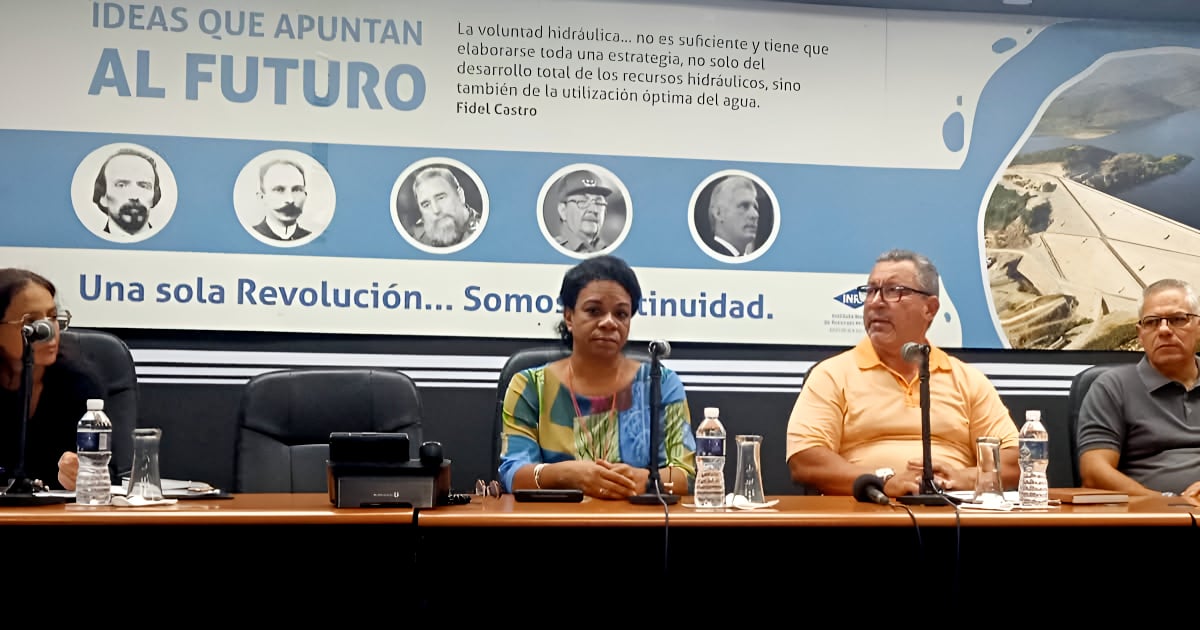
Amid prolonged water supply interruptions affecting hundreds of thousands of Cubans, Deputy Prime Minister Inés María Chapman Waugh resorted to the tired official mantra of “working with a culture of detail” this past Friday. This phrase has been repeatedly used by the regime for over a decade as a substitute for concrete policies to address the nation’s structural issues.
Chapman posted on X (formerly Twitter), “After assessing the situation on the ground, actions are being implemented to improve water supply in Eastern Havana. The National Institute of Hydraulic Resources has formed a working group to address pump repairs, valve replacements, and leak solutions. Working with a culture of detail.”
This message comes in the midst of one of Cuba's most severe water crises in recent years. Official statistics indicate that over 230,000 Havana residents are experiencing complete or partial service disruptions, while provinces such as Santiago de Cuba, Holguín, Ciego de Ávila, and Sancti Spíritus report distribution cycles that can exceed 30 days without running water.
In many communities, residents rely on irregular state water deliveries or pay exorbitant prices for private water trucks. The reference to a “culture of detail” — a slogan adopted since General Raúl Castro took power — has frequently been echoed by Miguel Díaz-Canel and other leaders to call for “efficiency,” “good taste,” and “order” in state operations. However, this concept has devolved into a propagandistic catchphrase devoid of actual substance, never translating into effective public policies or sustainable solutions for the populace's challenges.
Realities on the Ground
Recently, CiberCuba has documented the worsening potable water scarcity and public frustration with institutional neglect. In neighborhoods like La Habana Vieja, Diez de Octubre, and Guanabacoa, residents report going more than a month without receiving a drop of water. Meanwhile, power outages disrupt pump operations, and leaks remain unrepaired.
Chapman’s call for “working with a culture of detail” starkly contrasts with the reality of a collapsed hydraulic system, lacking maintenance resources, aging infrastructure, and insufficient energy to sustain pumping operations. On the streets, where water is absent, many Cubans see this phrase as a reminder of the disconnect between official rhetoric and daily life.
Chapman Waugh's Unorthodox Proposals
Inés María Chapman is no stranger to making statements that highlight the regime’s disconnect with everyday realities. Recently, she suggested “bringing a television outside and connecting it to a generator” so that residents could watch government directives during blackouts, a suggestion that was widely mocked on social media.
Earlier, in June of 2024, Chapman was filmed at a well in Santa Isabel de las Lajas, demonstrating — with a bottle of Ciego Montero water in hand — how to apply “science and innovation” so that residents could procure water using a “small, hand-operated pump, nicely painted green.” This scene went viral as a symbol of official insensitivity to hardship.
Also in 2024, the deputy prime minister was involved in another controversy after she published and then deleted a tweet inadvertently revealing part of the regime’s strategy for “social media engagement,” detailing the use of numerous corporate accounts for digital “combat” from the Institute of Information and Social Communication.
Between the water bottle, the TV with a generator, and the “culture of detail” slogan, Chapman Waugh has become one of the most emblematic figures of empty rhetoric and governmental bewilderment in the face of a national crisis that only worsens by the day.
Understanding Cuba's Water Crisis and Government Response
What is causing the current water crisis in Cuba?
The water crisis in Cuba is primarily due to aging infrastructure, insufficient maintenance resources, and frequent power outages disrupting pump operations, leading to prolonged water supply interruptions.
How have Cuban officials responded to the water shortages?
Cuban officials, like Deputy Prime Minister Inés María Chapman, have reiterated slogans such as "working with a culture of detail," but these have not translated into effective policies or solutions to the water shortages.