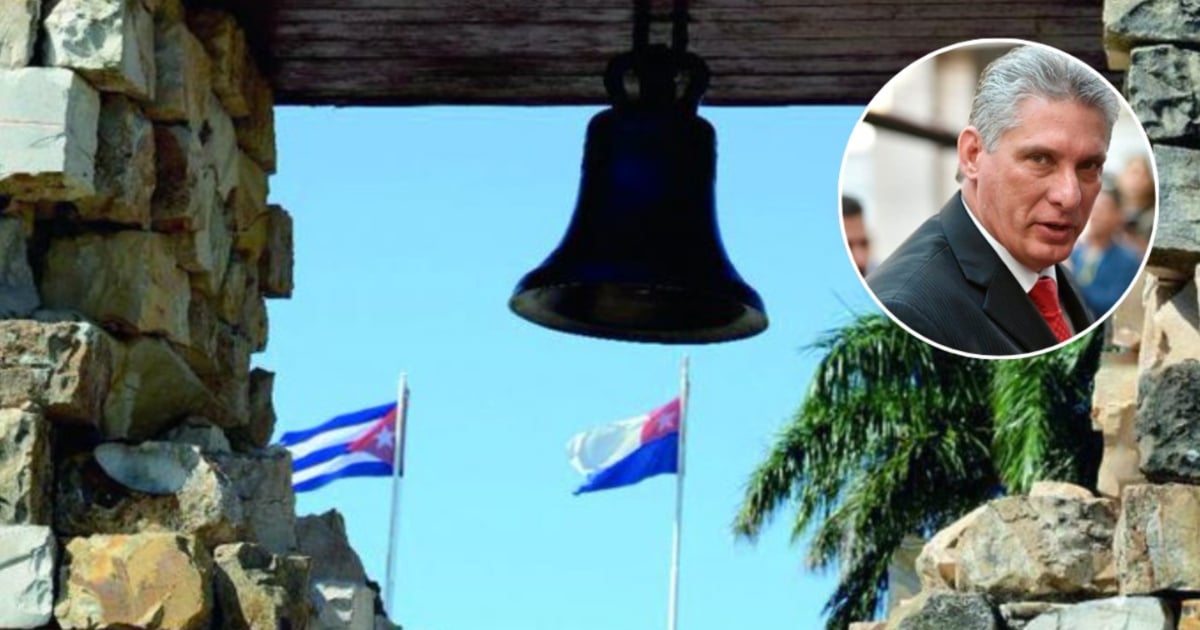
A statement by Cuban leader Miguel Díaz-Canel on the anniversary of Carlos Manuel de Céspedes' uprising has triggered a wave of criticism on social media. The controversy arose after Díaz-Canel claimed that the Cuban Revolution "began" on that date, October 10, 1868, in the sugar mill at La Demajagua.
The leader of the regime described that historic event as a "compass and guide" for the rise of Fidel Castro to power in 1959. However, his comments were met with backlash from users who accused him of "mixing" distinct historical events and co-opting the independence movement to legitimize the current government.
Díaz-Canel stated, "The radicalism and virtue of the protagonists of that uprising remain a compass and guide," effectively linking the 1868 Cry of Yara with Fidel Castro's revolution. This stance ignited a series of responses that questioned the historical continuity he proposed.
Among the most shared reactions was a user's question: "What does Céspedes' liberation of the slaves have to do with Fidel's 'revolution'? Stop distorting history. 1868 was evolution; 1959 was destruction." Others demanded not to "claim the liberators' struggle" or "taint their memories," accusing the current government of oppressing the people.
It was also noted that "the fight for independence ended on May 20, 1902, with the founding of the Republic of Cuba," referencing the conclusion of the independence cycle against Spain. Some responses included harsh language directly challenging the leader.
The exchanges highlighted the divide between the regime's narrative and the people's sentiment. One user starkly stated, "If those mambises were alive today, they would have beheaded all of you with a machete charge, which is what Cuba needs right now."
While the government attempts to draw a line of continuity between the 19th-century independence wars and the process initiated in 1959, a segment of the citizenry insists on distinguishing these periods, advocating for the republican character achieved in 1902 and rejecting its political exploitation.
The controversy fuels a broader debate on historical memory and official narratives in Cuba. For many historians and citizens, such claims aim to manipulate the past to justify the present, appropriating liberating struggles that predate the movement led by Fidel Castro in 1959.
Exploring the Historical Context of Cuba’s Revolution
What was the significance of the Cry of Yara in 1868?
The Cry of Yara marked the beginning of Cuba's Ten Years' War against Spanish colonial rule, initiated by Carlos Manuel de Céspedes, who freed his slaves and urged them to join the fight for independence.
How do citizens view the link between 1868 and 1959 revolutions?
Many Cubans view these as separate historical events, advocating that the independence achieved in 1902 should not be conflated with the political changes brought by Fidel Castro in 1959.