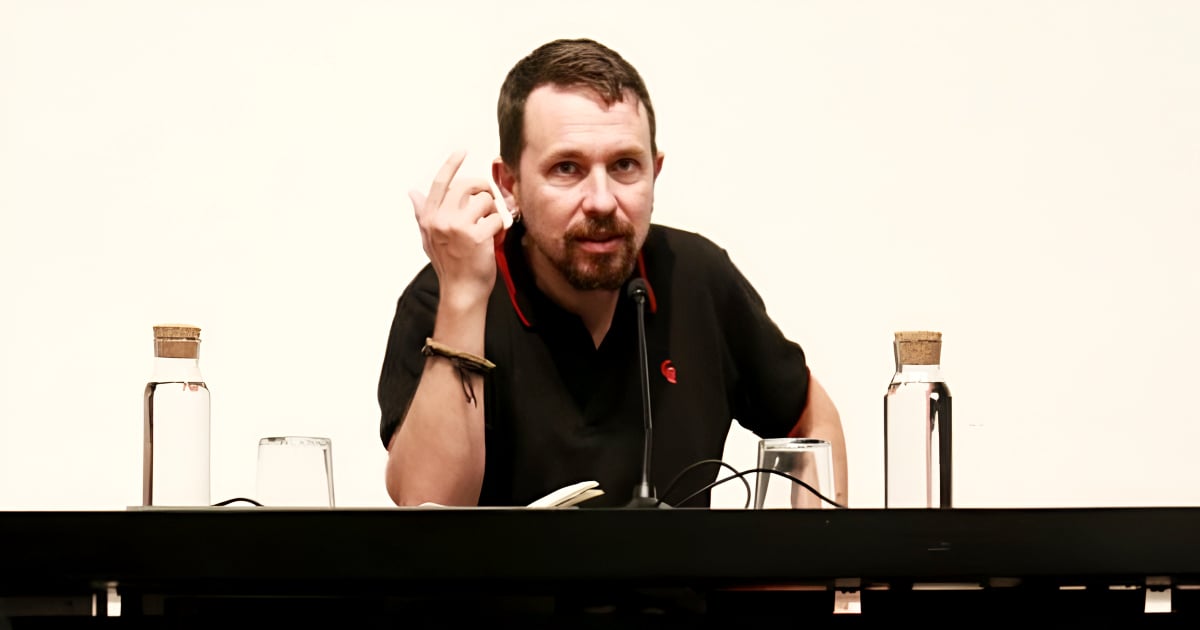
This past Friday, a significant uproar erupted on the social platform X (formerly Twitter) following a provocative statement by Pablo Iglesias, the former Vice President of Spain and founder of Podemos. Iglesias claimed that if communism were to fall in Cuba, the island would devolve into "a democracy like Haiti," marked by "hunger, violence, illiteracy, and complete lack of services."
The controversial comment emerged amidst a heated exchange between Iglesias and Cuban activist Magdiel Jorge Castro, an exiled communicator and member of the CiberCuba editorial team. Castro harshly criticized the Spanish politician for his remarks about Venezuelan opposition leader María Corina Machado, recently awarded the Nobel Peace Prize. Iglesias tweeted, "If they are giving the Nobel Peace Prize to Corina Machado, who has been trying to stage a coup in her country for years, they might as well have given it to Trump or even Adolf Hitler posthumously."
This mocking and hyperbolic statement ignited outrage across social media. Magdiel responded fiercely, labeling Iglesias as "authoritarian trash" and condemning his disdain for freedoms in Cuba and Venezuela. Rather than tempering his rhetoric, Iglesias retaliated by calling Magdiel a "traitor" and a "right-wing lapdog," accusing him of wanting to turn Cuba into "a democracy like Haiti."
At this point, the argument transcended mere social media bickering, exposing a deeply ingrained mindset within certain factions of the European radical left: the belief that any democratic alternative to socialism in Cuba would inevitably lead to chaos, dire poverty, and state collapse.
Insulting and Misleading Comparisons
Iglesias's assertion that a post-communist Cuba would resemble Haiti is not only incorrect but ideologically insidious. Such a claim represents a "false dilemma," presenting only two possibilities when, in reality, there are many more.
In this narrative, either Cuba maintains its communist regime—with its associated repression, poverty, censorship, and scarcity—or it becomes a collapsed state devoid of education, healthcare, and social unity, akin to Haiti. The implicit message is clear: "better dictatorship than disorder," echoing the rhetoric of Franco's dictatorship supporters in Spain.
This argument is profoundly offensive to both Cubans and Haitians. It denies Cubans the ability to build a democratic and prosperous future while simplifying Haiti's historical tragedies—centuries of colonialism, foreign intervention, natural disasters, and corruption—into a caricature of "failed capitalism" supposedly avoided by the Cuban revolution.
Why Use Haiti as an Example?
Employing Haiti as a scare tactic is not new. For years, pro-regime leftist figures—both within and outside Cuba—have used the Haitian example as political and emotional blackmail: if the Cuban system falls, chaos is inevitable.
This argument serves multiple purposes:
- Delegitimizing Democratic Alternatives: It suggests that those advocating for change in Cuba seek not freedom or justice, but hunger, violence, and destruction, as if pluralism, open economies, and human rights are threats rather than legitimate goals.
- Instilling Fear in Cubans: For decades, official propaganda has insisted that without the Communist Party, Cuba would become Haiti or a "failed state" controlled by imperialist interests. Iglesias merely echoes the regime's narrative with a different accent.
- Ideologically Shielding the Regime: If every attempt at change leads to disaster, then all criticism is invalidated. Despite political prisoners, insufficient wages, 20-hour blackouts, and doctors without medicine, the Cuban system remains "preferable."
Cuba and Haiti: Divergent Paths and Potentials
Comparing Cuba to Haiti fails both historically and structurally. The two countries have vastly different trajectories:
- Before 1959, Cuba was one of Latin America's most prosperous economies, boasting a high GDP per capita, a large middle class, over 70% literacy, and a strong cultural and commercial presence in the region.
- Cuba has a highly qualified human capital, recoverable institutional infrastructure, and a well-organized diaspora capable of contributing investment, knowledge, and leadership.
- Haiti, conversely, has endured repeated institutional collapses, a structurally informal economy, lack of territorial control in key areas, widespread violence, and chronic humanitarian crises.
Suggesting that Cuba would follow Haiti's path if it abandons communism denies the history, potential, and capacity of the Cuban people to organize an orderly democratic transition with modern institutions, civil liberties, and a productive economy.
European Romanticism and Cynicism
The alarming aspect of Iglesias's stance is not merely ignorance but conscious cynicism. As a Madrid-based politician, he enjoys democracy, private sector earnings, free publication, and founded a political party—privileges of the very system he critiques. Yet, from this comfort, he and his partner, Spanish deputy Irene Montero, justify repression in Cuba.
"The revolution, with all its errors and injustices, remains a more decent model than the one offered, under U.S. tutelage, to other Caribbean peoples," Iglesias wrote toward the end of his dispute.
Is it a "more decent model"? A country where 72% of the population lives below the poverty line, physicians earn barely $30 a month, there are over a thousand political prisoners, inflation exceeds 1,200%, protests are criminalized, and free association is punished?
Iglesias's discourse suggests an inverted colonial logic: Southern peoples must sacrifice in the name of a symbolic revolution, while Northern intellectuals celebrate it from their comfortable democracies. Magdiel aptly described this as "ideological tourism": "They wage the revolution in Latin America to watch from afar while enjoying democracy's privileges in Spain."
And What of Democracy?
Iglesias caricatures the Cuban opposition and exile as "mercenaries of Trump and Marco Rubio," as if the only possibility for democracy in Cuba is one overseen by the CIA. However, he overlooks the hundreds of thousands of Cubans—youth, artists, journalists, workers—who want what he already has: the right to vote, speak out, form a party, criticize power without fear of imprisonment.
"The revolution is not a model for anything... there are young people in their 20s imprisoned for doing what your party and you do in Spain every day," Magdiel reminded him.
What Does This Controversy Reveal?
This exchange between Iglesias and Magdiel is more than an anecdote. It highlights the clash between two worldviews:
- The exiled defending their people's rights from the perspective of suffering.
- The European bourgeois playing at being revolutionary but unwilling to live under the conditions of the system they justify.
The controversy also exposes that the Spanish left continues to cling to myths and dogmas about Cuba, unable to update its vision beyond the romanticism of the 1960s. They still view Cuba as a symbolic trench in their cultural battle against liberalism and the United States, even if it means endorsing prisons, hunger, and censorship.
Cuba's Potential for a Unique Path
Cuba will not be Haiti. It will be Cuba, free, if allowed to choose. The Cuban people do not need ideological tutors or imposed revolutions. They need institutions, justice, markets, education, democracy, and freedom. The successes of nations like the Czech Republic, Estonia, Chile, or Spain after their respective dictatorships are also possible for Cuba. Reducing its destiny to a choice between dictatorship or collapse is not only a lie but a form of complicity.
Understanding Cuba's Future and Potential
What did Pablo Iglesias claim about post-communist Cuba?
Pablo Iglesias claimed that if communism were to fall in Cuba, the island would become a democracy like Haiti, characterized by hunger, violence, illiteracy, and a lack of services.
How does the comparison between Cuba and Haiti fail?
The comparison is flawed both historically and structurally. Cuba and Haiti have different economic, social, and political histories. Cuba has a strong educational background and institutional infrastructure, while Haiti has faced repeated institutional collapses and chronic crises.
What is the argument behind using Haiti as a scare tactic?
Using Haiti as a scare tactic serves to delegitimize democratic alternatives, instill fear among Cubans, and ideologically protect the Cuban regime by suggesting that any change would lead to disaster.