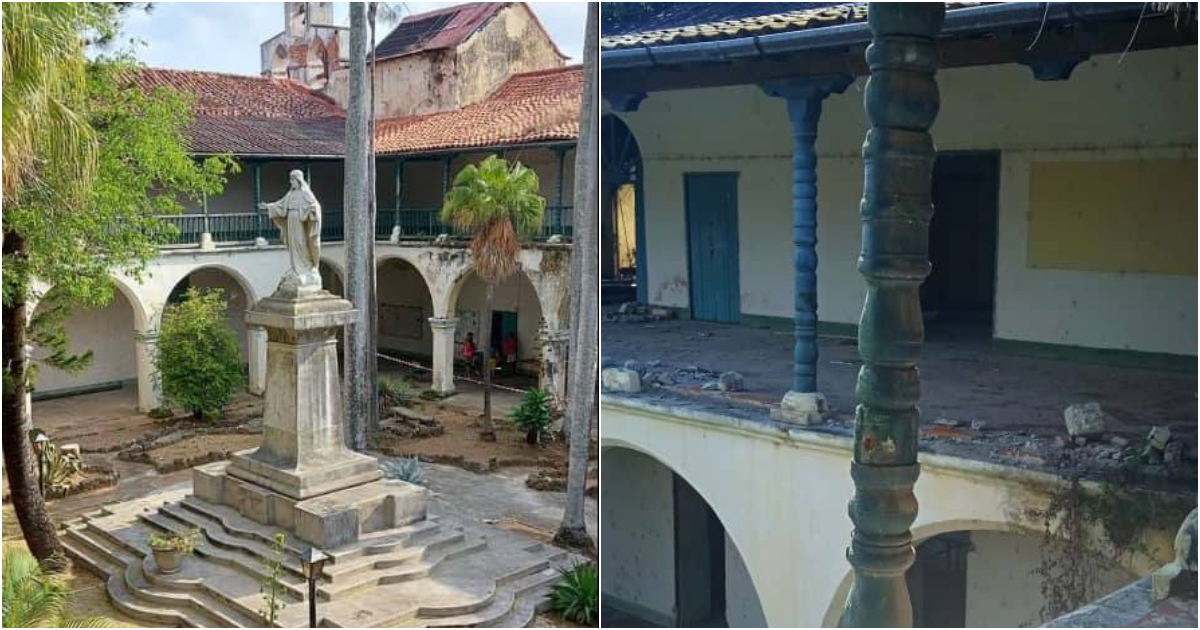
The renowned actor and theater director Jorge Mederos Reyes has raised alarms about the neglect of the Escolapios Convent located in Guanabacoa, a municipality in Havana. He has accused the local government of allowing the plundering and deterioration of this site, which is recognized for its high heritage value.
Mederos, who serves as the assistant director of El Sótano Theater and the artistic director of the Havana Theater Center, shared his concerns on Facebook. He expressed his distress as a Cuban, a resident of Havana, and a native of Guanabacoa over the deterioration of the San Francisco Javier Convent, commonly known as Los Escolapios.
In his post, Mederos acknowledged the challenges facing the nation but emphasized that neither the U.S. embargo nor the national government should be blamed for "the poor management by the Guanabacoa municipal government regarding its heritage." He pointed out that the building, which holds a Grade I Protection status, is a symbol of Cuba's humanistic and educational traditions, having educated generations of intellectuals and housed nationally significant libraries, laboratories, and scientific collections.
Current State of the Escolapios Convent
During a recent visit, Mederos recounted witnessing the severe state of decay affecting the structures. "The floors have vanished, railings are disappearing, and the gates and doors have been looted without consequence," he described. He noted that only the Océano theater group, which occupies part of the complex, is attempting to preserve the site, while the state entity responsible, the Education Department, has neglected its areas.
Government's Neglect and Cultural Loss
"Despite reports from the Heritage Department and repeated complaints, the municipal government fails to act. Instead, they aim to displace even the artists trying to protect the site," Mederos warned. He lamented the authorities' disregard for the looming "unbounded cultural massacre" and questioned, "What is happening in Guanabacoa? Must we wait for it to become like the Casa de las Cadenas?" He concluded his message with a heartfelt expression of anger and sorrow: "This pains an entire region. It pains history. It pains the Culture of a nation. It pains Cuba, damn it."
Broader Issues of Neglect Across Cuba
Recently, Father Rodhin A. Colomar voiced his concerns online about what he deemed an assault on religious freedom in Santiago de Cuba. He reported on Facebook that access to the Santa María Church in the Veguita de Galo neighborhood had been blocked, with platforms and tables set up as if it were a park or shopping center, ignoring the religious services held there on weekends.
The alarming number of public spaces, heritage sites, and iconic locations in Cuba being abandoned and left to decay is a stark reflection of a system unable to preserve them, compounded by official indifference and a populace resigned to decline amidst economic hardship. The San Pedro campground in Artemisa languishes with only half of its cabins operational, plagued by vandalism, illegal occupations, and resource shortages.
The San Rafael Cemetery in Guantánamo exhibits cracked tombs, unreadable or shattered gravestones, and eroded marble on the graves of Liberty Army heroes—a testament to institutional neglect, public ignorance, and systematic vandalism of a heritage site.
Another example is the El Arte printing house in Manzanillo, once a beacon of cultural significance in eastern Cuba, now withering in abandonment as its historical and editorial legacy crumbles amid state apathy.
The Máximo Gómez Airport in Ciego de Ávila, built with over 100 million pesos, now stands as a purposeless ruin, a public investment buried under neglect and absurdity.
In Marianao, the former Oriental Park racetrack, once a symbol of Havana's grandeur, has become a state warehouse amidst rubble.
The Cubanacán Art Schools—an unfinished project by Italian architects Vittorio Garatti and Roberto Gottardi alongside Cuban Ricardo Porro—are also languishing, despite being recognized as one of the most important architectural works of the revolutionary period.
Other significant cultural and architectural jewels, such as the former Spanish Casino of Havana in Playa, the emblematic Havana Musical Theater, and the old Venus Hotel in Santiago de Cuba, are similarly facing destruction.
Understanding the Impact of Cultural Neglect in Cuba
What is the significance of the Escolapios Convent in Guanabacoa?
The Escolapios Convent is a historically significant site in Guanabacoa, recognized for its humanistic and educational traditions. It has served as an educational institution for generations of Cuban intellectuals and housed important libraries and scientific collections.
How is the local government contributing to the neglect of heritage sites in Cuba?
Local governments are often criticized for poor management and neglect of heritage sites, allowing them to fall into decay. This is attributed to a lack of action despite repeated reports and complaints from heritage departments and the local community.
Why are cultural and heritage sites important for Cuba?
Cultural and heritage sites are crucial for preserving Cuba's history, identity, and traditions. They serve as tangible connections to the past and are vital for educational and cultural continuity.