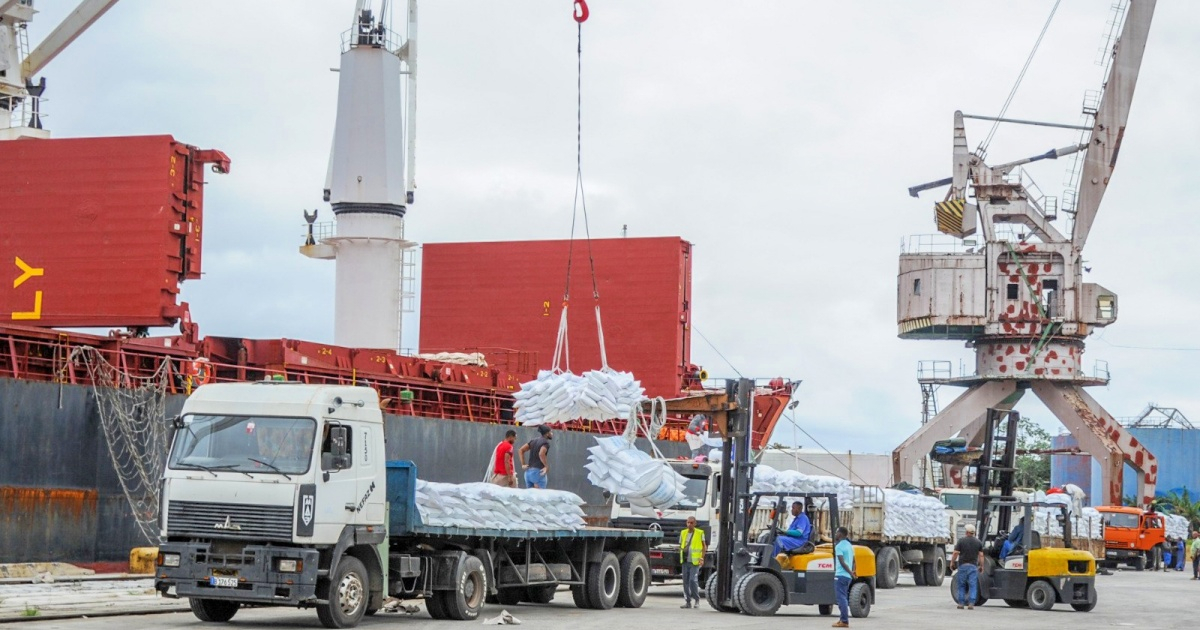
The U.S. Embassy has clarified that Cuba is free to purchase food, medicine, and medical equipment, without any restrictions imposed by Washington, countering the Cuban government's narrative that blames the so-called "blockade" for shortages of essential goods. According to the embassy's statement, for decades, U.S. laws and regulations have explicitly allowed these exports to the island.
Furthermore, the statement highlights that while U.S. financial and commercial limitations apply to certain transactions—particularly those linked to entities controlled by Cuban security services—these do not prevent Cuba from procuring foreign products through third countries. In essence, the regulatory framework does not obstruct the international purchase of food, medicines, or equipment, contrary to the repeated claims of the Cuban government.
"The U.S. restrictions on specific transactions between American citizens and certain Cuban entities (owned or controlled by security services) do not prohibit the purchase of foreign products by Cuba from third countries," the consular office explained.
The diplomatic representation labeled the regime's arguments, which hold the U.S. accountable for healthcare shortages, as "false narratives." Additionally, it pointed out that when American diplomats and congress members have offered to facilitate the acquisition of medical supplies and equipment, Havana has rejected the assistance, choosing instead to maintain its victimhood narrative.
U.S. Embassy Statement Amidst Health Crisis
The embassy's note comes during a period of health crisis and medication shortages reported by citizens and healthcare professionals on the island, a situation where the Cuban government typically blames the sanctions for the deterioration. However, the U.S. clarification emphasizes that there are no legal obstacles for Cuba to purchase these categories of products on the international market.
The statement shifts the responsibility to the Cuban government to explain why shortages persist despite existing legal avenues to acquire essential supplies. Cuban Foreign Minister Bruno Rodríguez Parrilla claimed that the U.S. embargo caused damages amounting to $7.556 billion in 2024, according to official estimates.
Rodríguez asserted that if the embargo did not exist, the Gross Domestic Product (GDP) at current prices would have grown by 9.2% last year. While the government continues to attribute the crisis to the U.S. embargo, independent economists argue that the decline is also due to low productivity, increasing fiscal deficits, lack of foreign investment, and a centralized model incapable of generating sustainable revenue.
Moreover, allegations of corruption within the regime persist: a recent investigation revealed that GAESA, a Cuban military conglomerate, holds over $18 billion while the population faces scarcity.
Understanding U.S.-Cuba Trade Relations
Can Cuba buy medicines and food from the U.S.?
Yes, U.S. regulations have long permitted the export of food, medicine, and medical equipment to Cuba.
What are the reasons for shortages in Cuba?
Independent economists cite low productivity, increasing fiscal deficits, lack of foreign investment, and a centralized economic model as key factors, along with alleged mismanagement and corruption.
How does the Cuban government justify the shortages?
The Cuban government frequently attributes shortages to the U.S. embargo, claiming it restricts access to essential goods.