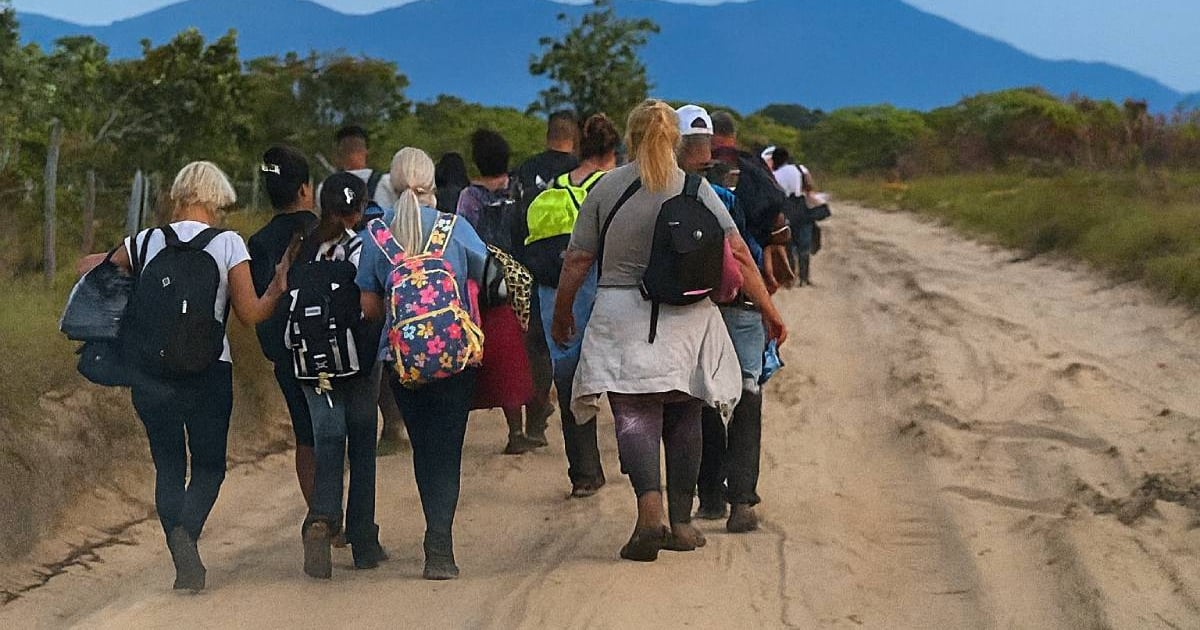
A group of 23 Cuban migrants was discovered and rescued by Brazilian authorities after being abandoned by human traffickers along the BR-401 highway in the state of Roraima, northern Brazil. This incident took place on the afternoon of October 9, in the municipality of Bonfim, when the Cubans were spotted behaving suspiciously near the Igarapé Arraia access, a rural area intersected by the main road.
According to reports from FOLHA BV, the migrants were being transported in several vehicles that suddenly left them behind upon noticing police patrols. As the police operation unfolded, the Cubans attempted to hide in the nearby forested areas but were eventually found by officers from the 5th Independent Company of the Border Military Police, who then proceeded with their rescue.
The Cuban migrants expressed that their ultimate goal was to reach southern Brazil in search of better living conditions, having fled Cuba due to the ongoing economic and political crisis. Left stranded by their drivers, they found themselves helpless in unfamiliar surroundings. The 23 individuals were taken to the Federal Police headquarters in Bonfim, where they received guidance and began the necessary legal processes.
Surge in Cuban Asylum Seekers in Brazil
This incident highlights a significant surge in the number of Cuban migrants heading to Brazil. According to data from the Observatory of Migrations (Obmigra), Brazil received 19,419 asylum applications from Cuban nationals in the first half of 2025, marking a 60.8% increase compared to the same period the previous year. Cubans now surpass even Venezuelans in the number of asylum requests, with Venezuelans submitting 9,850 petitions during the same timeframe.
Despite the increase in applications, the approval rate remains exceedingly low. From January to June of this year, the National Committee for Refugees (Conare) approved just two Cuban applications, rejected nine, and archived over 10,900 cases.
Challenges in Legal Entry and Risky Routes
The majority of Cuban migrants enter Brazil through the northern region, utilizing routes through Guyana, Surinam, and French Guiana, with key entry points being border towns like Bonfim (Roraima) and Oiapoque (Amapá). Meanwhile, access to legal entry remains restricted. In the past six months, the Brazilian Consulate in Havana issued only 10 work visas, compared to 445 for family reunification, 838 for visits, and 109 for studies.
Faced with growing desperation, many Cubans choose to risk their safety by undertaking perilous journeys through jungle routes, falling prey to human trafficking networks.
Understanding Cuban Migration to Brazil
Why are so many Cubans migrating to Brazil?
Many Cubans are fleeing the island due to its severe economic and political crisis, seeking better living conditions in countries like Brazil.
What challenges do Cuban migrants face when entering Brazil?
Cuban migrants often face restricted legal entry options and resort to dangerous routes through the jungle, making them vulnerable to human trafficking.
How does the asylum application process work for Cubans in Brazil?
Cubans must apply to the National Committee for Refugees (Conare), but the approval rate is very low, with many applications being archived or rejected.